
Key Takeaways
- Kusama's prints draw on a small set of deeply personal motifs — Infinity Nets, Dots, and Pumpkins foremost among them, alongside recurring flora, fauna, and fruit imagery — each with its own distinct origin in her life and work.
- Her most valuable print portfolio, Amour Pour Toujours, a complete ten-screenprint set finished with glitter, sold for roughly $340,000 at Phillips in October 2021 — the current record for a Kusama print set.
- Prints make up around 45% of all Kusama works sold at auction, with the majority trading between $13,000 and $63,000 — real depth across a broad, active market rather than a narrow trophy segment.
- Roughly 80% of Kusama works made since 2000 now sell in Hong Kong rather than New York or London, reflecting a decisive shift toward Asian collector demand over the past decade.
Yayoi Kusama has spent seven decades turning repetition into a visual language entirely her own — nets, dots, and pumpkins recurring across canvas, sculpture, installation, and print with a consistency few artists ever achieve. She holds the auction record for any living female artist, and topped Hiscox's ranking of best-selling contemporary artists in 2023, ahead of David Hockney. Her print market reflects that scale directly: broad enough to include a truly accessible entry point, deep enough to include editions that rival any name in contemporary art at auction.
This guide covers her life and the ideas behind her work, the recurring motifs that anchor everything she makes, the major print series worth knowing by name, current market performance, authentication, and how to think about acquisition across three collector levels.
Who Is Yayoi Kusama
Yayoi Kusama was born in Matsumoto, Japan, in 1929, and began drawing as a young child, working from vivid visual and auditory experiences that she has spoken about openly throughout her career and describes as a lasting influence on her work. She held her first solo exhibition in Japan in 1952, before moving to New York in 1958 with a small collection of her paintings, determined to establish herself within the American avant-garde.
She found it almost immediately: her 1959 solo show at the Brata Gallery, debuting the first of her Infinity Net paintings, was instantly recognised by artists, critics, and curators, and placed her within the same downtown scene as Donald Judd, Eva Hesse, and Claes Oldenburg. In 1966 she staged one of the defining guerrilla actions in postwar art history, laying 1,500 mirrored spheres across the lawn outside the Italian pavilion at the Venice Biennale as Narcissus Garden and personally selling them to visitors for two dollars each, until officials shut the unauthorised installation down. Twenty-seven years later, in 1993, she returned to Venice by official invitation — the first solo contemporary artist, and the first woman, to represent Japan at the Biennale.
She returned to Japan permanently in 1973 and has lived by choice at a psychiatric facility in Tokyo since 1977, working daily from a nearby studio she has maintained for decades. Her international reputation, quiet through much of the 1970s and 80s, was decisively reestablished by Love Forever: Yayoi Kusama, 1958–1968, a 1998 retrospective co-organised by LACMA and MoMA that toured to the Walker Art Center and the Museum of Contemporary Art Tokyo, and has only grown since — her influence is now widely cited among the artists who followed her, and her Infinity Mirror Rooms and Infinity Net paintings have become touchstones for an entire generation of installation-based practice. Kusama continues to produce new work today, across painting, sculpture, installation, and print, extending a practice now well into its eighth decade.
Her Recurring Motifs: Nets, Dots, and Pumpkins
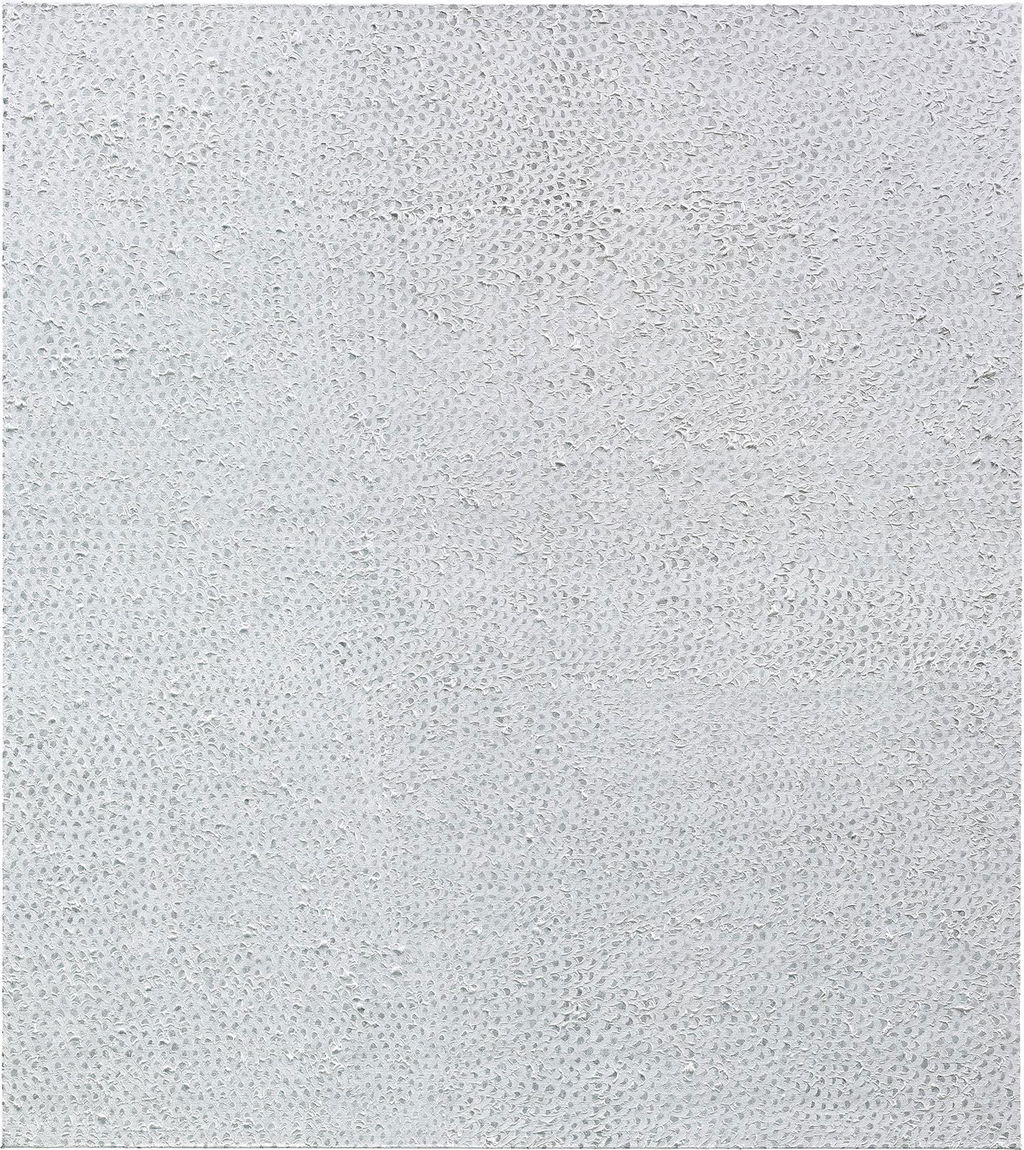
Kusama's work draws on a small set of deeply personal motifs, each with its own distinct origin. Infinity Nets — dense fields of small, repeated marks covering an entire surface — emerged from her earliest New York paintings and remain her most historically significant body of work, read by critics as both a formal exercise in pure repetition and a direct response to the hallucinatory patterns she has described experiencing since childhood. Dots, applied to everything from canvas to entire rooms, function differently: Kusama has described them as a way of dissolving the individual self into a larger, borderless pattern, a concept she calls self-obliteration.
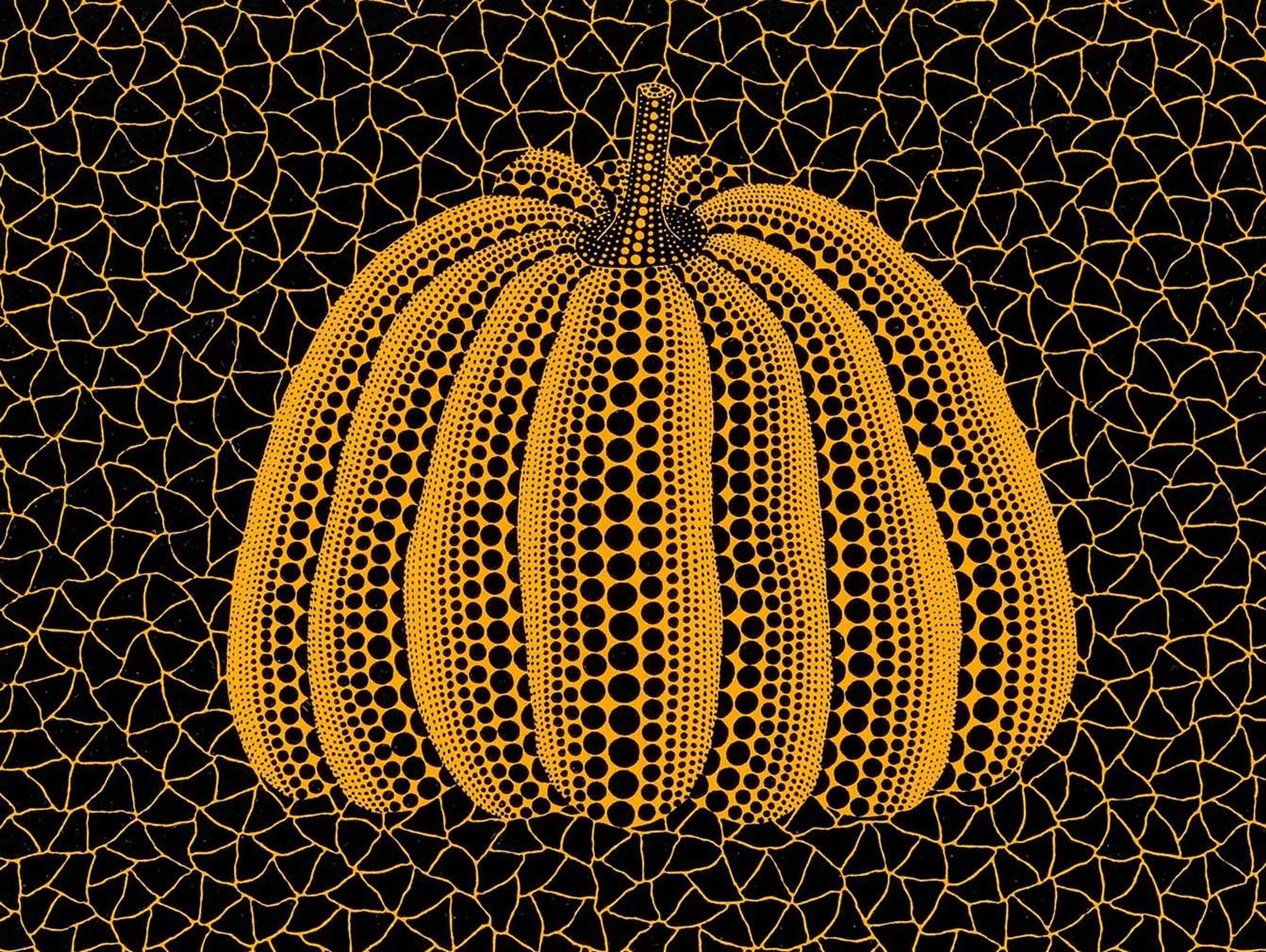
Pumpkins are a motif entirely their own, and one of the most personal in her entire body of work. Kusama has described first encountering a pumpkin as a child, on a visit to her family's seed-harvesting grounds with her grandfather — an encounter she recounts in her autobiography as the gourd "speaking to me in a most animated manner." Unlike the dots and flowers that emerged from her hallucinations and frightened her as a child, she has said she found pumpkins comforting from that very first meeting, drawn to their lumpy, unpretentious form. She made her first pumpkin work as a teenager in the 1940s, and has returned to the motif throughout her career since, across drawing, painting, sculpture, and print.
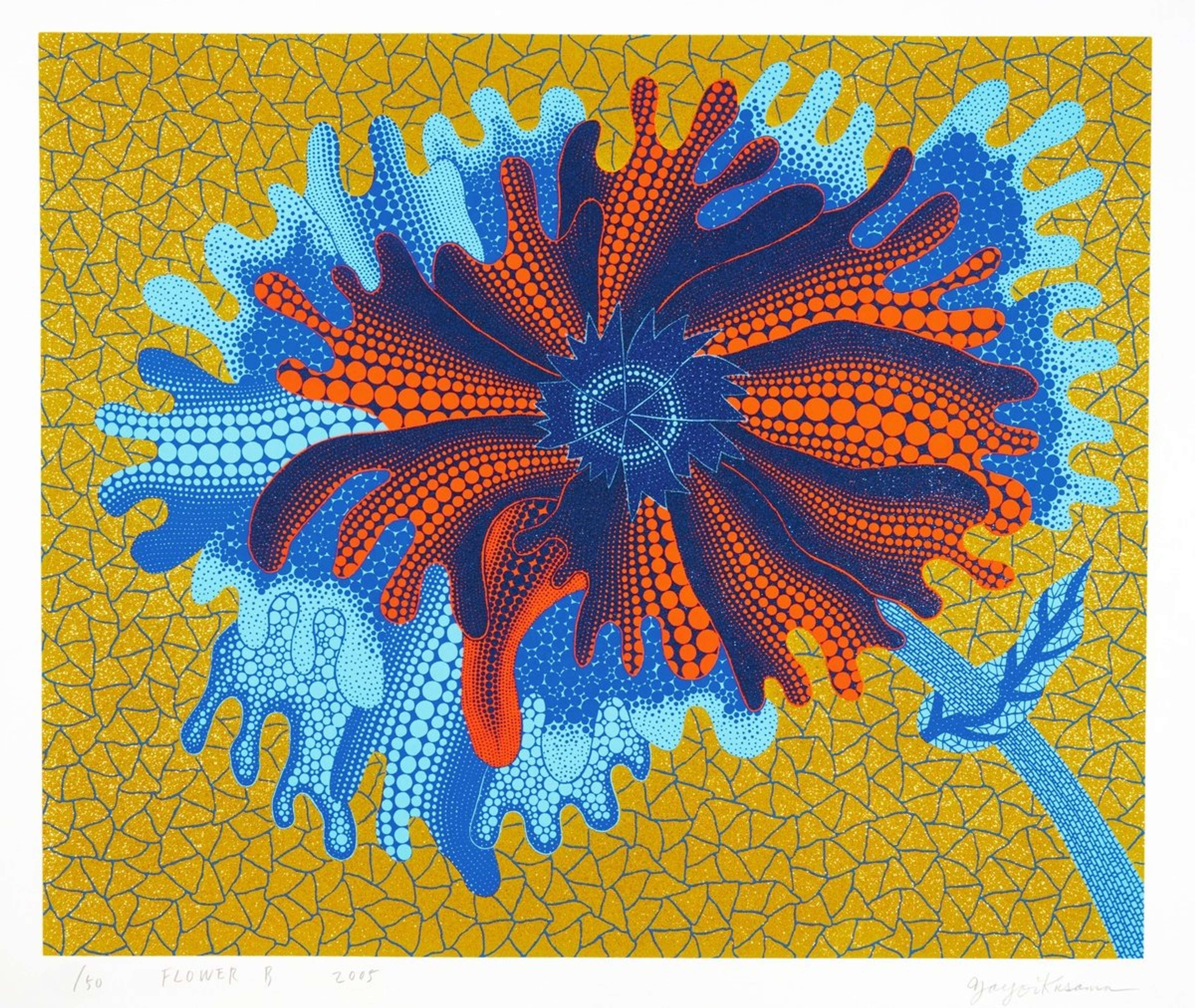
Beyond these three foundational motifs, Kusama's prints also draw regularly on flora, fauna, and fruit imagery rooted in the same childhood spent among her family's plant nurseries — flowers, insects, and other natural forms recur across her catalogue alongside nets, dots, and pumpkins, often combining several of these elements within a single image.
Major Series and Portfolios Every Collector Should Know
Amour Pour Toujours is Kusama's most valuable print portfolio: a complete set of ten screenprints finished with glitter, which sold for roughly $340,000 at Phillips in October 2021, the current record for any Kusama print set.
Infinity Nets prints translate her foundational painting series into editioned form, and remain the most historically significant single motif in her print catalogue — individual prints regularly trade well into five figures.
Pumpkin prints draw on the motif Kusama has returned to since her teenage years in the 1940s, rooted in a childhood memory of encountering a pumpkin at her family's seed farm — now among her most recognisable and widely collected images across every medium she works in.
Morning Is Here (2004) is a set of five hand-signed screenprints, each individually titled and issued in an edition of 95 plus 13 artist's proofs and 11 hors commerce proofs, published by Toki-no-Wasuremono — a well-documented, fully authenticated series that illustrates how her later editions are typically structured.
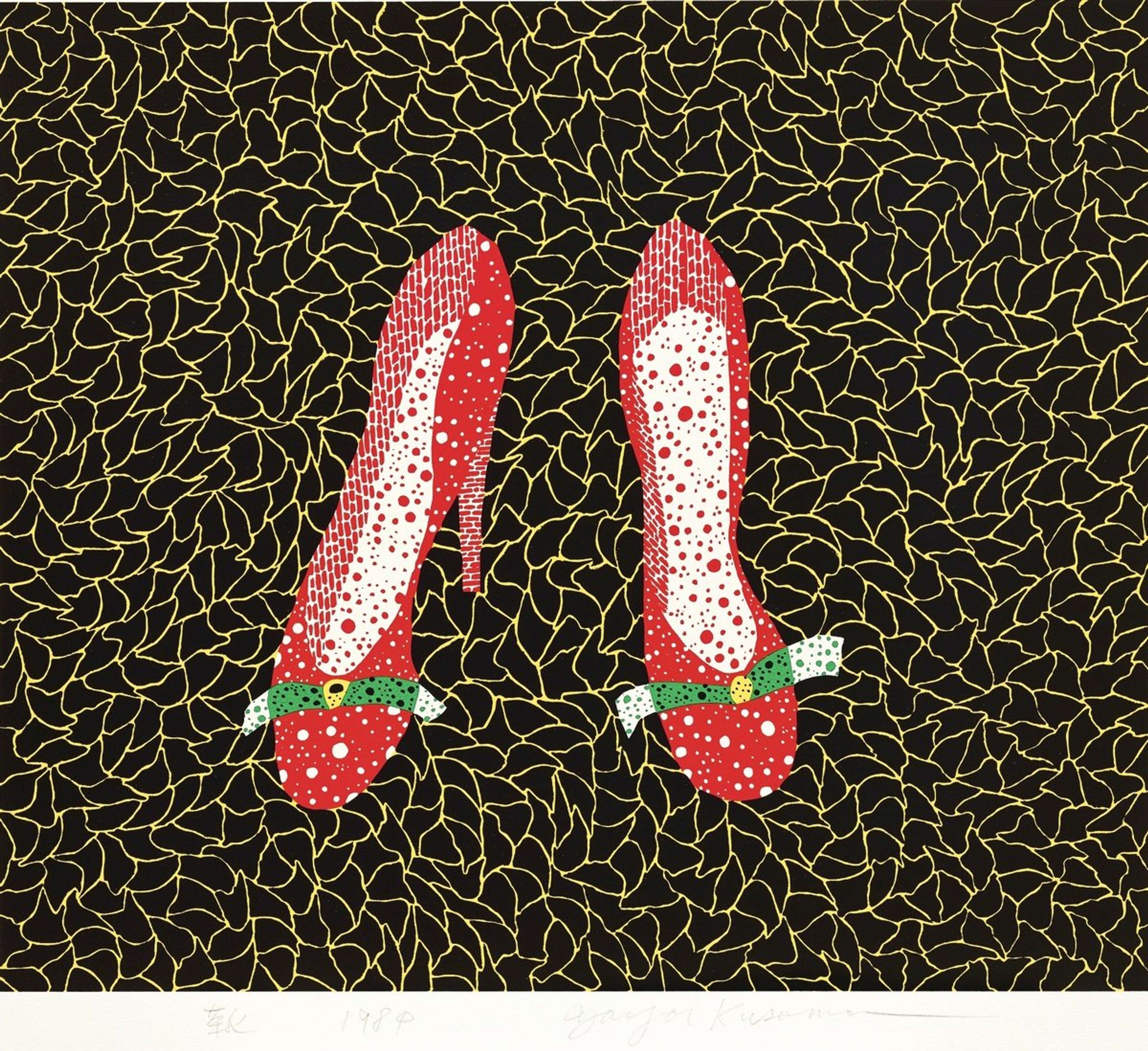
High Heels and Shoes are prints drawn from a motif Kusama has returned to since the late 1990s — heels, boots, and loafers rendered in her signature dots, read as symbols of femininity, movement, and self-expression. The motif carries real crossover appeal beyond the print market: her two collaborations with Louis Vuitton, in 2012 and again in 2023, brought polka-dot handbags and footwear built directly from this same visual language to a global fashion audience, and remain highly sought after in their own right — a rare case of a fine-art motif and a luxury-fashion line reinforcing one another's visibility at the same time.
The Market in 2026: Current Demand
Kusama's market has undergone a real geographic shift over the past decade. Roughly 80% of works made since 2000 now sell in Hong Kong rather than New York or London, driven by a strong and growing Asian collector base alongside major exhibitions — including a large-scale retrospective at M+ in Hong Kong and further shows in Tokyo and Melbourne — that have brought sustained public and institutional attention to her work.
Prints make up close to half of everything by Kusama that comes to auction, and the majority trade in a broad middle range rather than clustering at the extremes, evidence of a market with real depth rather than one dependent on a small number of headline results. Her reach well beyond the traditional art world — including two decades of Louis Vuitton collaborations — has widened her collector base further still, bringing in buyers who arrive through fashion and design before ever encountering her prints directly.
Authentication and Provenance
How can I tell if my Yayoi Kusama print is authentic? Confidence comes from checking a few things together, and the specific mix depends on when a print was made. Later editions are often issued with an official registration card from her studio or gallery — a distinctive feature of her market that, where present, offers strong documentation on its own. Earlier prints, issued before this system was standard, rely more heavily on publisher records and established dealer documentation. Across both periods, verify the signature and edition number where the print is signed — not every Kusama edition is hand-signed, and an unsigned print is not automatically less authentic, though it should be checked against documented records for that specific series. A traceable ownership history rounds out a confident assessment.
Collecting by Tier
How much does a Yayoi Kusama print cost? Her print market generally spans from around $15,000 to well over $100,000, with the strongest, most active trading concentrated in the $40,000–$80,000 range.
Starting a Collection ($20,000–$40,000) is where individual prints from her wider catalogue sit, including smaller-format, higher edition Infinity Nets and Pumpkin editions — real, documented Kusama material that suits a first acquisition.
Core Collector ($40,000–$80,000) is the heart of the market — the price range where the strongest, most consistently traded individual prints from her major series sit, including examples from Infinity Nets, Pumpkins, Flowers and her fashion inspired works.
Established Collector ($80,000 and above) is where her rarest prints and complete portfolios live, including a complete Amour Pour Toujours set and the strongest individual examples from her most sought-after series.
Acquisition Strategies
Motif Focus collects around a single recurring pattern — Nets, Dots, or Pumpkins specifically — tracing how Kusama has returned to the same idea across decades and mediums.
Series Focus concentrates on a single portfolio, such as Amour Pour Toujours or Morning Is Here, building depth within one complete body of work.
Era Focus builds around a specific period of her career, whether her formative New York years or her more recent output, rather than her full seven-decade span.
Rarity Focus pursues her smallest editions and least frequently traded prints, prioritising scarcity over breadth.
Quality-First ignores category entirely and simply chases the best physical example available — the sharpest colour, the cleanest registration card or provenance trail, the strongest condition — whatever motif or series it happens to belong to.
Kusama's Highest Auction Results
Her painting market and her print market aren't separate stories — the paintings pull the print market up behind them. Every new record set at auction, and every fresh wave of attention from a retrospective or a Louis Vuitton launch, brings new buyers to her prints as the more attainable way into the same body of work.
Untitled (Nets) (1959) — roughly $10.8 million, Phillips, May 2022. Her current auction record, from the same body of early New York work that established her critical reputation.
White No. 28 (1960) — $7.1 million, Christie's, December 2014. An early Infinity Net painting that held her auction record for nearly a decade and made her, at the time, the most expensive living female artist at auction.
No. 2 (1959) — $5.79 million, Christie's, November 2008. A rare early work once owned by the artist Donald Judd, a friend and contemporary from her New York years.
Is Yayoi Kusama Still a Good Investment in 2026?
Kusama's print market offers a truly rare combination: real accessibility at the entry level, real depth at the top, and a painting market that continues to set records for the artist who holds the auction record for any living female artist and topped the global rankings for contemporary art sales in 2023. Whatever level a collection is being built at, the strongest move is to prioritise her most historically significant motifs — Infinity Nets above all — and her rarest complete portfolios wherever budget allows, since it's precisely that combination of sustained global demand, a truly singular visual language, and an artist still actively adding to her own legacy that has kept her prints among the strongest-performing in the contemporary market.
For more information on our latest Yayoi Kusama prints for sale or to sell your Yayoi Kusama prints contact our team via info@alexyellop.com