
Key Takeaways
- Bacon made almost no prints until the 1970s, translating his own major paintings into lithograph and etching rather than building a separate, parallel print practice.
- Triptychs matter enormously to value: a matched set with corresponding edition numbers commands a real premium over the same sheets sold individually.
- Miroir de la Tauromachie, a four-lithograph portfolio, set the record for a Bacon print at $135,000 at Sotheby's in 2015.
- No official authentication committee has existed since shortly after his death in 1992 — verification rests on the Catalogue Raisonné published by the Estate of Francis Bacon, printer blindstamps, and documented provenance.
- 2013 and 2019 saw dedicated single-artist print sales at Christie's, and his print market index rose 15% around the 2013 sale alone, evidence of a market with real institutional attention behind it.
Francis Bacon spent most of his career as a painter's painter, working almost exclusively in oil and largely indifferent to the reproducible image. That makes his print catalogue a real rarity within it — a small, tightly focused body of work, made late in his life, translating his most psychologically intense paintings into lithograph and etching under his own close supervision. He treated the print edition as an occasional, carefully controlled extension of a single painting rather than a parallel career of its own, which is exactly why so few exist and why each one carries real significance in his market.
This guide covers his life, his late entry into printmaking, the recurring subjects that define his work, the major prints and portfolios worth knowing by name, current market performance, authentication, and how to think about acquisition across three collector levels.
Who Was Francis Bacon
Francis Bacon was born in Dublin, Ireland, in 1909 to English parents, and spent much of his childhood moving between Ireland and England. He left home as a teenager after a strained relationship with his father, and spent his twenties largely self-taught, working first as an interior decorator and designer in London before committing fully to painting in the late 1930s.
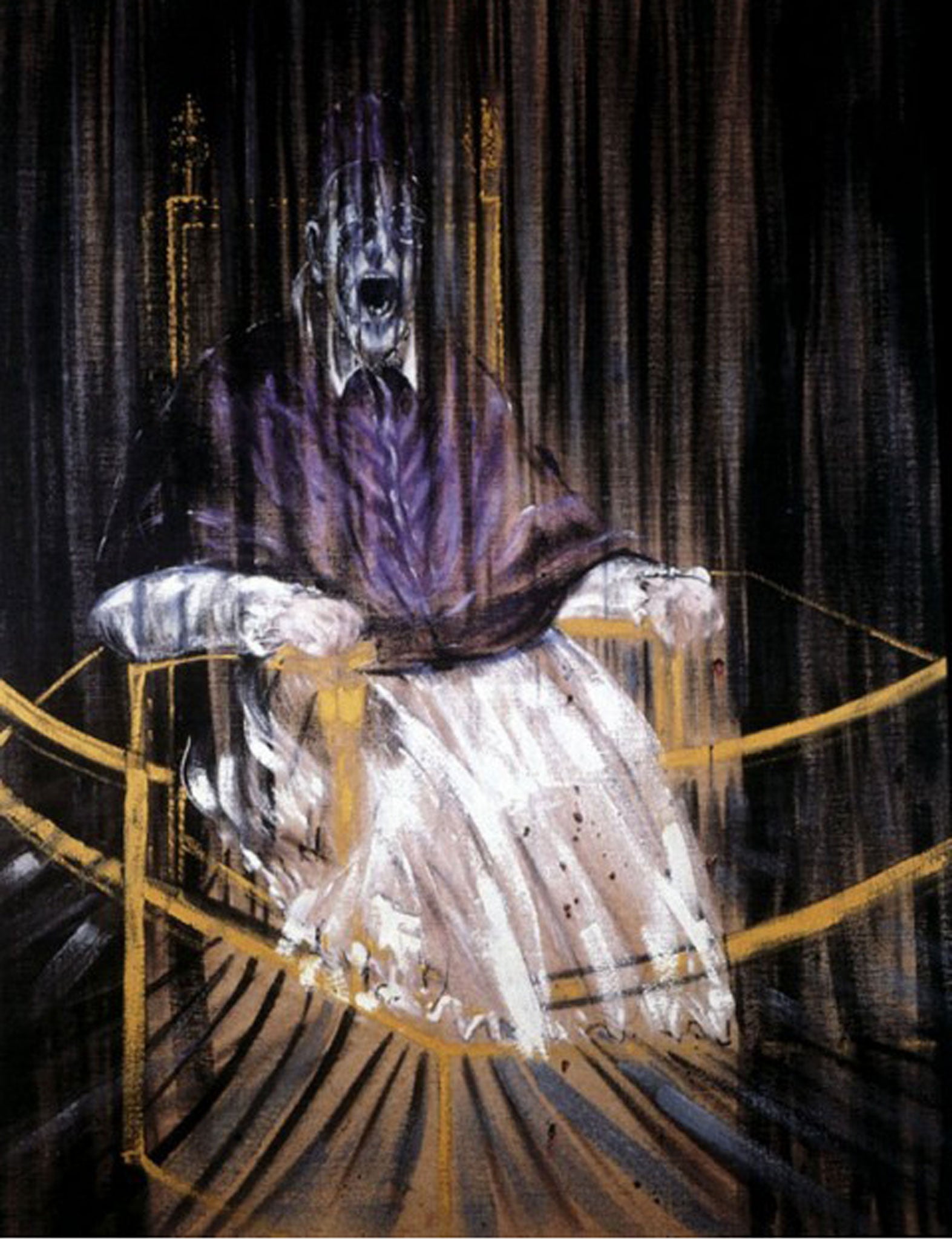
His breakthrough came in 1944 with Three Studies for Figures at the Base of a Crucifixion, a work whose raw, distorted figures shocked audiences when it was first shown in London and established the visual language — screaming mouths, smeared and contorted flesh, isolating geometric cages around his figures — that would define his career. He went on to paint obsessively from photographs and existing artworks rather than live models, most famously Diego Velázquez's Portrait of Pope Innocent X, which he reworked dozens of times across his so-called Screaming Popes. His close, complicated friendships — above all with fellow painter Lucian Freud, and later with George Dyer and the writer Michel Leiris — became recurring subjects throughout his work. Bacon died in Madrid in 1992, still painting until shortly before his death.
Bacon's influence extended well beyond his own lifetime. He was the central figure of what became known as the School of London, a loose group of painters working in figurative, psychologically charged styles through the mid-twentieth century, and his example shaped a later generation of artists directly, including Lucian Freud, Damien Hirst, Jenny Saville, Jake and Dinos Chapman, Cecily Brown, and Francis Alÿs, several of whom have spoken openly about his impact on their own work. Institutional recognition followed him throughout his career: in 1973 he became the first contemporary English artist to receive a major exhibition at the Metropolitan Museum of Art in New York, and retrospectives at the Tate Gallery and the Hirshhorn Museum further cemented his reputation internationally during his lifetime.
His Late Entry into Printmaking
Bacon did not begin making prints in earnest until the 1970s, decades into a painting career already built on canvases that sold for record sums. When he did, he approached it with the same perfectionism he brought to painting, working closely with master printers — chiefly Georges Visat, along with studios including Mourlot, Maeght, Polígrafa, and Atelier Arts Litho — and publishers Marlborough Graphics and Galerie Lelong, personally overseeing production and, on occasion, hand-finishing individual impressions. Nearly every print he made translates an existing painting, most drawn from his most significant and widely exhibited canvases, which is part of why his prints carry such a direct line to his core reputation rather than functioning as a separate body of work.
Recurring Subjects
Bacon's imagery returns constantly to a small set of preoccupations, and his prints inherit them directly from the paintings they translate. The Screaming Popes, built from his repeated reworking of Velázquez's Portrait of Pope Innocent X, remain his most historically significant subject, fusing religious authority with raw psychological distress. Self-portraits, made with the same unflinching distortion he applied to everyone else, form a substantial and consistently sought-after category. Bullfighting, drawn from his fascination with ritualised violence, produced some of his most striking compositions. And portraits of the people closest to him — Lucian Freud above all, along with George Dyer and Michel Leiris — carry the added resonance of Bacon's own turbulent relationships, giving these works a biographical as well as art-historical significance.
.jpg?mode=max)
Recurring Themes
Beneath Bacon's recurring subjects sits a smaller set of preoccupations that give his prints their unmistakable psychological charge. Isolation and confinement recur constantly through what he called his cage or spaceframe device, thin geometric lines enclosing a figure within an otherwise empty ground — a device he once explained simply by observing that offices, walled gardens, and homes are all boxes in their own right — and it carries directly into any print drawn from a composition that used it. The scream, distinct from the Popes it's often associated with, traces back to a single film still Bacon encountered early in his career, an injured woman crying out during the Odessa Steps sequence in Sergei Eisenstein's Battleship Potemkin, and it recurs across decades of his output as a register of pain that goes beyond any single subject. His treatment of flesh, animality, and mortality, often discussed in relation to the existentialist philosophy current in Paris as his career took shape, runs through nearly everything he made, giving even his most formally composed images a sense of unresolved physical and psychological pressure.
Major Prints and Portfolios Every Collector Should Know
Miroir de la Tauromachie is a portfolio of four lithographs and Bacon's most valuable print set, achieving $135,000 at Sotheby's in 2015 — the current record for any Bacon print.
After Second Version of the Triptych 1944 (1989) reworks Bacon's own earlier reimagining of his 1944 breakthrough painting, and a signed three-panel set achieved $93,800 at a Polish auction in June 2024, a result that underscored his reach well beyond the traditional London and New York markets.
Study for a Bullfight No. 1 (1971), issued in an edition of 150, has traded consistently since the late 1990s — a 2024 result of roughly $41,600 marks a substantial rise from just over $5,000 when it last sold in 1999.
Three Studies for Self-Portrait (1990) presents three self-portraits on a single horizontal sheet rather than in Bacon's usual triptych format, drawn from an original painting whose black-background version sold for tens of millions at auction. An HC (hors commerce) edition achieved roughly $49,100 in 2022.
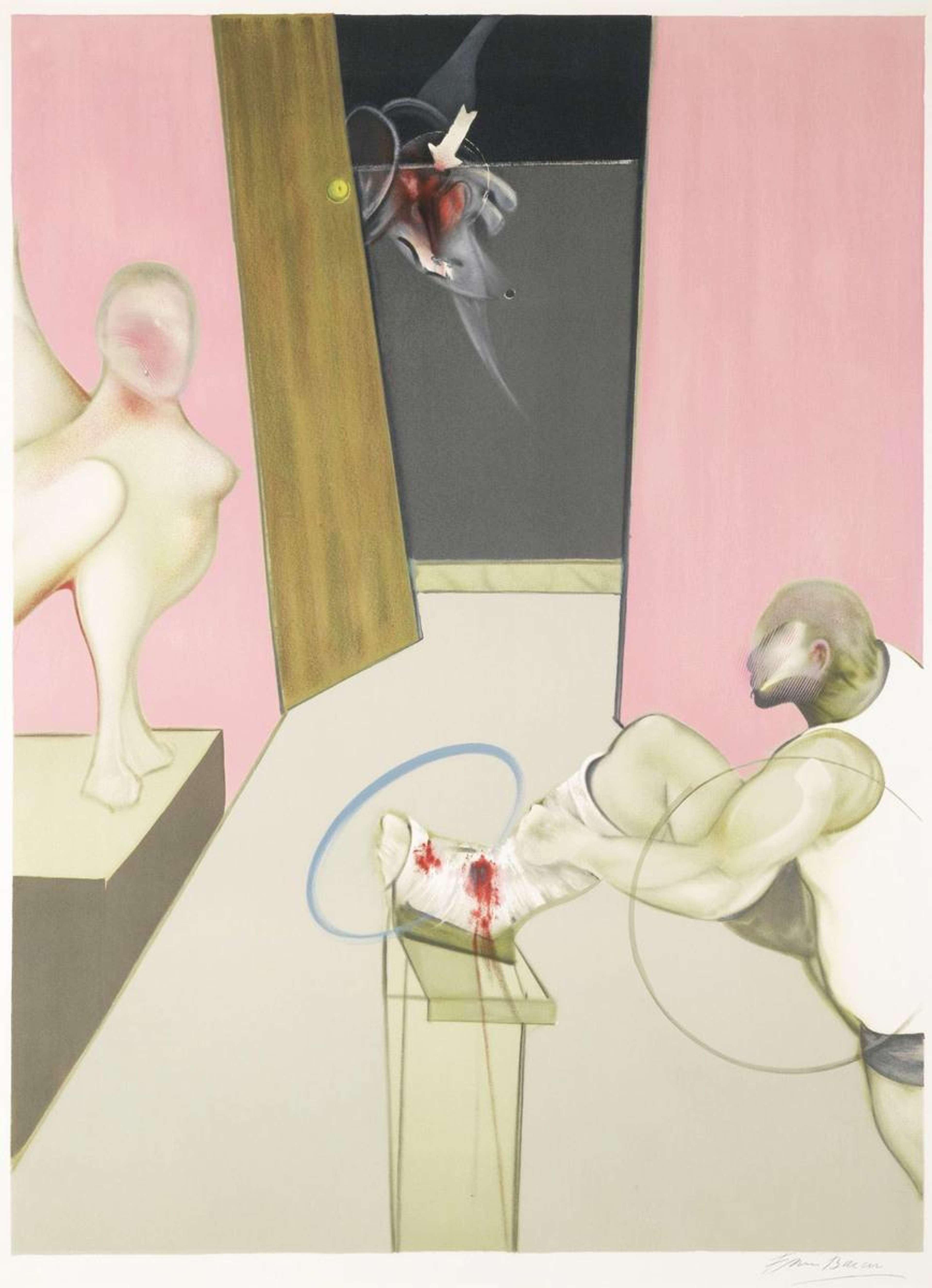
Oedipus and the Sphinx (1984) and Study for a Portrait of Pope Innocent X (1989) round out his most consistently traded individual prints, drawing respectively on his engagement with classical mythology and his defining Popes imagery.
The Market in 2026: Current Demand
Bacon's print market operates at real institutional scale. In 2013, Christie's staged a dedicated single-artist sale devoted entirely to his complete prints, and his print market index rose 15% around that sale alone. Print sales have continued at real volume since, with 2019 and 2022 standing out as particularly active years for public sales.
His painting market pulls the print market up behind it directly. Major retrospectives — including Gagosian's Couplings in London in 2019 and the Royal Academy's Man and Beast in 2022 — have consistently coincided with renewed attention and stronger results across his prints, since the two markets share the same imagery and the same collector base far more directly than for most artists.
Authentication and Provenance
How can I tell if my Francis Bacon print is authentic? No official authentication committee has existed since shortly after Bacon's death in 1992, which makes documentation the foundation of any purchase. Two reference catalogues, both specific to his print output rather than his paintings, are the standard here: Bruno Sabatier's Francis Bacon: Œuvre Graphique, published in 2012, is the foundational text for identifying and documenting his authenticated graphic and printed work, and Alexandre Tacou's Francis Bacon: Prints is the other key reference volume collectors and galleries use to verify editioned lithographs, etchings, and multiples. Beyond that, verify the printer: Bacon worked with a specific, well-documented set of studios — Mourlot, Maeght, Polígrafa, and Atelier Arts Litho among them — and a blindstamp consistent with the correct print supports its history. Signature matters too, though it varies: some prints are signed in felt-tip pen or pencil, while a small number of posthumous prints, approved by Bacon before his death but issued afterward, carry an estate stamp rather than his own signature. A documented ownership history closes the picture.
Collecting by Tier
How much does a Francis Bacon print cost? His market spans a truly wide range within a small catalogue: individual prints from his more widely editioned series at one end, and matched triptych sets or his rarest portfolios reaching well into six figures at the other.
Starting a Collection (Sub-$20,000) is where individual, non-triptych prints from his more widely available editions sit, alongside single sheets from larger series — documented, well-provenanced Bacon material at an accessible entry point into a truly scarce catalogue.
Core Collector ($20,000–$65,000) is where strong individual prints from his major subjects trade, including examples tied to his Popes, self-portraits, and bullfighting imagery.
Established Collector ($65,000 and above) is where his rarest material lives: matched triptych sets with corresponding edition numbers, and portfolios such as Miroir de la Tauromachie.

Acquisition Strategies
Subject Focus builds around one of Bacon's core preoccupations — the Popes, self-portraits, or bullfighting imagery — rather than collecting across his output indiscriminately.
Triptych Discipline prioritises matched, correspondingly numbered sets over individual sheets wherever budget allows, since intact triptychs consistently outperform their component parts sold separately.
Relationship Focus collects around Bacon's portraits of the people closest to him — Lucian Freud, George Dyer, Michel Leiris — for collectors drawn to the biographical thread running through his work as much as the imagery itself.
Timing Discipline pays attention to major retrospectives and institutional exhibitions, which have consistently preceded stronger results across his print market.
Quality-First sets category aside and simply pursues the strongest available impression that clears authentication and provenance checks, letting condition and rarity make the decision rather than subject or format.
Bacon's Highest Auction Results
His paintings, not his prints, are where the truly historic sums are recorded — and they're worth knowing, since they explain the level of attention his name commands across the rest of his market.
Three Studies of Lucian Freud (1969) — $142.4 million, Christie's, November 2013. A triptych portrait of his friend and fellow painter, briefly the most expensive artwork ever sold at auction, and still Bacon's record.
Triptych, 1976 — $86.3 million, Sotheby's, May 2008. Held his auction record for five years before Three Studies of Lucian Freud surpassed it.
Study for Portrait of Lucian Freud (1964) — $52.8 million, Sotheby's, 2022. Originally intended as the centre panel of a larger triptych before Bacon chose to exhibit it alone.

Is Francis Bacon Still a Good Investment in 2026?
Bacon's print market offers something truly unusual: real scarcity built into the catalogue itself, since he simply never produced very many. Whatever level a collection is being built at, the strongest move is to prioritise his core subjects — the Popes and his portraits of Lucian Freud above all — and intact triptych sets wherever budget allows, since it's precisely that scarcity, combined with a painting market that keeps producing some of the highest prices in art history, that has kept his prints among the most closely watched in the entire market.
For more information on our latest Francis Bacon prints for sale or to sell your Francis Bacon prints, contact our team via info@alexyellop.com