
Key Takeaways
- Riley has made screenprints continuously since 1962, using the medium to work through visual ideas that often later reappear in her larger compositions.
- Prices typically range from around $10,000 to $100,000, giving collectors real room to build a collection at whichever level suits them.
- Her print market has nearly doubled in both sales volume and lots sold over the past five years, with average prices reaching roughly $14,300 across 65 lots in 2023.
- The Fragment series, screenprinted onto reflective Perspex rather than paper, is among her most technically distinctive and sought-after early work, and truly rare in undamaged condition.
- Bridget Riley: The Complete Prints, published by Thames & Hudson with a foreword by Riley herself, is the definitive reference for authenticating her editioned work.
Bridget Riley built an entire career on a deceptively simple idea: that a flat surface, marked with the right pattern of lines, shapes, or colour, could make a viewer's eye do something the surface itself never does. That idea launched Op Art as a movement in the early 1960s and has occupied her ever since, across seven decades of continuous work. Her prints sit right at the centre of that practice rather than at its edges, since she has used screenprinting from the very start of her career as a real testing ground for ideas that sometimes only later found their way into her larger compositions.
This guide covers her life and the ideas behind her work, her recurring visual concerns, the major print series worth knowing by name, current market performance, authentication, and how to think about acquisition across three collector levels.
Who Is Bridget Riley
Bridget Riley was born in Norwood, London, in 1931, and studied at Goldsmiths' College from 1949 and the Royal College of Art from 1952. She worked for a period in advertising and illustration before committing fully to her own practice, and her earliest mature work was figurative and loosely pointillist, shaped directly by an intensive study of Georges Seurat's technique, particularly his 1886 work The Bridge at Courbevoie.
Her breakthrough came in the early 1960s, when she began working almost entirely in black and white, using precisely calculated geometric patterns to produce sensations of movement, vibration, and depth on an entirely flat surface. Movement in Squares, from this period, is generally treated as the work that established her mature visual language. Her 1965 debut solo exhibition in New York sold out, and she became closely associated with the newly coined term Op Art almost overnight, a label she has said she never much cared for. In 1967 she introduced colour into her work for the first time with her Stripes series, and she has continued to develop her visual concerns across paint, drawing, and print ever since, including a body of work in the early 1980s inspired by ancient Egyptian art. Riley continues to work today, dividing her time between London, Cornwall, and southern France.
Her Recurring Visual Concerns
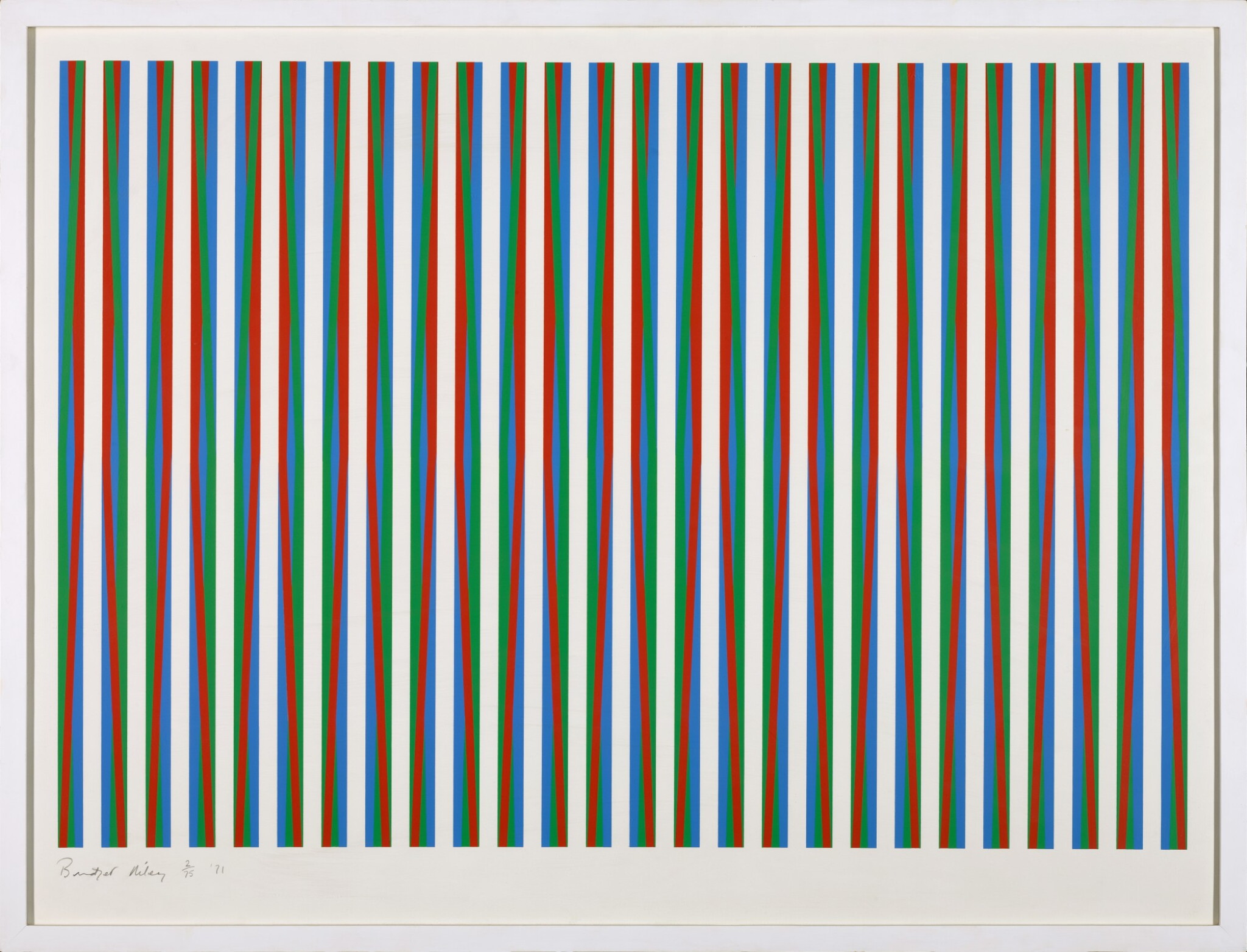
Riley's work returns constantly to the same underlying question: how much a viewer's perception can be shaped by pattern, repetition, and colour relationship alone, without any figurative subject at all. Her earliest black-and-white work relied entirely on precisely calculated curves, lines, and grids to generate a sense of motion the eye supplies rather than the surface itself. After 1967, colour became central to that same investigation, with adjacent hues chosen for how they interact optically rather than for any expressive or symbolic purpose. Across every phase of her career, the underlying commitment has stayed consistent: that looking itself, closely and attentively, is the actual subject of the work.
Major Print Series Every Collector Should Know
The Fragment series (mid-1960s) is among the most technically distinctive work Riley ever produced in print form, screenprinted directly onto reflective Perspex rather than paper, printed by Kelpra Studio and published by Robert Fraser Gallery. The reflective surface interacts directly with its surroundings, adding a literal, physical dimension to the optical effects her paintings only suggest. Because Perspex is far more vulnerable to damage than paper, prints from this series in truly pristine condition are rare, and command a real premium over examples with visible wear.
The Dominance series (1977) comprises three screenprints, Green Dominance, Blue Dominance, and Red Dominance, each issued in an edition of 100. The three were conceived and exhibited together, and while each stands on its own, complete matched sets rarely appear at auction, making an intact suite a real rarity within her print catalogue.
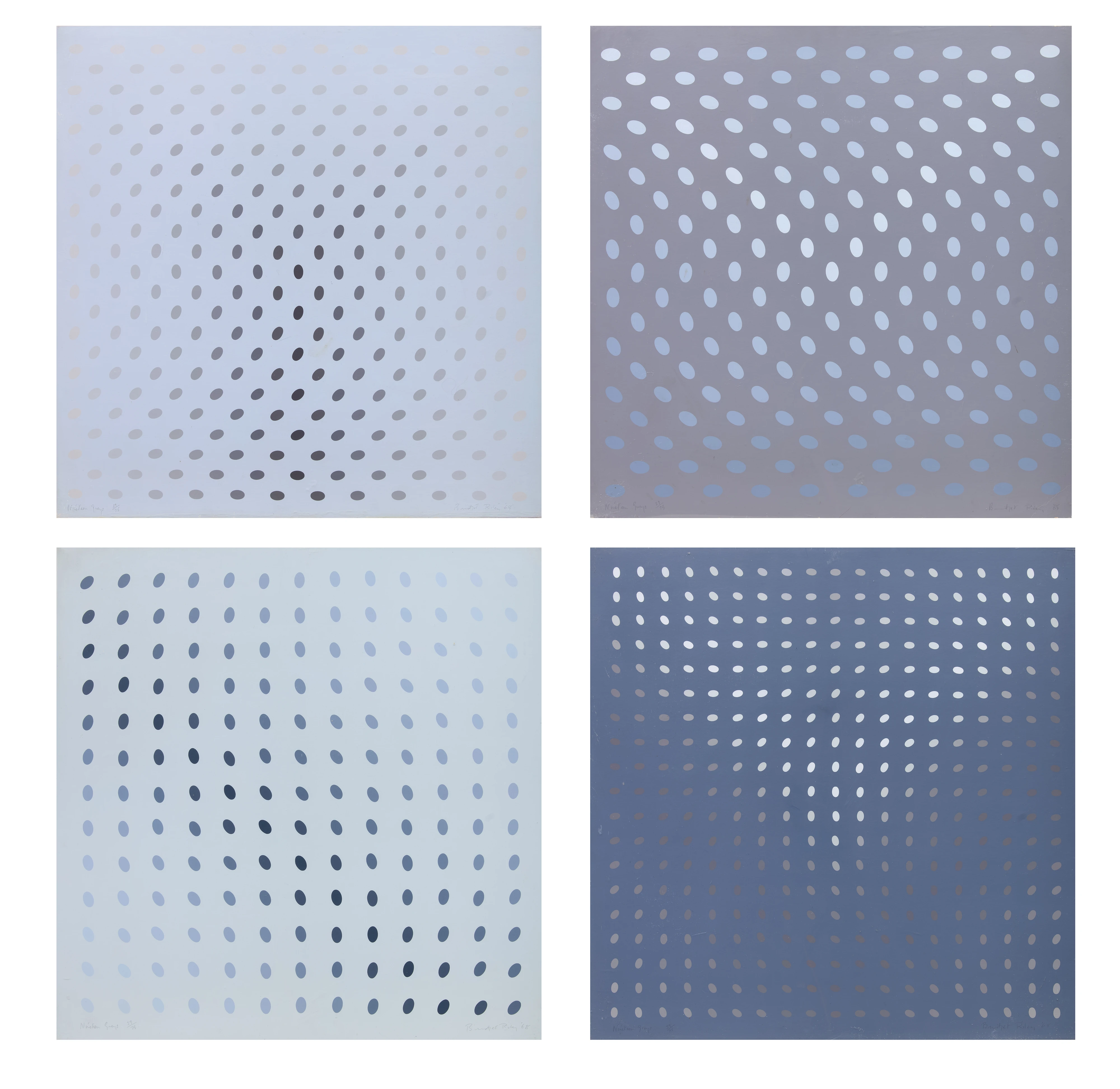
Individual screenprints from across her career — including Chicago 8 (1971), Firebird (1971), Nineteen Greys A–D (1968), and later colour-focused prints such as Bagatelle 1 and Bagatelle 2 (2015) — trade regularly and give collectors direct access to specific moments in her development, from her monochrome breakthrough through her mature colour work.
The Market in 2026: Current Demand
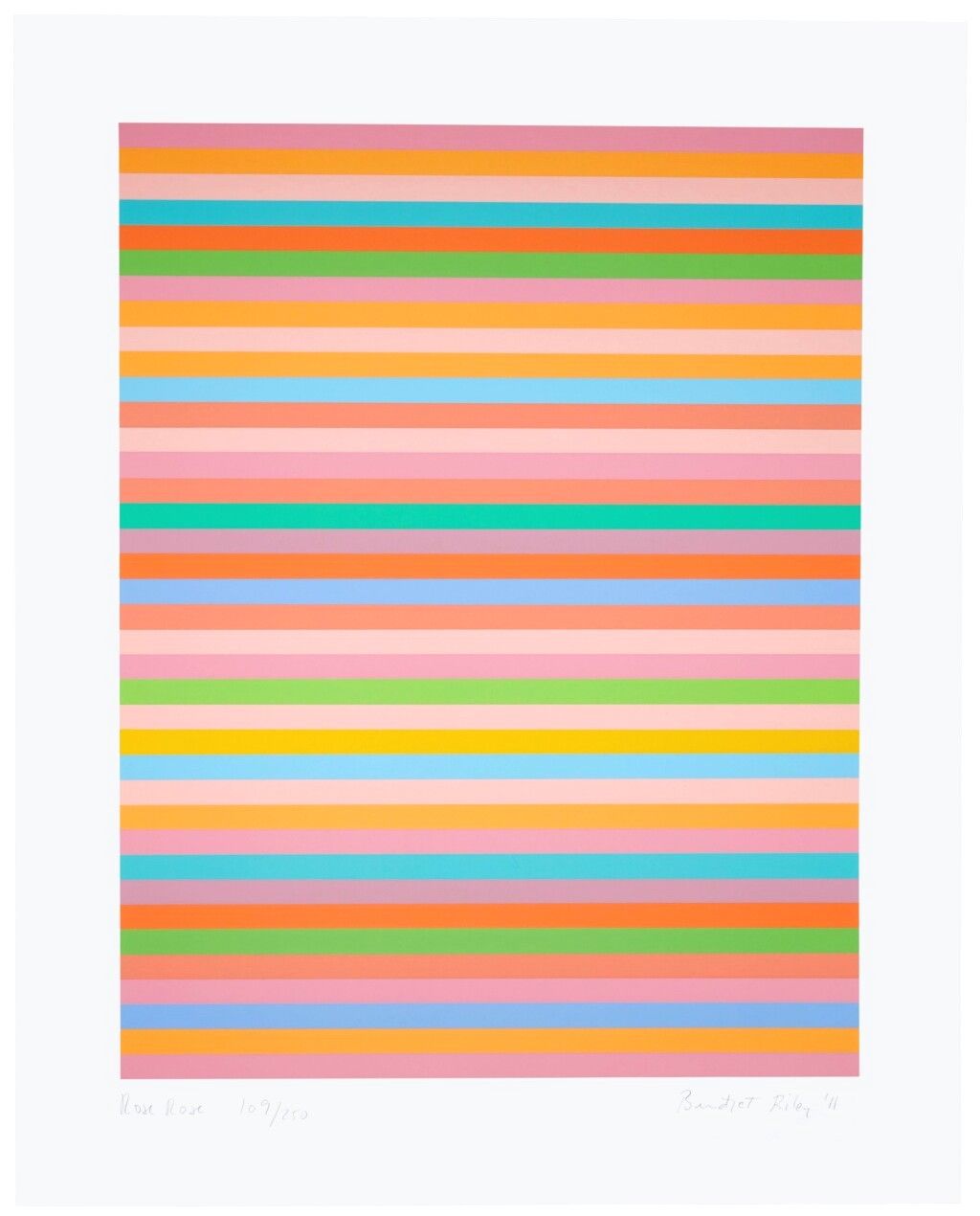
Riley's print market has grown substantially over the past five years, with both sales volume and the number of lots sold nearly doubling across that period, and average prices climbing to roughly $14,300 across 65 lots in 2023. Demand runs across her full career rather than concentrating on a single decade: her early monochrome work draws collectors specifically interested in her Op Art breakthrough, while her later colour work attracts buyers drawn to the more expansive, atmospheric direction her practice took after 1967.
Her painting market continues to set fresh records in real time, with Gala (1974) achieving roughly $5.8 million at Christie's in March 2022, her current auction record — a level of sustained institutional attention that keeps her prints, drawn from the same visual investigation, firmly in view for collectors at every level.
Authentication and Provenance
How can I tell if my Bridget Riley print is authentic? Confidence comes from checking a few things together. Bridget Riley: The Complete Prints, published by Thames & Hudson and carrying a foreword written by Riley herself, is the definitive catalogue raisonné for her editioned work and the first reference to check any print against. Beyond that, verify the printer — Kelpra Studio produced many of her most significant early prints, and a documented printer or publisher consistent with the correct period supports a work's history. Signature and edition number should be checked against known examples from the same print, and a traceable ownership history closes the picture.
Collecting by Tier
How much does a Bridget Riley print cost? Her market spans a truly wide range within a single career: individual screenprints at the accessible end, and her rarest early work or complete portfolios reaching well into six figures at the other.
Starting a Collection (Sub-$25,000) is where individual screenprints from her wider catalogue sit — including prints such as Two Blues, Shade, Frieze, Echo, and And About — real, documented Riley material spanning several decades of her career, and a real entry point into a market that reaches into six figures at its top end.
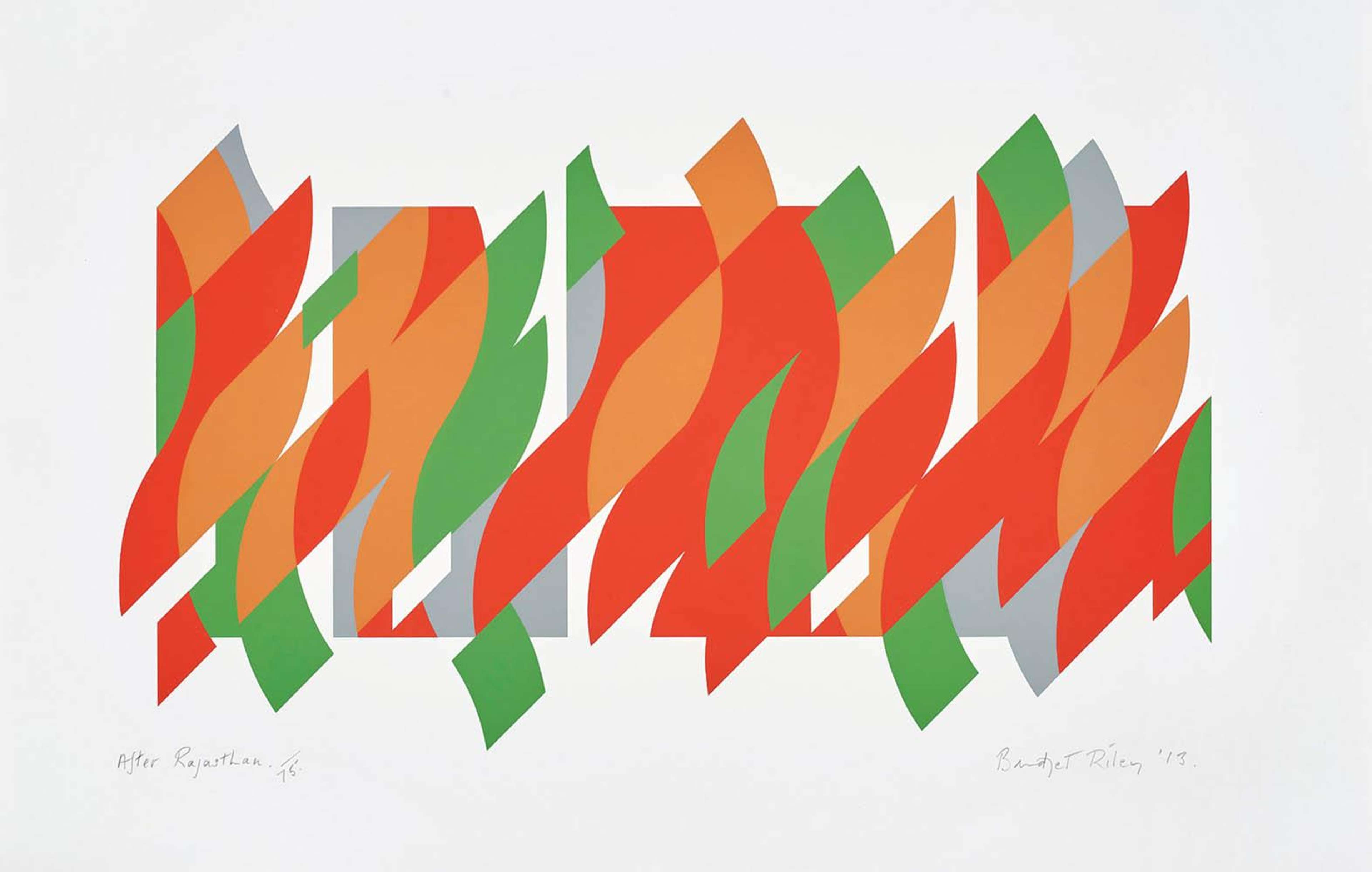
Core Collector ($25,000–$60,000) is where strong individual prints from her most significant series generally trade, including examples from the Fragment series in good condition, individual Dominance prints, and prints such as June, After Rajasthan, Edge of Light, and Silvered 2.
Established Collector ($60,000 and above) is where her rarest material lives: pristine Fragment prints on Perspex, a complete matched Dominance suite where one can still be found intact, and complete multi-print portfolios such as Nineteen Greys.
Acquisition Strategies
Decade Focus builds around a specific period of her development — her monochrome 1960s breakthrough or her post-1967 colour work — telling a coherent story about one phase of her long career.
Suite Focus aims to acquire complete matched sets, such as the Dominance trio, rather than individual prints bought separately, prioritising completeness over breadth.
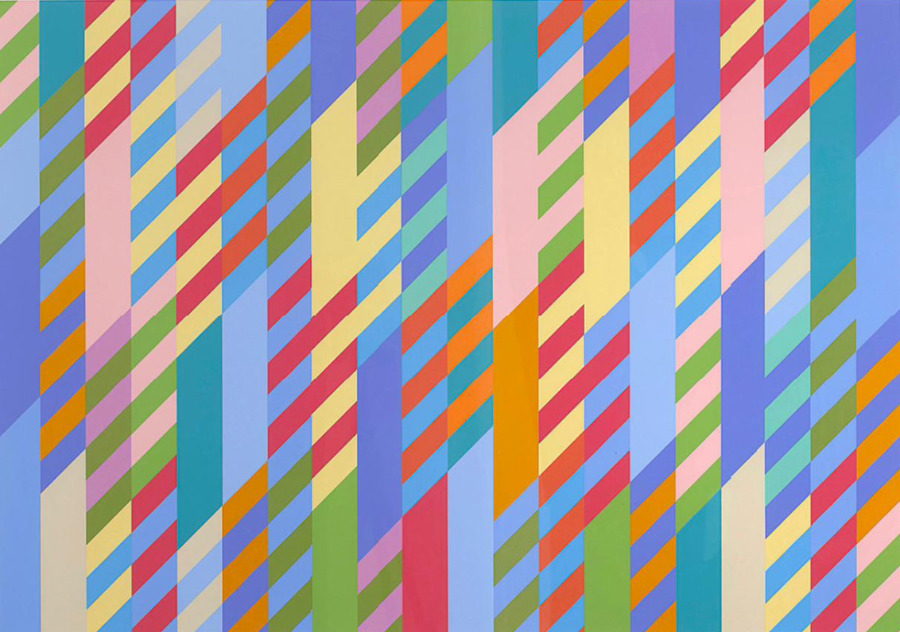
Colour Focus collects specifically within her post-1967 work, tracing how her use of colour relationships evolved across decades of continued experimentation.
Quality-First sets all of the above aside and simply pursues the strongest, best-preserved example available at whatever price point fits, letting condition matter more than any particular series or period.
Riley's Highest Auction Results
Her prints and her paintings share the same visual investigation directly, more so than for most artists, which makes her painting results real, relevant context for understanding demand across her entire market.
Gala (1974) — $5.8 million, Christie's, March 2022. A vividly coloured composition that exceeded its $4.4 million estimate and set her current auction record.
Untitled (Diagonal Curve) (1966) — $5.81 million, Christie's, June 2016. One of her late large-scale black-and-white curve compositions, and her record holder for six years before Gala.
Chant 2 (1967) — $5.1 million, Sotheby's, July 2008. First exhibited at the Venice Biennale in 1968, and her auction record before Untitled (Diagonal Curve) surpassed it.

Is Bridget Riley Still a Good Investment in 2026?
Riley's print market offers a rare combination for a single career: real art-historical significance dating back to the very origins of Op Art, a body of work still actively growing today, and real accessibility at nearly every price point. Whatever level a collection is being built at, the strongest move is to prioritise her most technically and historically significant series — the Fragment prints above all — and complete matched sets wherever they can be found intact, since it's precisely that combination of sustained demand, continued output, and real scarcity in her most distinctive formats that has kept her prints among the steadiest performers in the contemporary market.
For more information on our latest Bridget Riley Prints for sale or to sell your Bridget Riley prints contact our team via info@alexyellop.com