
Yayoi Kusama’s death on 14 August 2026, aged 97, closes a remarkable chapter in contemporary art. Few artists have achieved such recognition across museums, fashion and popular culture while maintaining so distinctive a visual language. Her dots, mirrored environments and brightly coloured sculptures became familiar far beyond the gallery. Behind that visibility lies a career that challenged expectations about artistic form, cultural authority and who could command the international stage.
Kusama’s influence reaches beyond any single motif. She helped expand art into an experience that could surround the viewer, occupy public space and move between disciplines. Her achievement also carries particular significance as a Japanese woman who established herself within a Western art world that frequently treated her gender and nationality as more remarkable than her ideas.
Claiming a Place in the Avant-Garde
Born in Matsumoto in 1929, Kusama pursued art despite her family’s opposition. After studying painting in Kyoto, she moved to the United States in 1957 and settled in New York the following year. The city offered artistic freedom, but access to its institutions and networks was far from equal.
Her position exposed the limitations of an art world that understood innovation largely through Western male artists. Tate has described how critics’ responses were shaped by her nationality and gender, against a background of lingering anti-Japanese prejudice. Kusama’s determination to define her own identity was therefore inseparable from her professional ambition.
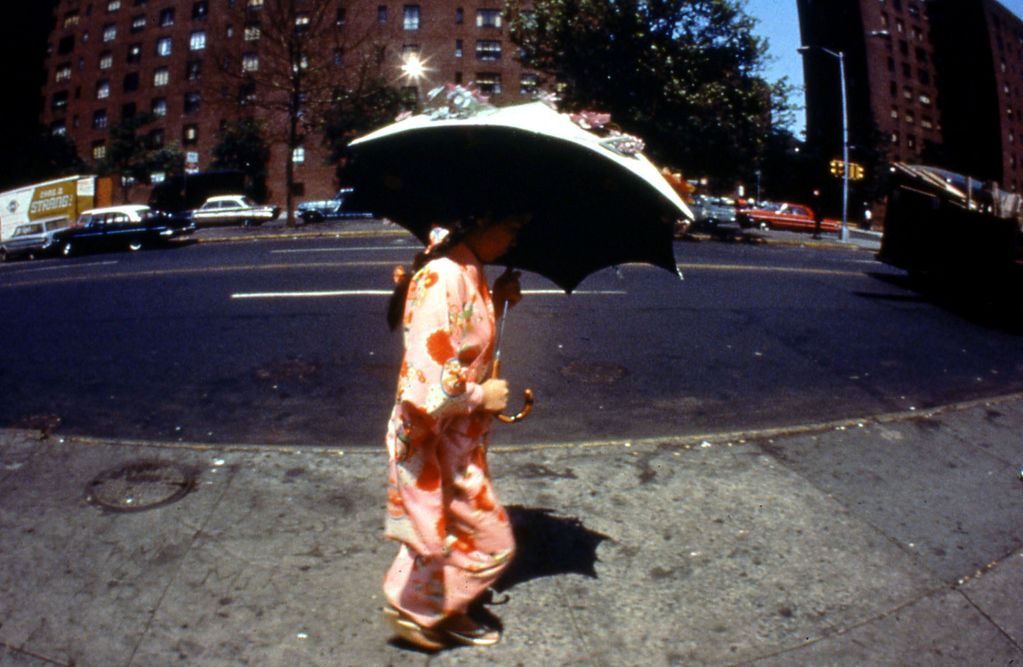
Walking Piece, documented in 1966, gives this experience a striking visual form. Wearing a pink kimono and carrying a parasol, Kusama moves through New York’s industrial streets. Her appearance deliberately invokes an American stereotype of Japanese femininity, while the surrounding city heightens her isolation. The work turns the experience of being perceived as foreign into a subject she controls.
Her career consequently asks us to reconsider the geography of post-war art. Kusama was an active participant in the exchanges through which it developed. Her work drew on experiences across Japan and the United States while resisting the expectation that a non-Western artist should represent a single cultural tradition.
Expanding What Art Could Be
The Infinity Nets illustrate the independence of her thinking. Developed into ambitious canvases in late-1950s New York, their countless looping brushstrokes create fields without an obvious centre. They combine the physical presence of painted marks with a structure that appears capable of continuing beyond the canvas.
At a time when Abstract Expressionism associated artistic intensity with dramatic gesture, Kusama found extraordinary force in patient accumulation. These paintings connect the attention to process of Abstract Expressionism with the repetition and restraint associated with Minimalism. Their importance lies partly in how confidently they move between those categories.
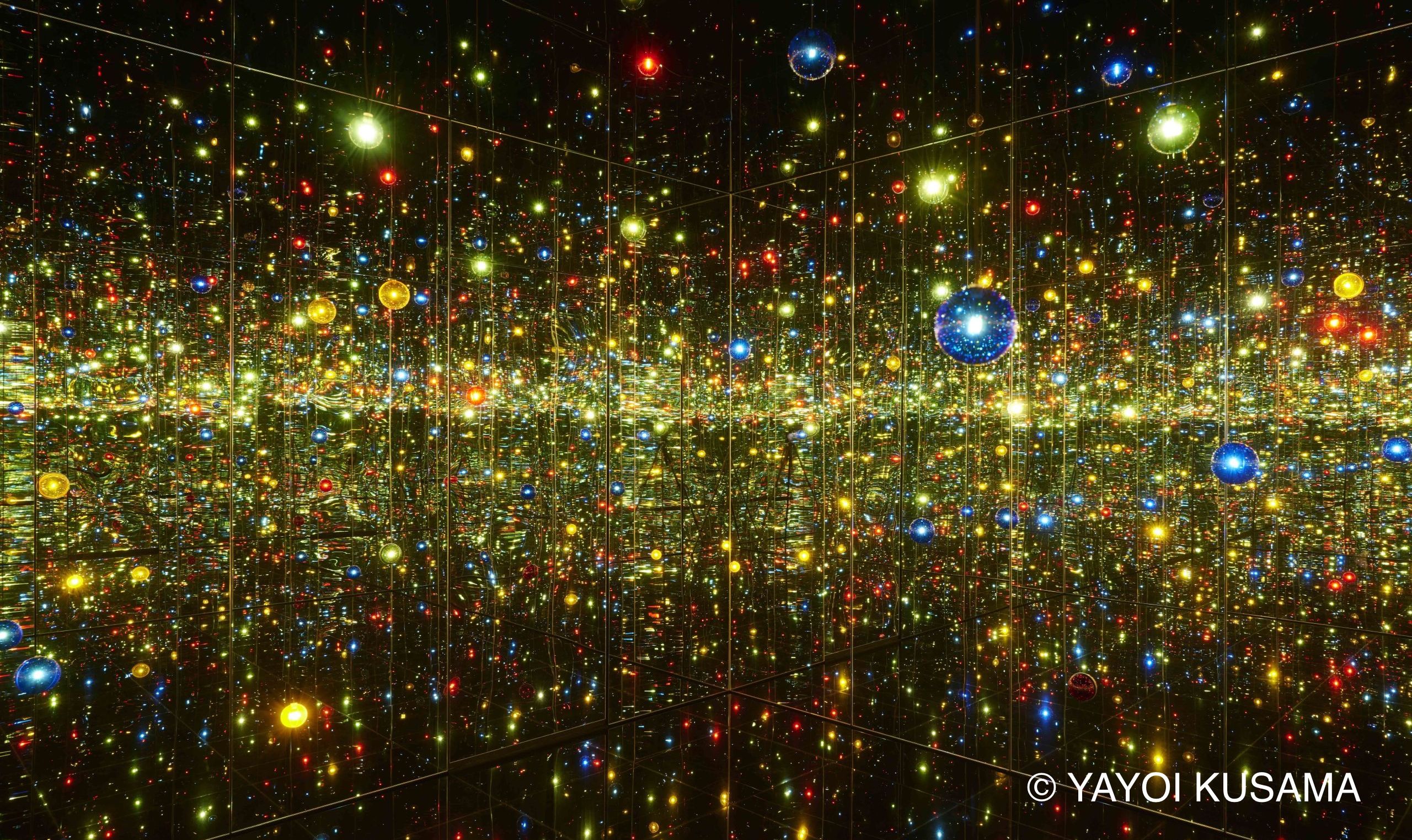
That freedom extended into sculpture. Her Accumulations covered everyday furniture with repeated, stuffed forms, transforming domestic objects into unsettling encounters with sexuality and the body. In Infinity Mirror Room—Phalli’s Field, first shown in 1965, mirrors multiplied similar forms into an apparently endless environment. A method developed on a painted surface became something the viewer could enter.
Kusama’s performances brought that experimental energy into public life. During the 1960s, she organised happenings involving body painting, nudity and collective participation, addressing sexual liberation and opposition to the Vietnam War. Her practice connected visual invention with the social questions of the moment.
The Artist, the Image and the Audience
Kusama also understood that an artist’s public image could become part of the work. Photographs frequently show her surrounded by her creations, wearing clothing that echoes their patterns. Her body appears to merge with the environment, linking self-presentation to her recurring idea of self-obliteration.
Her openness about hallucinations and mental illness offers context for that idea. Repeated patterns could express the sensation of boundaries dissolving between herself and the surrounding world. Yet her work also involves deliberate construction, humour and a sophisticated awareness of how images circulate.
Narcissus Garden brings these concerns together. Presented at the 1966 Venice Biennale, it comprised a field of reflective spheres. Kusama attempted to sell them individually to visitors, confronting the relationship between art, self-image and commerce. Reflection became both an optical device and a way to examine the audience’s desires.
Her later mirror rooms brought related questions to a much wider public. Their popularity on social media demonstrates how readily her work entered contemporary image culture. The photograph records a personal encounter, but the physical experience remains larger: the viewer becomes one small presence within an apparently immeasurable space.

Louis Vuitton and Cultural Reach
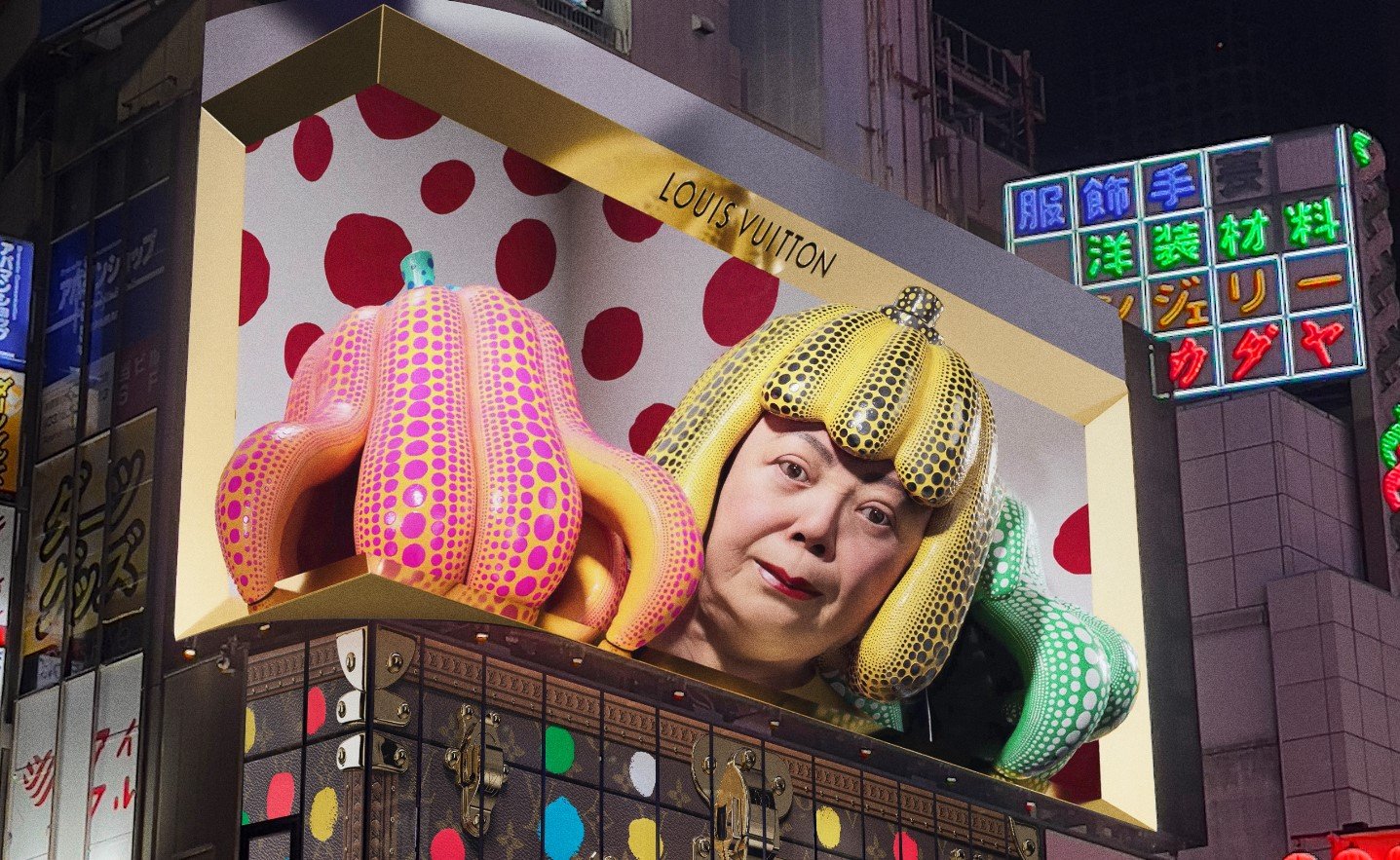
The Louis Vuitton collaborations of 2012 and 2023 extended Kusama’s imagery into the everyday visibility of luxury fashion. Dots, flowers and other motifs appeared across clothing and accessories, bringing her work to audiences who might first encounter it through a shop window rather than a museum.
This relationship had roots in her own practice. Kusama had explored clothing and fashion businesses in the 1960s, treating the dressed body as another surface for artistic intervention. The collaborations continued that movement between art, design and self-presentation on a substantially greater scale.
They also introduce a productive tension. An artist who had questioned the commodification of art became central to a global luxury campaign. Commercial visibility can simplify a complex practice into recognisable signs. Equally, it can create an invitation to discover the work behind those signs. Kusama’s collaborations demonstrate both the power and the ambiguity of art’s place within contemporary consumer culture.
Recognition and Lasting Influence
Her Pumpkins show how much substance can remain within an immediately accessible image. Their irregular shapes, patterned surfaces and often vivid colours combine affection with optical intensity. Across paintings, prints and sculpture, an ordinary vegetable becomes an unmistakable artistic presence.
Her representation of Japan at the 1993 Venice Biennale marked an important moment of international recognition. It also provides perspective on a career whose eventual fame can obscure the difficulty of its earlier reception.
For collectors, Kusama’s breadth is essential to understanding her significance. Paintings, editions, performances and installations belong to a sustained investigation of repetition, identity and perception. Her enduring achievement was to make that investigation accessible without exhausting its complexity. She changed both what contemporary art could look like and how widely it could be experienced.
For more information or to buy Yayoi Kusama prints, please contact us. If you would like to sell Yayoi Kusama prints, we would be pleased to discuss your work.