
Authenticating a Yayoi Kusama print begins with identifying the exact edition and establishing whether its signature, numbering and documentation correspond to that publication.
Recognising a pumpkin, flower or field of dots is only the starting point. Kusama revisited subjects across different dates, colours and techniques, while her imagery also appears on exhibition posters and licensed products. Similar-looking objects can have very different production histories.
For collectors, the most useful questions are specific: where should the signature appear, how should the print be numbered, and what records support its identification? Those details should be assessed together with provenance.
Where are Kusama prints usually signed and numbered?
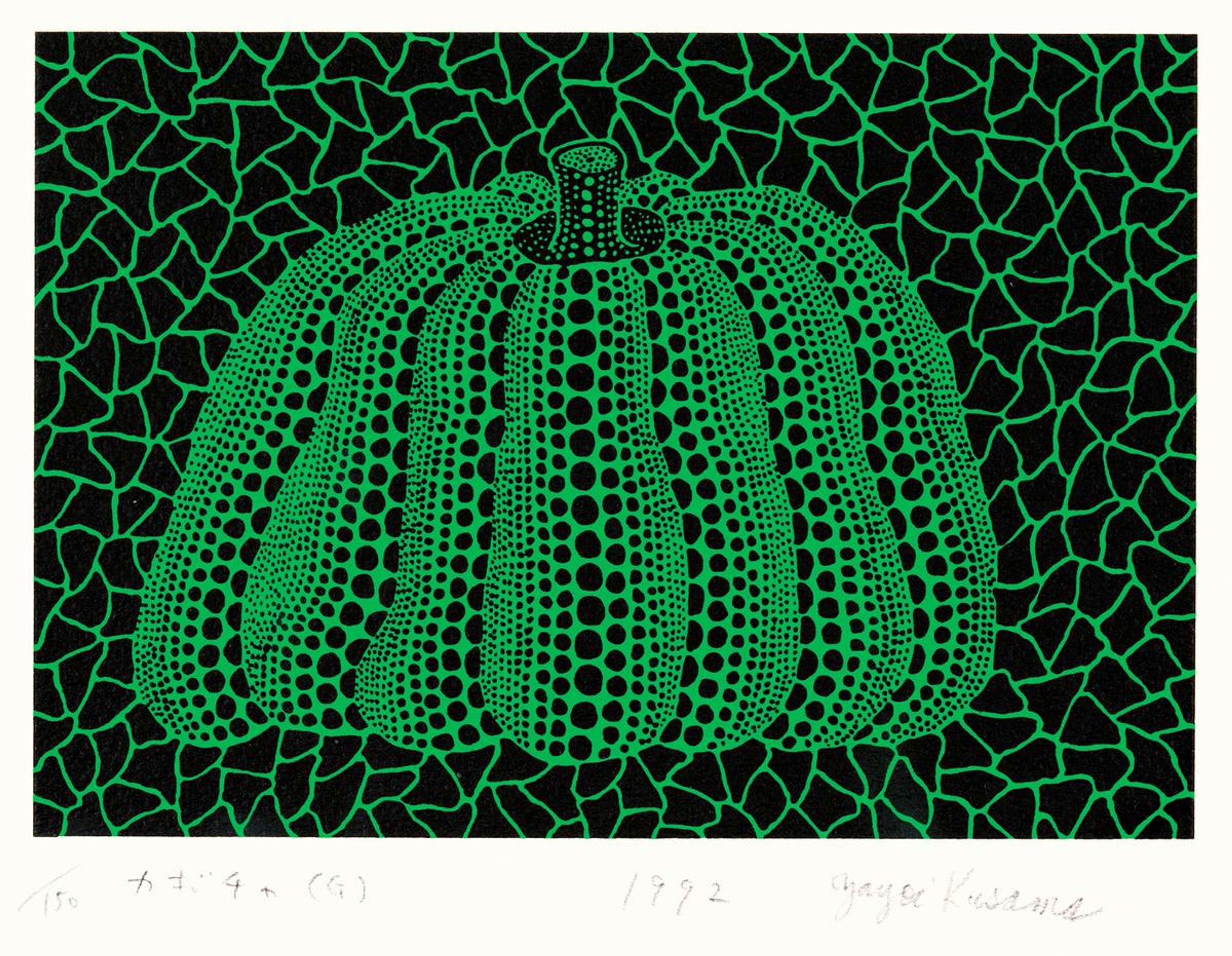
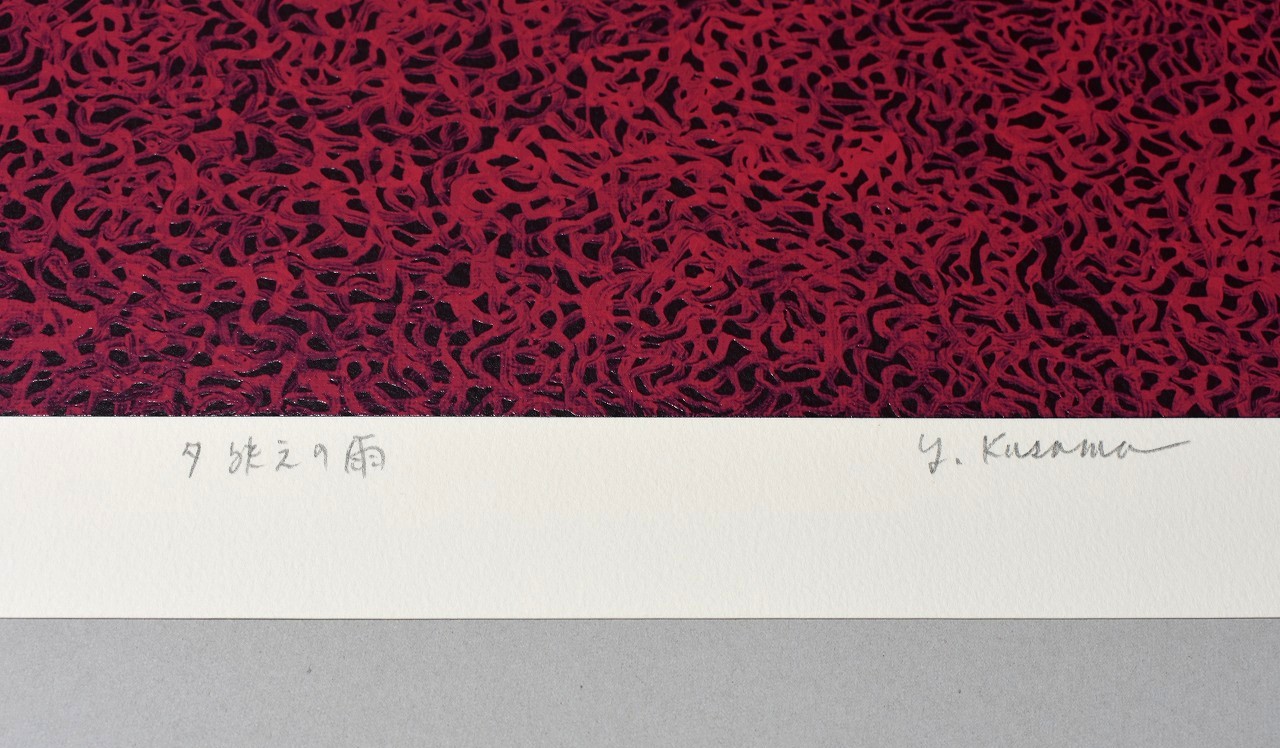
On many Kusama prints, the handwritten pencil signature reads “Yayoi Kusama” in Roman letters and appears in the lower-right margin, with the edition number at the lower left. The title, written in Japanese or English, and the date are usually arranged along the same lower margin. Their exact positions vary between publications.
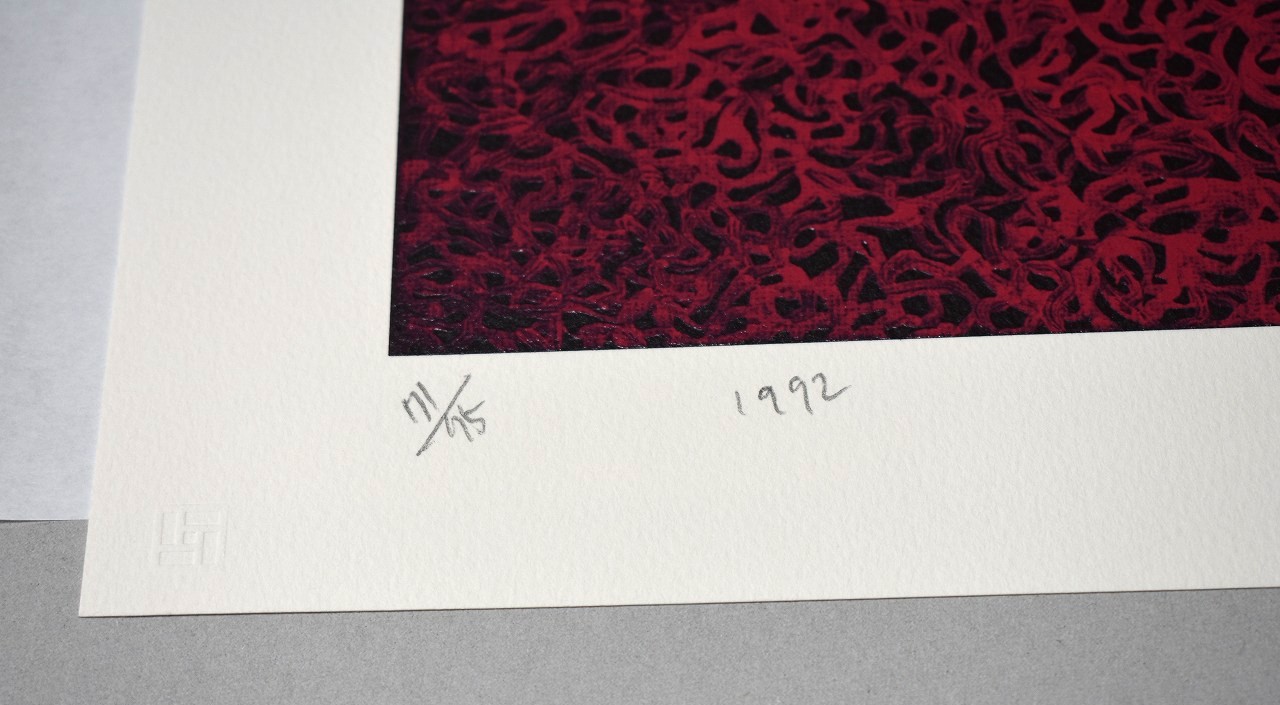
Numbering commonly takes the form of a fraction, identifying the individual impression and the size of the numbered edition. Proof impressions may carry lettering such as AP for artist’s proof or PP for printer’s proof. These designations should correspond to the documented arrangements for that edition.
A handwritten signature must be distinguished from a name reproduced within the printed image. Descriptions such as “signed in the plate” indicate a printed signature, while “signed in pencil” means the inscription was applied separately by hand.
When examining a signature, a specialist considers its line quality, writing material and relationship to the paper, comparing it with documented examples from the same publication and period. Natural differences in handwriting can occur, but a broadly similar appearance alone provides limited reassurance.
Request photographs of the complete sheet and close-ups of all inscriptions. The signature, title, date and numbering should be assessed together: a convincing-looking signature cannot resolve an incorrect edition number or unsupported publication history.
Should the title be written in Japanese or English?
Both Japanese and English titles occur on documented Kusama prints. Neither language should be treated as an independent test of authenticity.
The wording should agree with the edition being offered, including any letters or other identifiers that distinguish it from related compositions. These details can be useful when researching works with similar subjects and titles.
Dates may accompany the signature or appear alongside the title and numbering. Their position should be checked against the particular publication rather than assumed.
For collectors unfamiliar with Japanese, an accurate reading can help establish whether the inscription corresponds to the title used in the sales description. It may also clarify distinctions that have been lost through abbreviated or inconsistent translations.
What should the edition number tell you?
A fraction such as 24/100 ordinarily identifies impression twenty-four from a numbered edition of one hundred. The denominator should agree with the documented publication.
The numbered edition may not represent every impression produced. Additional proofs can exist, including artist’s proofs, printer’s proofs and hors commerce impressions. Their designations and quantities should be checked against reliable records.
An unfamiliar inscription requires investigation. Describing it as a “rare proof” is insufficient without evidence explaining its place within the publication.
The numbering should also be assessed alongside the signature and other inscriptions. A plausible fraction can be copied, so it gains significance through its consistency with the rest of the work.
If a print is offered as part of a complete portfolio, check whether the numbering and accompanying documentation support the description of the set.
Is a catalogue number the same as an edition number?
A catalogue reference identifies a particular work within a published reference book. An edition number identifies an individual impression within its publication.
This distinction is especially useful when researching Yayoi Kusama pumpkin prints, where closely related subjects can be difficult to distinguish by title alone.
A reference such as K. 298 identifies Pumpkin 2000 (Yellow) in the print catalogue. It is not the number of the individual impression and should not be expected to appear as its handwritten edition number.
Published references, including Yayoi Kusama: Prints 1979–2011 and Yayoi Kusama: Prints 1979–2017, help establish the documented composition and publication details.
The relevant entry should be consulted wherever possible. A catalogue reference copied into a listing provides limited reassurance unless the image and accompanying information correspond to it.
Catalogue inclusion supplies a basis for comparison. It does not authenticate every sheet reproducing that composition.

How do you establish which Kusama edition you own?
Begin with the full title, date and catalogue reference where available. Then establish the medium, edition size, publisher and expected inscriptions.
General descriptions such as “yellow pumpkin” or “Infinity Nets” are insufficient. Kusama returned to these subjects repeatedly, producing distinct works that share familiar visual features.
Letters and other identifiers within a title should be retained when they distinguish the publication. Removing them can make it harder to research the correct work.
The same care applies to Kusama’s Infinity Nets prints. Identifying the broader motif does not establish the technique, date or edition of the particular impression.
Once the publication has been identified, its documented characteristics provide a meaningful basis for assessing the signature and numbering.
Can the Kusama studio authenticate prints?
Yayoi Kusama Inc.’s current artwork registration programme excludes prints and editions. The Yayoi Kusama Foundation also states that it cannot provide authentication services or respond to enquiries about the authenticity of prints.
Collectors should therefore distinguish the registration arrangements for eligible individual artworks from the evidence required for editioned works.
Historical auction descriptions sometimes refer to signature verification by Kusama’s office. Those statements relate to the documentation associated with the particular work at that time. They do not establish that an equivalent service is currently available.
The absence of a registration card is consequently not, by itself, evidence against a print. A claim that a print is “studio registered” should nevertheless be explained precisely: what documentation exists, when was it issued and what does it confirm?

Does a certificate of authenticity prove a Kusama print is genuine?
A certificate should be assessed according to its issuer, contents and connection to the individual impression.
The Yayoi Kusama Foundation has warned that forged certificates of authenticity have been identified. Ota Fine Arts has also reported the forgery or fraudulent misuse of gallery labels, invoices and certificates.
A familiar logo or professional appearance cannot settle the question. Useful documentation identifies the work through details such as its title, date, medium, edition number and photograph. Those details should agree with the impression being offered.
A seller’s certificate may record that seller’s opinion or the terms of a transaction. Documentation supplied with the original publication may serve a different purpose. Both should be understood according to what they establish.
The absence of a separate certificate does not automatically invalidate a print supported by reliable provenance and consistent evidence. Equally, a certificate cannot resolve an unsupported signature or incompatible numbering.
What provenance should accompany a Kusama print?
Provenance traces the ownership history of the particular impression.
An original publisher or gallery invoice can be especially useful when it records the title, edition number and purchaser. Later invoices, auction entries, correspondence and photographs may help connect that transaction to the present owner.
The connection to the individual sheet matters. A document referring simply to a “Kusama pumpkin” is less informative than one identifying a particular edition and impression.
Previous auction references should also be checked carefully. The sale of another impression provides comparative information, rather than provenance for the print under consideration.
Similarly, an exhibition or book reference may concern another example from the edition. It should not automatically be presented as part of the individual sheet’s history.
Where documentation needs clarification, contact details should be obtained independently. The institution’s policies must also be respected: being named on a document does not mean a gallery offers a general authentication service.
How do you distinguish a signed edition from a reproduction?
An authorised poster or licensed reproduction can legitimately feature Kusama’s imagery. Its publication history differs from that of a signed limited edition.
The practical task is to establish what the object was originally issued as. Who published it? Was it sold as a poster, an editioned artwork or another type of product? Do reliable records support the description now being used?
A handwritten number or accompanying certificate cannot independently turn a reproduction into an impression from a documented edition.
An unsigned work also needs to be assessed according to its publication. The absence of a handwritten signature may be expected for a particular poster, while being inconsistent with a claimed signed edition.
Clear descriptions should identify the object and its relationship to Kusama’s work without relying on ambiguous phrases such as “original print”.

What should you gather before buying or selling?
Begin with photographs of the complete front and reverse, followed by close details of the signature, title, date, edition number and any labels or stamps.
Record the sheet dimensions and gather invoices, certificates, correspondence and previous sale references. If the work is framed, request photographs that show the margins clearly and establish whether the reverse has been examined.
Ask for a precise written description of the publication. Any discrepancy in the title, signature, numbering or documentation should be explained with supporting evidence.
A sound assessment connects the individual impression to its documented edition. The signature and numbering should be appropriate to that publication, while the provenance should support the ownership history being presented.
For advice on Yayoi Kusama prints for sale or to discuss selling your Kusama print, contact our team at info@alexyellop.com.