
Roy Lichtenstein’s prints are immediately recognisable, but establishing the authenticity of an individual impression can be more complicated. Original editions, exhibition announcements and later reproductions often share familiar imagery, making it difficult to distinguish between them without understanding how they were produced, published and signed.
For collectors, authenticity is paramount. Before purchasing, it is essential to understand exactly what is being offered and what supports its identification. Some genuine Lichtenstein publications are signed but unnumbered; others exist as unsigned exhibition material. These differences can significantly affect both the nature of the work and its value.
Lichtenstein’s varied publishing history makes general rules unreliable. A signature is important evidence, but it must be considered alongside the edition, printing process and provenance.
What is an original Roy Lichtenstein print?
An original Roy Lichtenstein print is an artwork conceived for production through a printing process, often developed by Lichtenstein in collaboration with a specialist workshop. Its existence in multiple impressions is part of its intended form.
A reproduction copies an existing artwork. It may have been licensed by the appropriate rights holder, but that permission does not make it an impression from an original edition.
The distinction is especially relevant to Lichtenstein, whose work deliberately adopts the appearance of commercial illustration. Dots, flat colour and precise outlines are features of his imagery rather than evidence of a particular printing process. They can be reproduced convincingly in objects with no connection to the original publication.
A sales description should identify the title, date, medium and edition or publication. The phrase “signed Lichtenstein print” leaves unresolved both the nature of the object and the circumstances of its signing.
Which Lichtenstein prints were issued unsigned or unnumbered?
The publications associated with Leo Castelli Gallery do not follow a single edition structure. Some were issued as signed and numbered prints; others circulated as exhibition announcements, posters or unnumbered impressions. In certain cases, the same composition appeared in several forms.
These publications occupy an important place within Lichtenstein’s prints of the 1960s. Their promotional origins are part of their history, rather than a reason to dismiss them. However, collectors need to distinguish the different versions before assessing an impression.
Crying Girl, 1963
Crying Girl was issued in an edition of unknown size, without numbering. Many impressions were signed. Exhibition mailers carried information on the reverse and were folded for posting, while blank-backed impressions were usually signed and distributed through the gallery.
An absent number is therefore consistent with this publication. Original mailing folds can also help explain its intended use, although the impression must still be assessed as a whole.

CRAK!, 1963–64
CRAK! exists as a signed, dated and numbered edition of 300, alongside separate poster versions in editions of unknown size.
The poster versions differ in lettering, paper and colour separations. Signed examples of several versions are documented, so a signature alone does not establish that an impression belongs to the numbered edition. Exhibition text and printer credits can be significant identifying features.

Temple, 1964
Temple was published in a signed, dated and numbered edition of 300, alongside an unknown number of unsigned exhibition mailers.
The mailers carry exhibition information on the reverse. An unsigned example may therefore be consistent with the original publication, but it should be identified and described as the mailer rather than presented as an impression from the signed edition.

Foot and Hand, 1964
Foot and Hand has a documented numbered edition of 300, together with an unknown number of unnumbered proofs. The catalogue also records impressions bearing a signature without numbering.
The inscriptions appear in the upper-left area, within the boot—a useful reminder that Lichtenstein did not invariably sign beneath the image.

Shipboard Girl, 1965
Shipboard Girl was not produced in a numbered edition, and its total size is unknown. Signed impressions are documented, together with a few unsigned proofs discovered in the printer’s estate.
Those proofs require particular care. Their existence does not establish that unsigned examples generally belonged to the normal distribution; the history of an unsigned impression needs its own supporting evidence.

Sunrise, 1965
Sunrise is documented in an edition of unknown size, with signed impressions recorded. Unsigned proofs associated with this publication and Shipboard Girl were also discovered in the printer’s estate.
As with Shipboard Girl, an unsigned proof should be identified through its production history and provenance rather than assumed genuine because comparable signed impressions exist.
Brushstroke, 1965
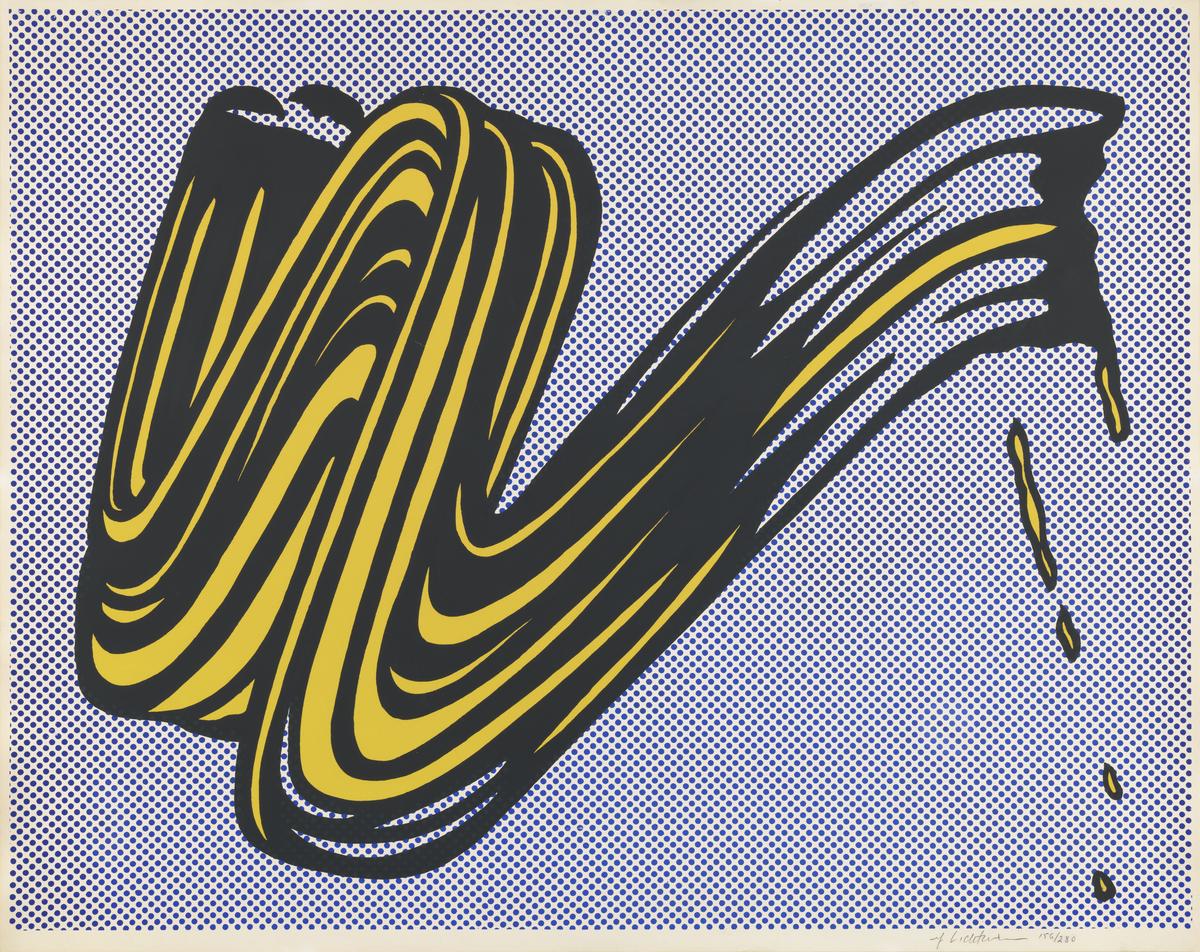
The 1965 Brushstroke screenprint was published in an edition of 280 signed and numbered impressions, with additional proofs. The image also appeared as a poster and exhibition mailer.
These publications must be distinguished from one another. The 1965 work should also not be confused with Brushstrokes, the separate print published in 1967.
These differences explain why an absent number is not necessarily unusual. They also show why an unsigned impression requires a precise explanation: it may be an exhibition mailer, a documented workshop proof or a work whose relationship to the publication remains unresolved.
An edition of unknown size means that the total has not been established. It should not automatically be described as unlimited, nor assigned a conventional edition size because comparable works were numbered that way.
Where are Lichtenstein prints usually signed and numbered?
Many Lichtenstein prints carry a handwritten pencil signature in the lower margin, often at the right. A frequently documented form reads “rf Lichtenstein”. A date may accompany the signature, while the edition number can appear towards the left or alongside the other inscriptions.
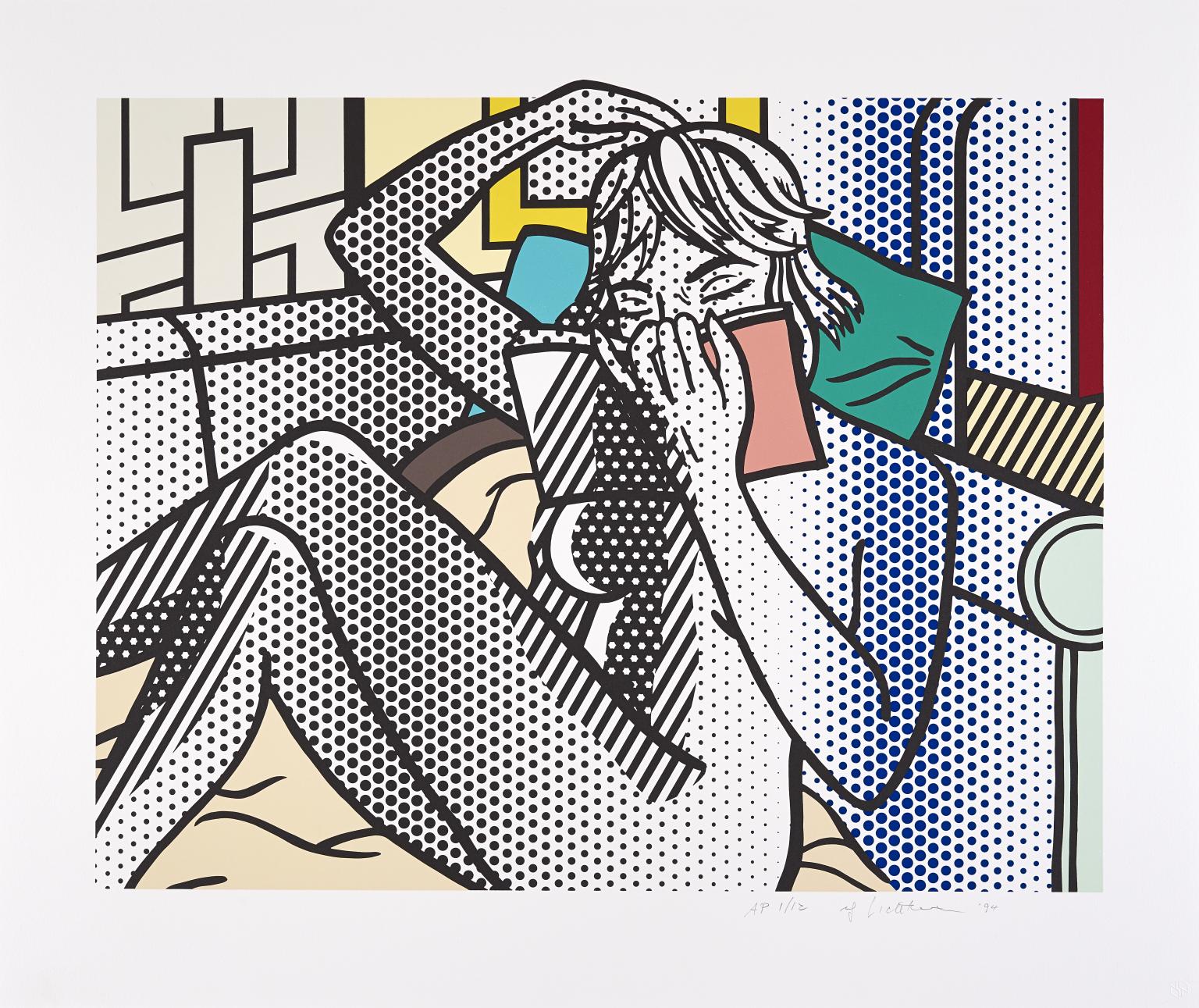
The arrangement varies across his career. In Reverie, numbering appears at the lower left and the signature at the lower right. In Nude Reading, the number, signature and date are grouped at the lower right.
There are also exceptions to pencil inscriptions on the front. Seascape (1), for example, is documented as signed and numbered in black ink on the reverse.
Collectors should request photographs of the complete sheet, together with clear details of the inscriptions. A mount can conceal margins, while a tightly cropped photograph may exclude information essential to identifying the work.
The signature requires more than a resemblance to an online example. Its handwriting, writing material and application should be considered alongside the print’s other characteristics. Natural variation is expected; equally, a convincing imitation cannot resolve inconsistencies elsewhere.
Descriptions should distinguish a handwritten signature from one reproduced through printing. “Signed in the plate” does not mean that Lichtenstein separately signed the sheet by hand.

What do artist’s proofs and different states mean?
Alongside numbered editions, Lichtenstein’s publications include proof impressions carrying their own inscriptions. AP generally denotes an artist’s proof, while PP indicates a printer’s proof. Other designations reflect the arrangements of a particular workshop or publication.
These inscriptions need to correspond with the recorded edition. Describing an impression as a “rare proof” does not remove the need to establish its origin.
The Nudes series also includes works published in different states. A state records a version of an image following changes to the printing matrix or composition; it is distinct from a proof designation.
A numbered impression, an artist’s proof and an impression from another state may therefore share a title while requiring separate consideration. Understanding which is being offered is necessary before making comparisons with other examples.
What do Corlett and RLCR references establish?
Mary Lee Corlett’s catalogue of Lichtenstein’s prints remains a principal reference for his published graphic work. The Roy Lichtenstein Foundation’s online catalogue provides RLCR numbers alongside earlier references and additional documentation.
A catalogue number identifies a work within that reference system. The “C.38” often attached to Reverie, for example, refers to its Corlett entry. It is separate from the handwritten number identifying an individual impression.
The relevant entry can clarify the medium, support, publication history, inscriptions and known variations. It may also record concerns absent from a brief sales description. The entry for Reverie notes the existence of unauthorised impressions, some potentially bearing copied signatures and artist’s-proof inscriptions.
The composition may therefore be correct and the inscription plausible, while the relationship to the authorised edition remains unresolved. A catalogue reference in a listing should lead to an examination of the entry and the artwork together.

Why is the printing technique important?
Lichtenstein worked across several printing processes, sometimes combining them within a single publication. There is no uniform surface or dot pattern against which all his prints can be judged.
Nude Reading is a relief print produced with Tyler Graphics. Reverie is a screenprint, while the documented Crying Girl publication is an offset lithograph. Each process forms part of the work’s identity.
A reproduction can preserve the composition while differing substantially in its production. Conversely, an imprecise sales description may misidentify the technique of a genuine work. Such discrepancies should be resolved before purchase.
Measurements require similar care. Image dimensions describe the printed composition; sheet dimensions describe the complete support. The visible area within a frame may correspond to neither. Trimming or concealed margins can complicate comparison and should be explained.
Condition is a related but separate consideration. An authentic impression may have faded or undergone restoration. A well-preserved example may retain strong colour through careful storage and limited exposure. Freshness alone is not grounds for suspicion, just as age-related wear is not evidence of authenticity.
What can workshop marks and provenance reveal?
Printer and publisher markings help connect an impression to its production. They may include an embossed, inkless stamp—usually described as a blindstamp or chop—or inscriptions and workshop numbers on the reverse.
Lichtenstein’s collaborations involved different workshops, each with its own practices. No single workshop stamp is expected across his entire output. Its presence and position should make sense for the publication concerned.
Provenance addresses the subsequent history of the individual impression. Purchase invoices, identifiable auction records and gallery correspondence can establish how it passed between owners and whether its description has remained consistent.
The distinction between an edition’s history and an impression’s history is important. An auction record for another example confirms that the work has circulated, but does not establish the ownership of the sheet under consideration.
Documentation becomes persuasive when it can be connected to the particular artwork. An edition number, photograph or recorded inscription may help make that connection more precise.

Does a certificate of authenticity provide a guarantee?
A certificate should be considered in relation to its issuer, the expertise behind it and the evidence it records.
A document that merely repeats the artist’s name and title adds little to the description. A substantive opinion should identify the work clearly and explain the basis on which it has been assessed.
Collectors should also understand the role of the Roy Lichtenstein Foundation and the Estate. Neither authenticates artworks, and inclusion in the online catalogue is not a warranty of authenticity or provenance.
Specialist assessment brings together the publication records, the physical impression, its inscriptions and its documented history. Photographs can support an initial examination, although questions concerning printing, signatures or alterations may require inspection in person.
Buying a Lichtenstein print with confidence
A purchase should be supported by a coherent account of the work: what it is, how it was published, how its inscriptions should be understood and what is known of its ownership and condition.
That account should be reflected accurately in the sales documentation. Where a number is absent, a signature appears in an unfamiliar position or a measurement differs from the published reference, the explanation should be established before purchase.
Lichtenstein’s varied publications reward this degree of attention. Their differences reveal the relationships between the artist, his galleries and the workshops with which he collaborated. Understanding them gives collectors a firmer basis for assessing an impression—and a fuller appreciation of the work they intend to acquire.
For more information about Roy Lichtenstein prints for sale, or to discuss selling a Roy Lichtenstein print, contact our team at info@alexyellop.com.