
In January 2023, a remarkably lifelike Yayoi Kusama appeared in the window of Louis Vuitton’s Fifth Avenue store in New York. She moved her arm, painting dots across the glass as people stopped to watch. It was an animatronic likeness, but the effect was entirely appropriate: Kusama’s art had escaped the gallery, occupied the shop window and brought the pavement to a standstill.
Elsewhere, dots spread across bags, clothes and buildings. Harrods received a multicoloured makeover. The distinction between fashion collection, advertising campaign and public spectacle became increasingly difficult to draw.
Louis Vuitton’s collaborations with Kusama, launched in 2012 and again in 2023, offered a particularly convincing meeting of artist and fashion house. Her work already concerned repetition, participation and the transformation of everyday surroundings. Fashion gave those ideas somewhere else to go.
How did Kusama’s relationship with Louis Vuitton begin?
The story began before the first collection. Marc Jacobs, then Louis Vuitton’s artistic director, visited Kusama’s Tokyo studio in 2006. He admired the sustained intensity of her work: the repeated marks, the accumulation of forms and the sense that a painting or installation might continue indefinitely.
By 2012, the relationship had developed into a collection spanning clothing and accessories. Kusama’s dots appeared across skirts, leggings, shoes and handbags, bringing her patterns into contact with Vuitton’s established designs.

The timing mattered. A major touring retrospective had brought renewed attention to Kusama’s career, with presentations at Tate Modern and the Whitney Museum of American Art. Louis Vuitton supported both exhibitions, connecting its commercial collaboration with an opportunity to encounter the wider body of work.
Jacobs also recognised that fashion could introduce Kusama to people who might never visit a contemporary art exhibition. A handbag could become the beginning of an interest in the artist behind it.
Kusama was designing clothes long before Vuitton
Kusama’s involvement in fashion reached back to the experimental atmosphere of 1960s New York.
She designed clothes for herself, performers and models, using garments to explore ideas also present in her paintings and sculptures. Some carried hand-painted nets. Others incorporated stuffed fabric forms or circular openings that exposed the body beneath.
These clothes belonged to the era’s arguments about sexual freedom, convention and who could decide how a body should appear in public. Certain designs could accommodate several people at once, turning getting dressed into a collective activity.
In 1969, Kusama established Kusama Fashion Company and launched a ready-to-wear collection. Her designs were sold through New York retailers and her own boutique.
That history gives the Vuitton partnership greater depth. Kusama had already treated clothing as a medium through which art could circulate, be worn and acquire a life beyond an exhibition. Luxury fashion provided a very different commercial setting, but the interest in dressing people in her work was well established.
Why were the dots such a powerful fit?
A dot is simple enough to recognise immediately. Kusama’s use of it is more complicated.
Across her work, repeated dots connect the individual with something immeasurably larger. A single mark can suggest a person, a planet or one particle among countless others. As dots multiply across bodies, objects and their surroundings, the boundaries separating them begin to weaken.
Kusama described this process as “self-obliteration”: the self becoming part of a larger, continuous whole.
On clothing, that idea acquires a physical presence. The wearer carries the pattern into the world. When the same marks extend across a bag, a dress and the surrounding space, the person becomes part of the composition.
The encounter with Louis Vuitton’s Monogram was especially effective. Both patterns are immediately recognisable through repetition. Overlaid, they create a lively exchange between two identities: the established order of the fashion house and Kusama’s spreading, irregular marks.
Her dots could interrupt one of luxury’s most familiar surfaces while leaving it recognisable.
What changed in the 2023 collection?
The second collaboration, titled Creating Infinity, expanded the partnership considerably. Launching in two stages in 2023, it encompassed womenswear, menswear, bags, shoes, luggage, accessories and fragrances.
Its opening collections explored Painted Dots, Metal Dots, Infinity Dots and Psychedelic Flower. These treatments brought different qualities of Kusama’s work into focus, from the apparent immediacy of a painted mark to the reflective surface of a polished sphere.
The Painted Dots pieces were particularly revealing. Louis Vuitton used screen-printing and embossed printing to reproduce the texture and appearance of Kusama’s brushwork on leather and coated canvas. The intention was to retain something of the painted gesture as it moved into manufactured objects.

That distinction matters. An apparently spontaneous mark became the subject of careful technical development. The collection depended on translating the character of Kusama’s art across materials, rather than simply placing a flat image on a bag.
The result also played with expectations of luxury. Vuitton’s controlled surfaces appeared freshly marked, animated by a hand that had interrupted their usual finish.
Beyond dots: pumpkins, flowers and faces
The later stage of the 2023 collaboration broadened the picture further, introducing pumpkins, flowers, faces and Infinity Nets alongside additional dotted designs.
This was important because Kusama’s extraordinary visibility can sometimes reduce an extensive career to a single motif.
Her pumpkins bring humour, warmth and a distinctive bodily presence to her work. Their rounded forms can appear solid and reassuring, or stretch into something animated and strange. A print such as Dancing Pumpkin, 2004, shows how far she could take that familiar subject.
Within the Vuitton collection, the pumpkin could function both as an image on a bag and as an inspiration for its shape. Fashion offered a way to turn the motif into an object with volume and practical use.
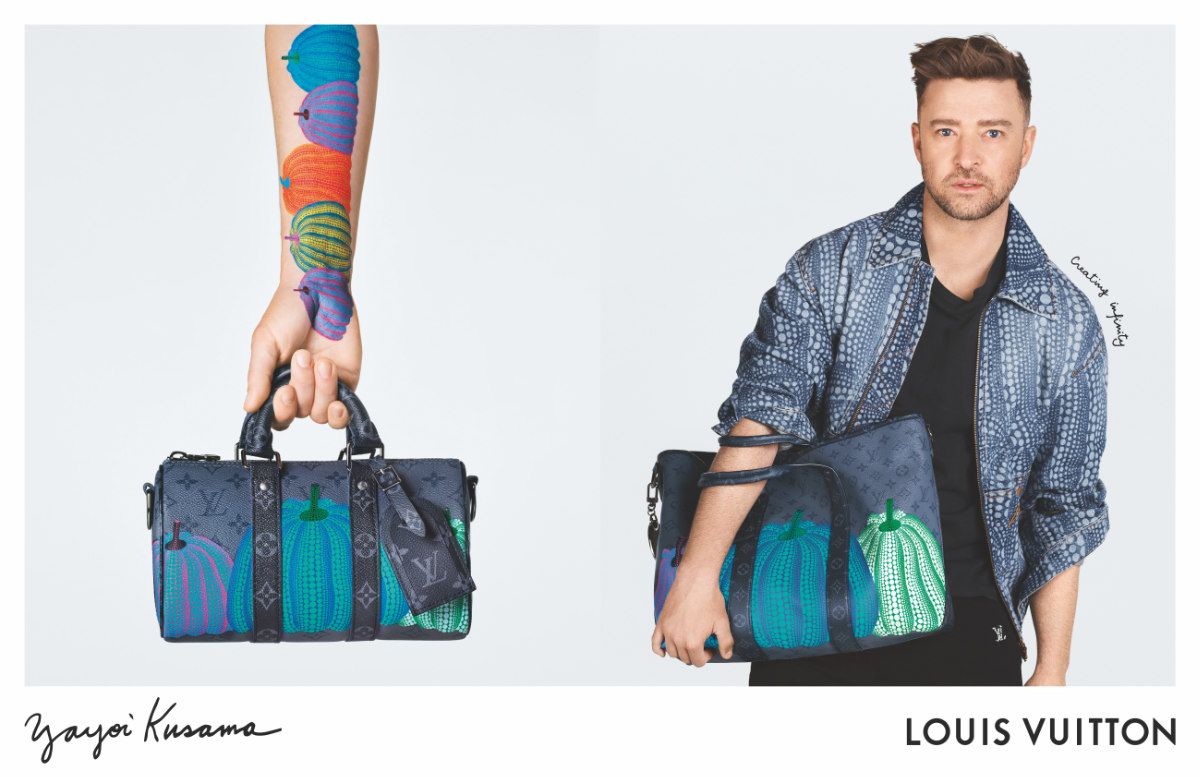
The flower prints offer another route into her work. Flowers gave the collaboration a broader range of organic shapes and colour relationships, moving beyond the rhythm of repeated circles.
The accompanying campaign, photographed by Steven Meisel, extended these motifs across portraits of figures including Cate Blanchett, Naomi Osaka and Justin Timberlake. Clothes, accessories, faces and make-up became parts of a coordinated composition.
From mirrored spheres to luxury objects
The Metal Dots designs introduced another strand of Kusama’s history through their connection with Narcissus Garden.
First presented unofficially at the Venice Biennale in 1966, the installation consisted of mirrored spheres spread across the ground. Their surfaces reflected visitors and their surroundings, breaking the scene into a multitude of curved images.
Kusama stood among them and offered the spheres for sale, accompanied by a sign declaring, “Your Narcissism for Sale.”
The work brought reflection, self-image and commerce into the same encounter. Its later echo in a luxury collection creates an intriguing tension. A project that questioned the relationship between art, possession and desire became a reference within objects designed to be desired and possessed.
That tension gives the collaboration something to think about beyond its immediate appeal. The history remains present, even as the material, audience and commercial setting change.
When the shop became part of the artwork
The scale of the 2023 launch made the surroundings almost as memorable as the products.
At Harrods, painted dots spread across the façade, while windows and interior spaces carried the collaboration through the building. In New York, the animatronic Kusama made the act of painting into a performance for passing crowds.
These displays worked because Kusama’s art had long challenged the idea that a work should stay within a frame. Patterns could cover furniture, bodies and entire rooms. Repetition could change the experience of a space.
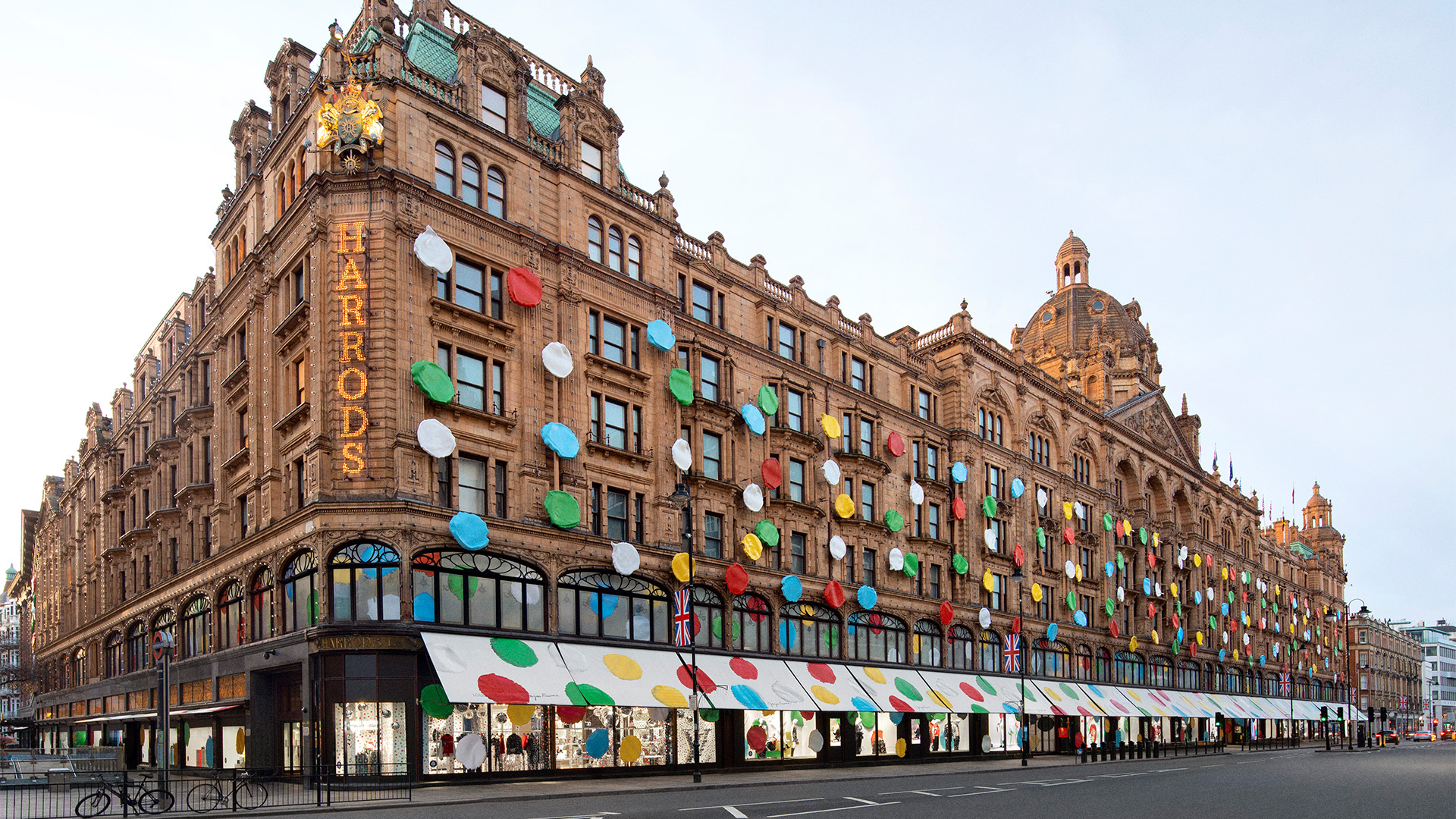
The retail installations applied that principle to places people encountered during an ordinary day. A passer-by could become involved without buying anything, simply by stopping, looking or taking a photograph.
There was also something unmistakably theatrical about Kusama’s own image becoming part of the display. Her distinctive appearance joined the dots and pumpkins as an instantly recognisable presence. The artist herself had become part of the world her work created.
What did the collaboration mean for Kusama’s wider legacy?
Fashion moves quickly; Kusama developed her recurring subjects across decades. The interest of the Vuitton partnership lies partly in that difference.
The collections gave familiar motifs a fresh setting while directing attention towards a much longer artistic history. Behind a dotted bag stood paintings, performances, experimental garments, installations and an enduring concern with how individuals relate to the world around them.
For collectors, those connections make the collaboration a useful starting point. Recognition can lead to closer looking: at the rhythm of marks, the treatment of a familiar subject, or the ways an image changes across different works. Our article on Kusama’s influence and legacy considers that broader reach.
Louis Vuitton gave Kusama an enormous platform. She brought a body of work capable of transforming its products and surroundings together. At its most compelling, the collaboration made a recognisable handbag feel like one small part of a much larger Kusama world.
For more information on Yayoi Kusama prints for sale, or to discuss selling a Yayoi Kusama print, contact our team at info@alexyellop.com.