
In the late 1970s, Jean-Michel Basquiat and Al Diaz began leaving short, cryptic sentences on walls in Lower Manhattan under the name SAMO. They were writing for people on their way somewhere else. A phrase had to catch the eye quickly, although it could leave the person who stopped to read it wondering what, exactly, they had just been told. That tension stayed with Basquiat long after he stopped writing as SAMO. Even in his largest paintings, a word can have the urgency of something glimpsed on the street and the ambiguity of something that takes much longer to understand.
New York shaped Basquiat’s work in ways that go well beyond graffiti. It was where he encountered art as a child, where musicians and artists shared venues, and where an exhibition in a vacant building could lead to a show in a commercial gallery. It also gave him a close view of how recognition worked: who could command a room, whose name made it onto a record sleeve, and who was still expected to explain why they belonged there.
A childhood in Brooklyn, an education across New York
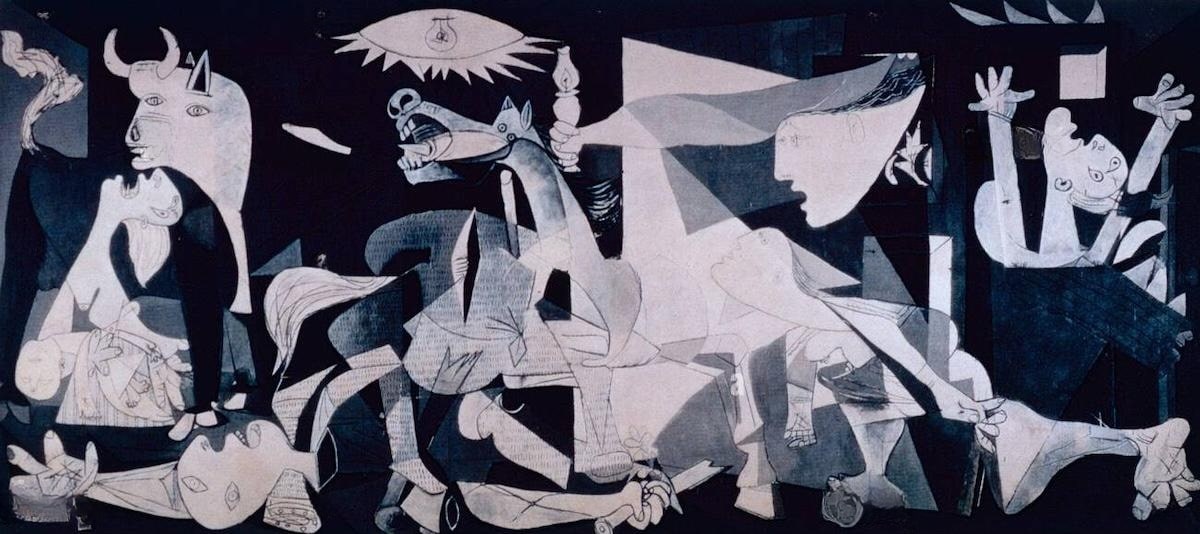
Basquiat was born in Brooklyn in 1960 to a Haitian father and a mother of Puerto Rican descent. His mother, Matilde, encouraged his interest in art and enrolled him as a junior member of the Brooklyn Museum. Among his favourite childhood memories, he later recalled, was seeing Picasso’s Guernica, then on long-term loan at the Museum of Modern Art. Long before SAMO made his words familiar on the walls of Lower Manhattan, Basquiat was already spending time in New York’s museums, looking closely at the work of artists who would matter to him for years.
By the time he was painting professionally, the languages of museums, newspapers, advertising and music were all available to him. He could put a name from jazz history next to a line that sounded like a headline, or use a diagram from an anatomy book alongside a figure he had invented. Our article on how Picasso influenced Basquiat looks more closely at that early familiarity with art history. In New York, it sat alongside an equally attentive reading of the city around him.
SAMO and the art of being read in passing
Basquiat and Diaz developed SAMO together. Their phrases often sounded like fragments of advertising or announcements from an organisation that didn’t exist. The familiar tone gave the writing a way in, but the words themselves could be sceptical, funny or difficult to pin down. Writing near the galleries and businesses of SoHo put those messages in front of people accustomed to being told what to buy or what to pay attention to. SAMO borrowed some of that authority without offering anything so straightforward as a product.
The experience helps explain why words in Basquiat’s paintings can be so assertive even when their meaning is uncertain. Some are repeated; others are crossed out just enough to make us work harder to read them. The difference is that in a gallery, there is time to go back. A phrase that might have caught someone for a second on a wall can take on several meanings when it sits beside a figure or another line of writing. That’s one reason the paintings reward a second look even after the words themselves have been deciphered.
From the Times Square Show to SoHo
Basquiat exhibited in the Times Square Show in 1980, a group exhibition organised by Colab and Fashion Moda in a vacant building near Seventh Avenue and 41st Street. The setting tells us something about how the city’s art scene worked. Artists could show outside a conventional gallery, and work that might have been kept apart elsewhere could be seen together. The following year, Diego Cortez included Basquiat in New York/New Wave at P.S.1 in Long Island City, where dealers including Annina Nosei encountered his work.
The shift into galleries gave him access to different materials and collaborators. One result was the 1982 Anatomy portfolio, which Nosei published and Jo Watanabe printed. In Femur, the bone is isolated against a dark ground, with little to compete for attention. It’s a useful work to put beside the denser paintings of the same years. Basquiat’s New York was crowded with information, but he knew how to make an image by leaving almost everything else out.

New York on the canvas
In New York, New York (1981), Basquiat used oil, acrylic and spray paint in a work made as his career was moving from downtown exhibitions to an international audience. In Mecca (1982), the city appears through one of its best-known buildings. The Empire State Building sits beneath a crown, while the word Empire appears in quotation marks. Basquiat gives us enough to recognise the skyline, then makes the building’s name sound like a claim someone has made about the city.
His relationships with other artists belong to this history, too. Keith Haring was developing a different way of addressing the public through his subway drawings and symbols, while Andy Warhol would become both a collaborator and Basquiat’s landlord at 57 Great Jones Street. The encounters mattered, but Basquiat already had a way of seeing New York before either artist became part of his story. Mecca is a good example of how much he could make of something that millions of people had looked at before him.
The New York he heard
The city’s music scene gave Basquiat another way to work. In 1979 he co-founded the experimental band Gray with Michael Holman. In 1983 he produced Beat Bop, a record by Rammellzee and K-Rob, and designed its sleeve. A record cover reached people through a different route from a painting. It could travel with the music, and someone might spend time with Basquiat’s drawing without ever setting foot in one of the galleries showing his work.
His interest in jazz was equally particular. Horn Players (1983) pays tribute to Charlie Parker and Dizzy Gillespie, whose names and instruments become part of the composition. In King Zulu (1986), he drew on the image of Louis Armstrong at the 1949 New Orleans Carnival. It would be easy to say that the paintings look improvised, but the people and references Basquiat chose were specific. He was paying attention to the history of the music, including how the musicians were presented and what audiences expected them to be.
The city he took with him
Some of the clearest evidence of New York’s influence appears in a painting Basquiat made after leaving it. He painted Hollywood Africans in Los Angeles in 1983, depicting himself with Rammellzee and Toxic, two friends who had travelled from New York. Around them are words that point to the limited roles American entertainment had historically offered Black performers. The three men are in Hollywood, but they come to it from a scene in which they were already making records, paintings and images of their own.
That’s why New York matters to Basquiat’s art even when it isn’t the subject. It gave him several kinds of audience, from the passer-by in SoHo to the person turning over a record sleeve or standing in front of a painting. He understood what each audience expected to see and used that familiarity to show them something they might otherwise have missed.
Explore Jean-Michel Basquiat prints for sale or contact our team at info@alexyellop.com for advice on selling a Basquiat print.