
Andy Warhol has been a fixture of the auction market for decades, with his screenprints appearing regularly in editions sales and his major paintings commanding some of the highest prices in post-war art. His auction record stands at $195.04 million, set by Shot Sage Blue Marilyn at Christie’s New York in 2022, but the works that follow it show how much of his market extends beyond the celebrity portraits for which he is best known.
We explore the ten Warhol paintings that have fetched the most at auction, looking at the works themselves and the sales that established their place at the top of his market.
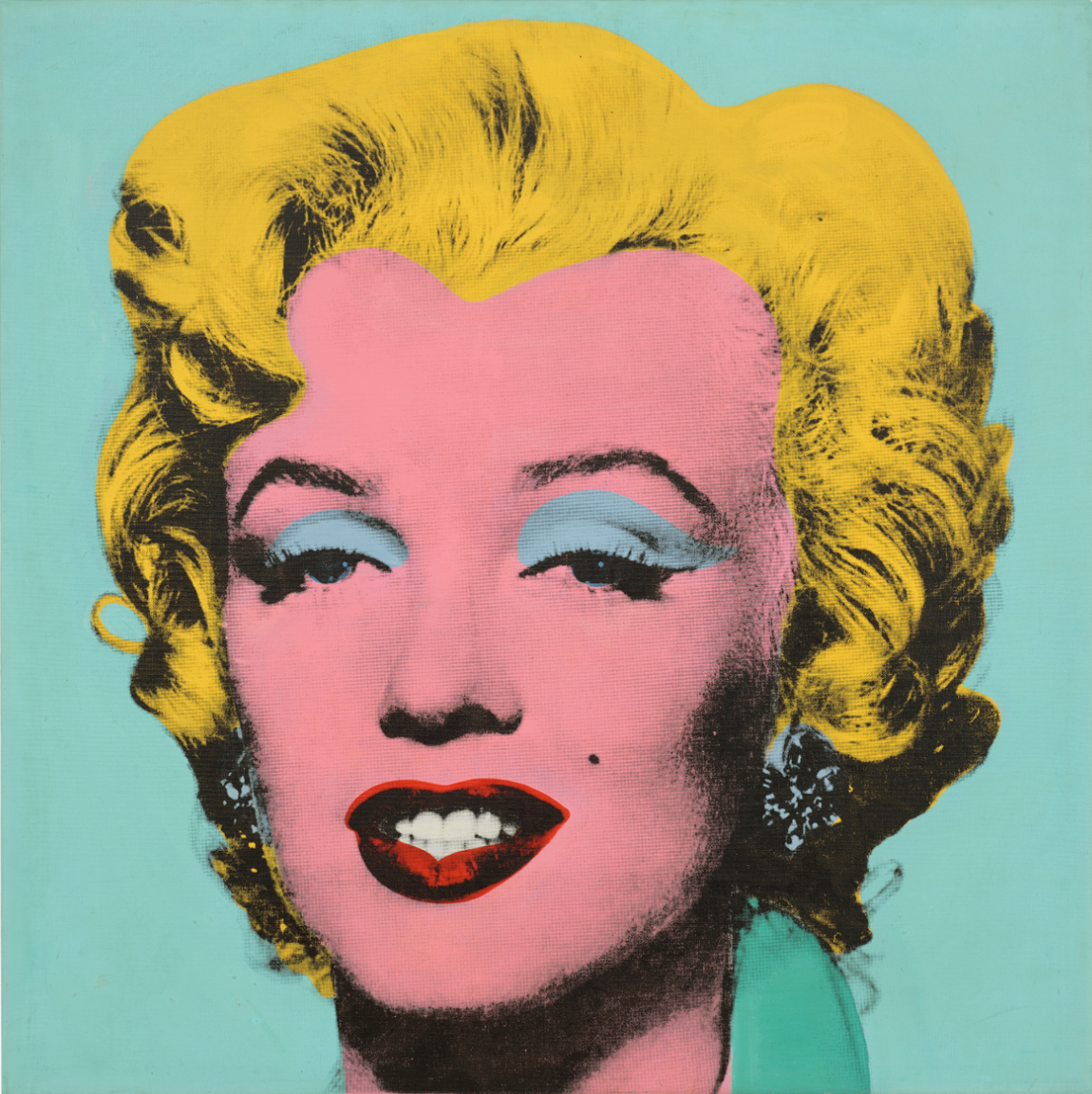
1. Shot Sage Blue Marilyn (1964) — $195.04 million
Christie’s New York, May 2022
Warhol began working with a publicity photograph from Marilyn Monroe’s film Niagara in 1962, the year she died. In this 1964 painting, the sage-blue background sets off the yellow hair, while the red of her lips sits just apart from the photographic image. It’s an unusually direct portrait for an artist so closely associated with repetition. There’s only one Marilyn on the canvas, and the whole picture rests on what Warhol did with that face.
The painting came to auction from the collection of Thomas and Doris Ammann and surpassed Warhol’s previous record by nearly $90 million. It also shares its source photograph with the Marilyn Monroe screenprints Warhol published in 1967. In the portfolio, the photograph becomes the constant across ten different colour combinations, making it possible to see how much a change of palette can alter the character of the same face.
2. Silver Car Crash (Double Disaster) (1963) — $105.445 million
Sotheby’s New York, November 2013
Warhol repeats a photograph of a wrecked car across the left-hand canvas and leaves the right-hand canvas silver and empty. After the crowded panel, the blank one can feel like a release, although it gives the viewer nowhere else to go. The eye returns to the crash and starts to notice how differently the same photograph comes through in each impression.
The space Warhol leaves empty is what distinguishes this work from the other crash paintings in the ranking. He gives the absence of an image as much room as the image itself, so the second panel changes how we look at the first without adding anything to the scene. The painting set Warhol’s auction record in 2013 and held it for nearly nine years.

3. White Disaster [White Car Crash 19 Times] (1963) — $85.35 million
Sotheby’s New York, November 2022
The crash photograph appears nineteen times in White Disaster, though some impressions are clearer than others. The eye keeps looking for a version that might make the scene easier to understand, only to be sent back into the sequence. At more than three and a half metres tall, the painting gives a press photograph a scale that makes it difficult to take in at a glance.
Unlike Silver Car Crash, there is no separate panel to interrupt the sequence. Instead, the image fades and returns within the painting itself. It came to auction six months after the Marilyn record, having spent more than twenty-five years in the same collection. That two such different paintings could achieve those results in the same year gives a good sense of the range at the top of Warhol’s market.
4. Triple Elvis [Ferus Type] (1963) — $81.925 million
Christie’s New York, November 2014
The gun, the stance and the costume come from publicity for the Western Flaming Star. Warhol repeats Elvis three times against silver, allowing the figures to overlap like successive frames caught on the same screen. The gun points towards the viewer, but the overlapping outlines make the figure seem less solid than the pose suggests.
Audiences already knew Elvis from records, television and film, so Warhol needed very little of the original photograph to summon the whole celebrity. The 2014 sale paired Triple Elvis with Four Marlons, giving bidders a rare chance to see two of his large Hollywood paintings in the same auction. Together they fetched more than $151 million.
5. Green Car Crash (Green Burning Car I) (1963) — $71.72 million
Christie’s New York, May 2007
The source is a press photograph, but the bright green takes it a long way from the news page. The colour catches the eye before the scene has fully registered. By the time we understand what we’re looking at, the painting has already done what an advertisement is designed to do: made us stop.
The sale more than quadrupled Warhol’s previous auction record. It also established the importance of the Death and Disaster paintings at the top of his market well before either of the two higher-priced crash works came to auction. Of the three, Green Car Crash makes the most immediate use of colour, putting one of Warhol’s most familiar devices to work on a subject far removed from his celebrity portraits.

6. Four Marlons (1966) — $69.605 million
Christie’s New York, November 2014
Warhol took the image of Marlon Brando in a leather jacket from The Wild One, the film that helped make that look shorthand for rebellion. He concentrates the four impressions on one side of the painting and leaves much of the linen bare. The image is familiar enough to carry the whole composition, even though it occupies surprisingly little of it.
Set beside Triple Elvis, which sold in the same evening auction, Four Marlons shows how differently Warhol could handle two subjects with much in common. Elvis seems to move across the painting, while Brando stays put in a tight block of images. Both stars came to Warhol through film publicity, but one looks like a sequence and the other like the same photograph posted repeatedly in a single spot.

7. Men in Her Life (1962) — $63.3625 million
Phillips de Pury, New York, November 2010
The photograph comes from Life magazine and shows Elizabeth Taylor with her husband Mike Todd, alongside Eddie Fisher and Debbie Reynolds. Taylor later married Fisher, giving the public a reason to look again at a picture that had originally recorded a social occasion. The photograph hadn’t changed, but almost everything readers brought to it had.
Warhol repeats the group in black and white, letting the image vary in clarity across the canvas. In his better-known portraits of Taylor, her face is enough to hold our attention. In Men in Her Life, recognising her is only the beginning. We look from one person to the next because we know what happened after the photograph was taken, and that knowledge turns an otherwise ordinary scene into something worth scrutinising.

8. Race Riot (1964) — $62.885 million
Christie’s New York, May 2014
Warhol worked from Charles Moore’s photographs of police using dogs against civil rights demonstrators in Birmingham, Alabama. Across four panels, the images appear in red, white and blue, bringing the colours of the American flag into contact with what the photographs show. The historical title is worth pausing over, since the violence depicted is being directed at demonstrators by police.
The photographs were already made to be seen by a wide audience. What Warhol changed was the amount of space and time they could occupy. A reader could turn the page; a viewer standing in front of the painting has to decide how long to look. The result is one of the clearest examples in the ranking of Warhol’s interest in what happens to a troubling image once it enters everyday circulation.

9. Sixty Last Suppers (1986) — $60.875 million
Christie’s New York, November 2017
Warhol worked from a reproduction of Leonardo da Vinci’s Last Supper, repeating it sixty times across a canvas nearly ten metres wide. From a distance, the arrangement can look like a pattern. Closer up, the familiar gathering becomes visible in each rectangle, though the eye is constantly being drawn to the version next to it.
For Warhol, who was raised Catholic, the image had a different significance from a soup label or a publicity still. It was also a picture many people already knew through copies, long before they had any chance to see Leonardo’s mural in Milan. That combination made it a particularly apt subject for his late work. The painting asks how much of an image’s meaning survives when it has been copied so often that recognition comes before a proper look.

10. Double Elvis [Ferus Type] (1963) — $53 million
Christie’s New York, May 2019
Two impressions of Elvis are enough to unsettle the familiar publicity pose. The second follows the first like an afterimage, and the space between them changes the rhythm of the picture. Seen beside Triple Elvis, it shows how much Warhol could do by changing the number and placement of the figures while keeping the source photograph the same.
Warhol made several Elvis paintings from that image, which is why the title alone won’t identify a particular auction result. The $53 million sale belongs to the painting Christie’s sold in 2019. A different Double Elvis [Ferus Type] came to auction at Christie’s in May 2026, a useful reminder to check which version actually sold before comparing prices.

What these records tell us about Warhol’s market
The best-known image sits at the top, yet three of the five highest prices went to paintings of car crashes. Race Riot and Sixty Last Suppers widen the picture further. Recognition helps explain the demand for Warhol, but it doesn’t tell us why one painting sells for more than another. The way he handled the image, the scale of the work, its exhibition history and how often it has come to market all make a difference.
For collectors of Warhol’s prints, the same attention to the individual work matters. A 1967 Marilyn screenprint shares its source photograph with the record-setting painting, but recent sales of the same colourway in comparable condition offer a more useful guide. An individual impression, a trial proof and a complete portfolio each call for different comparisons. Our guide to collecting Andy Warhol prints explains what to look for.
Explore Andy Warhol prints and paintings for sale, or contact our team at info@alexyellop.com for advice on selling a Warhol artwork.