
A woman gives a reluctant answer over the telephone, a man peers through a peephole, and a nurse glances at something beyond the frame. Roy Lichtenstein built some of his most celebrated paintings around these small vignettes of everyday life. In the comics he drew on, a hesitation or a sideways glance helped move the story along; enlarged and held in place, it became something worth looking at in its own right. We recognise the moment even when we know nothing about the people in it.
All three paintings went on to break Lichtenstein’s auction record, part of a run that culminated in the $95.4 million sale of Nurse at Christie’s in 2015. By then, the dots and outlines he had borrowed from American commercial printing had become an international shorthand for Pop Art, familiar from advertising and graphic design as well as museum walls. The appeal of his paintings reaches beyond those first comic book canvases. In 2020, bidders in New York and Hong Kong competed for Nude with Joyous Painting, made in 1994; six years later, Anxious Girl, painted three decades earlier, fetched almost exactly the same price.
We explore the ten Roy Lichtenstein paintings that have fetched the most at auction, from those early scenes of private life to a Picasso portrait recast in Pop and the late nudes. Nurse still holds the auction record, while the reported $165 million sale of Masterpiece took place privately.
1. Nurse (1964) — $95,365,000
Christie’s, New York, November 2015
The white cap tells us what she does, but it gives little away about what’s happening. The nurse looks off to one side, her lips parted as though she has just seen or heard something. Lichtenstein leaves whatever caught her attention outside the frame, so a glance that might have occupied a second in a comic becomes the whole subject of the painting.
The work passed through the collections of Leon Kraushar, Karl Ströher and Peter Brant before selling at Christie’s in 2015. Its price put it more than $39 million ahead of the previous Lichtenstein auction record, set by Woman with Flowered Hat two years earlier.

2. Woman with Flowered Hat (1963) — $56,123,750
Christie’s, New York, May 2013
The collector Morton Neumann owned Picasso’s portrait of Dora Maar and sent Lichtenstein a reproduction. Lichtenstein kept the fractured features and elaborate hat, turned the hair blonde and gave the face the pink dots he used for his comic book heroines. Picasso’s portrait is still recognisable, but Dora Maar suddenly looks as though she might belong in one of Lichtenstein’s romance pictures.
Working from a reproduction was part of the point. Lichtenstein treated a Picasso that people might know from a book or magazine with the same freedom he brought to a panel from a comic. The painting set his auction record in 2013, a position it held until Nurse came up for sale.

3. Nude with Joyous Painting (1994) — $46,242,500
Christie’s, New York, July 2020
When Lichtenstein returned to romance comics in the 1990s, he began undressing women who had been clothed in the original illustrations. It was a way of revisiting the imagery that had made him famous while taking on the history of the painted nude. In Nude with Joyous Painting, the picture on the wall gives the eye somewhere else to go, even as the cropped figure keeps drawing it back.
The work was shown in Lichtenstein’s 1994 Nudes exhibition at Leo Castelli Gallery. More than twenty-five years later, it was the highest-priced lot in Christie’s global ONE sale. It remains his most expensive late painting at auction.

4. Anxious Girl (1964) — $46,060,000
Christie’s, New York, May 2026
Unlike several of Lichtenstein’s best-known women, the girl in this painting looks straight at us. There’s no speech bubble to explain her expression, and a slight furrow in her brow does much of the work. Without it, the picture might read as a straightforward portrait of a composed young woman in a brightly patterned dress.
Formerly owned by Horace and Holly Solomon, Anxious Girl had been in the same private collection since 1994. Its appearance at Christie’s in 2026 gave bidders a rare opportunity to compete for a painting from Lichtenstein’s breakthrough years that had been off the market for more than three decades.

5. Sleeping Girl (1964) — $44,882,500
Sotheby’s, New York, May 2012
Lichtenstein found his subject in a romance comic drawn by Tony Abruzzo, where the woman’s bowed head, raised hand and gathering tear suggest distress. He removed the hand and the tear, and the same tilt of the head became the posture of someone asleep. It’s one of the clearest examples of how much he could change a scene by taking things away.
Beatrice and Philip Gersh acquired the painting from Ferus Gallery in 1964, the year it was made. It remained in their collection for almost half a century before setting a new auction record for Lichtenstein at Sotheby’s in 2012.

6. I Can See the Whole Room!...and There’s Nobody in It! (1961) — $43,202,500
Christie’s, New York, November 2011
A man peers through a circular opening in a nearly black canvas and announces that there’s nobody on the other side. The joke depends on where we stand: we can see him looking out, but he can’t see us looking back. There’s so little else in the picture that the longer we look, the stranger the arrangement becomes.
Painted in 1961 and acquired early by Emily and Burton Tremaine, it belongs to the moment when Lichtenstein was working out how far he could go with comic imagery. Its sale in 2011 broke the auction record set by Ohhh...Alright... the previous year.

7. Ohhh...Alright... (1964) — $42,642,500
Christie’s, New York, November 2010
A red-haired woman grips a telephone and gives an answer that hardly sounds like agreement. In the original romance comic, there was a reason for her disappointment. Lichtenstein gives us just her side of the call, leaving the hesitation in the words and the look on her face to suggest what has gone wrong. It’s the kind of ordinary exchange a reader might skim past on the way to the next panel. In the painting, there’s nowhere else to go.
The work set a record for Lichtenstein when it sold in 2010. A year later, I Can See the Whole Room! surpassed it by just $560,000.
8. The Ring (Engagement) (1962) — $41,690,000
Sotheby’s, New York, May 2015
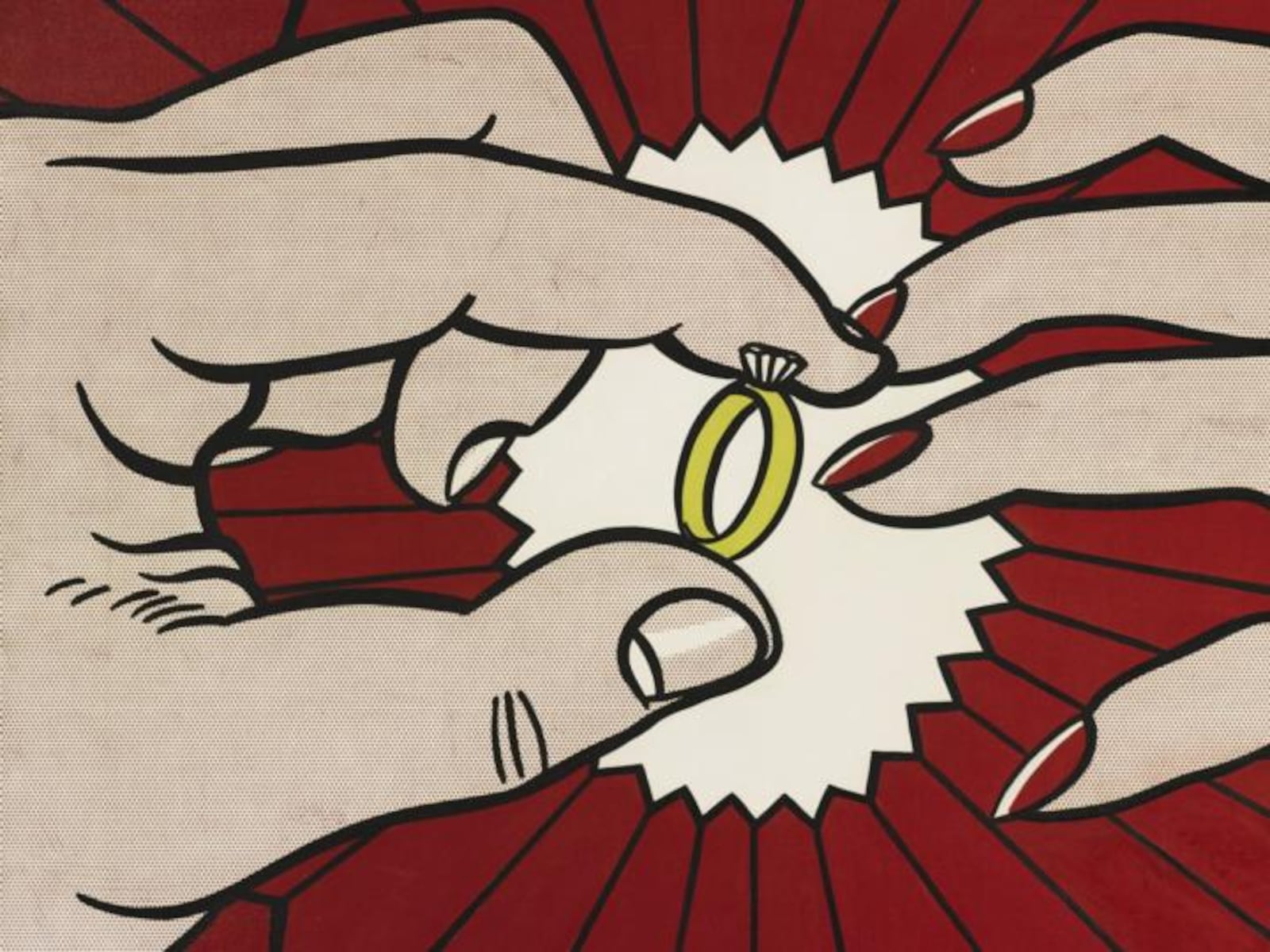
An engagement is the sort of event a romance comic might spend several pages building towards. Lichtenstein gets it across with a ring and a gesture. The diamond gets the attention that would usually go to the couple, which makes the painting feel as close to a jewellery advertisement as it does to a love story.
The work passed through the collections of Giuseppe Panza di Biumo and Stefan Edlis. It fetched about $2.2 million at Sotheby’s in 1997 and $41.69 million when it returned to the same auction house in 2015. Few paintings on this list offer such a clear comparison between two public sales of the same work.
9. Seductive Girl (1996) — $31,525,000
Christie’s, New York, November 2013
In the source comic, a woman lies awake worrying about a rival. Lichtenstein cut the text and removed her nightgown, leaving a reclining nude whose sidelong glance is harder to read. The painting makes an especially good comparison with Sleeping Girl: both start with a woman alone, and both lose the details that explained her state of mind. One becomes a picture of repose; the other keeps us wondering what she’s thinking.
Christie’s sold the 1996 painting for $31.525 million in 2013. It is a different work from the 1964 painting of the same title, a distinction that matters when comparing auction results.

10. Kiss III (1962) — $31,135,000
Christie’s, New York, May 2019
Two figures close their eyes as they kiss, while the shapes behind them make the embrace feel like a small explosion. Lichtenstein gives the scene all the drama it could have had on the page, then makes us stay with it long enough to notice how deliberately that drama is put together: the large hand at the woman’s shoulder, the firm outlines and the carefully controlled dots.
The painting sold at Christie’s in 2019 for just under the price achieved by Seductive Girl. The works were made thirty-four years apart. The early painting makes a private moment look like a public spectacle; the late one withholds the words that would tell us what to make of it. Together they show how far Lichtenstein could move within a style that became recognisable almost from the moment he arrived.

For more information on Roy Lichtenstein prints for sale, or to discuss selling a work by Lichtenstein, contact our team at info@alexyellop.com.