
Key Takeaways
- Lichtenstein's print market hit a record $16.5 million in public auction sales in 2025, nearly double 2021's total.
- Price is driven by series, subject, and rarity: core 1960s Pop imagery sits at the top of the print market, abstract or architectural series at the accessible end.
- Some of the strongest and most recognisable works come from Lichtenstein's core 1960s period with strong comic book imagery.
- Sweet Dreams Baby! and Reverie (both 1965), two of Lichtenstein's best-known early Pop images, typically trade between $100,000 and $190,000.
- Water Lilies (1992), his late-career series printed on swirled stainless steel, sits among the strongest and most distinctive works in his entire print catalogue.
- Lichtenstein's Nudes series has, in recent years, become one of his most popular bodies of work, fusing the classical portrayal of the female nude with his iconic style.
Roy Lichtenstein offered the most refined and influential take on Pop Art of his generation, narrowing the distance between fine art and the disposable, mass-produced image with a precision none of his contemporaries matched. He borrowed from comic strips and advertising and rendered them at gallery scale — dots, flat colour, printed halftone texture and all — so that the mechanics of mass reproduction, normally invisible, became as much the subject of the painting as the image itself. But that impulse was only half the story. He worked in equally deliberate conversation with art history — reworking Cézanne, Picasso, and Mondrian in his own idiom, and once observing that art since Cézanne had grown too romantic for its own good, a remark that reads almost as a mission statement for the harder-edged, more immediate vocabulary he went on to build.
This guide to collecting Roy Lichtenstein's prints covers his life and working method, his major print series, current market performance, authentication, and how to think about acquisition across three collector levels.
Who Was Roy Lichtenstein
Roy Lichtenstein was born in New York City in 1923. He studied art at Ohio State University, earning both his undergraduate and master's degrees there after a period of wartime service, and spent much of the 1950s teaching and painting in a loosely Abstract Expressionist style that gave little indication of what was coming next.
The shift arrived around 1961, when he began painting directly from comic strips and advertising imagery — Look Mickey, based on a children's book illustration, is generally credited as the turning point. Within a year he had developed the visual approach that would define his career: hand-painted reproductions of Ben-Day dots, the mechanical printing pattern used in commercial colour reproduction, rendered at a scale and precision no printing press could match. His first solo show of this new work, at Leo Castelli Gallery in 1962, sold out before it opened.
Lichtenstein treated printmaking as a continuation of his painting practice rather than a secondary output, working closely with master printers at studios including Gemini G.E.L. and, later in his career, with publisher Donald Saff at Saff Tech Arts on experimental projects that pushed the medium into new material territory. He married his second wife, Dorothy Herzka, in 1968, and the couple lived in Southampton, New York, from 1970 until his death in 1997. Dorothy Lichtenstein now serves as president of the Roy Lichtenstein Foundation, which maintains the artist's catalogue raisonné and authentication resources.
How Lichtenstein Worked
Lichtenstein's central technique involved a kind of double translation: he took an image that had already been mass-produced once — a comic panel, an advertisement, a fragment of a Cézanne or a Picasso — and rebuilt it by hand using the visual vocabulary of commercial printing. Ben-Day dots, flat primary colour, and heavy black outlines gave every canvas the look of mechanical reproduction, even though each dot was placed individually, often with the aid of a hand-cut metal stencil. That tension between mechanical appearance and manual labour sits at the centre of his work's ongoing relevance to questions of authorship and originality, not simply a stylistic choice.
His printmaking followed the same logic. Because his paintings already borrowed the language of the printed page, moving into screenprint, lithography, and later woodcut and metal relief felt less like translating his work into a new medium and more like returning it to its source material.
Why Lichtenstein Still Matters
Lichtenstein's central premise was insisting that comic-book and commercial imagery — often discarded or denied any real cultural importance — deserved the same scrutiny as any painting in a museum, and, throughout his career, he often fused his distinct style with historical references to the artists who came before him. The dealer Ivan Karp, an early champion of Pop Art, once said every major artist falters occasionally except Lichtenstein — a reputation for reliability that has held up in his market ever since.
His paintings continue to anchor major evening sales worldwide. Nurse (1964) holds the current auction record at $95.4 million, set at Christie's in 2015, and that level of sustained demand keeps his prints — drawn from the same visual approach — firmly in view for collectors at every level.
What Drives Value
What determines how much a Lichtenstein print costs?
Series and subject. Core 1960s Pop imagery — Lichtenstein's heroines, comic-derived scenes — trades well above his later abstract and architectural series.
Medium and material. Screenprints, lithographs, and woodcuts make up the bulk of what's available; experimental formats such as the stainless-steel Water Lilies sit apart from paper-based work entirely.
State and edition. Some prints exist in multiple states with real compositional differences; earlier, better-documented states typically command a premium.
Condition and provenance affect price at every level, as with any print purchase.
His Major Print Series
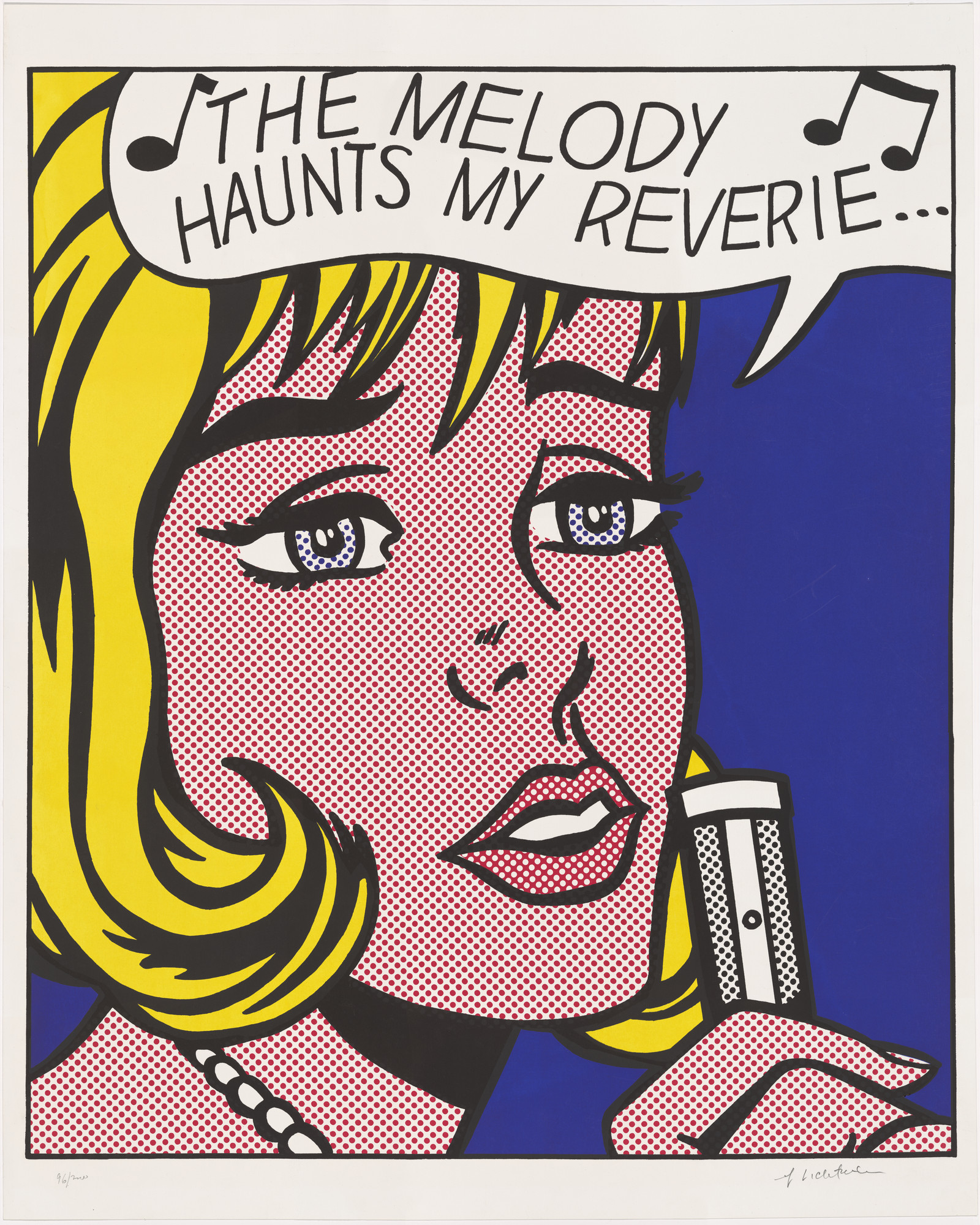
Sweet Dreams Baby! and Reverie (both 1965) are Lichtenstein's two most recognisable early Pop prints, both issued through the 11 Pop Artists portfolio though widely collected as individual images rather than as a set. Sweet Dreams Baby!, nicknamed the "pow print" for its punch-and-exclamation composition, typically trades between $100,000 and $130,000. Reverie — properly titled The Melody Haunts My Reverie, after the Hoagy Carmichael song it references — depicts a lovelorn singer mid-performance and trades higher, typically $130,000 to $190,000, with an average annual growth rate around 6%.
Water Lilies (1992) was made late in Lichtenstein's career in collaboration with publisher Donald Saff, reinterpreting Monet's water lily paintings — which Lichtenstein called his "mechanical Monets" — printed on swirled stainless steel rather than paper. It stands apart from the rest of his print catalogue both materially and conceptually, and is among the most distinctive work he made in any medium.
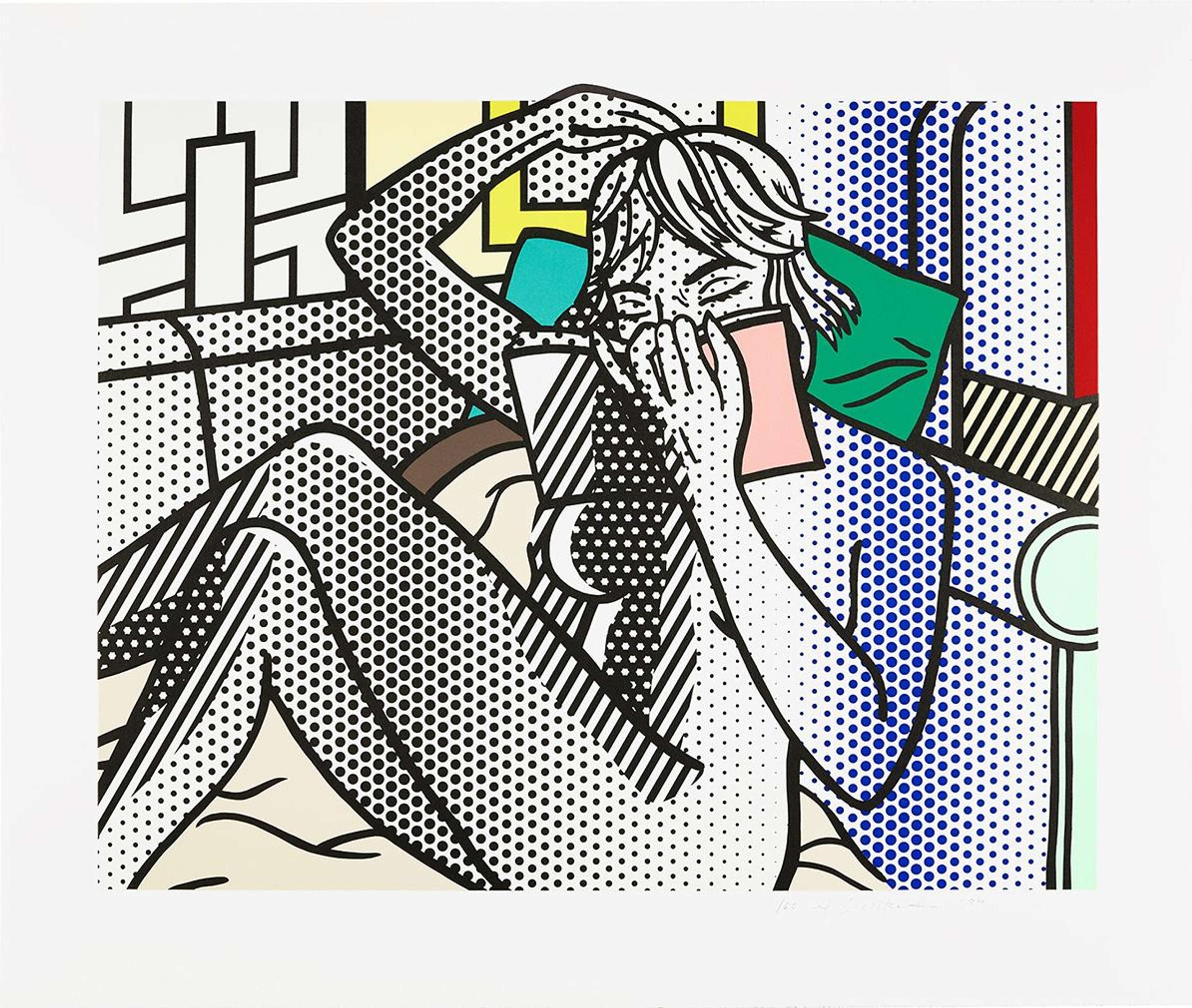
The Nudes (1990s) return to Lichtenstein's signature female figures with a more painterly hand than his 1960s work, and have produced some of the strongest paper-print results in his entire market — the clearest evidence that demand for his printmaking extends well beyond the early Pop period.
Brushstrokes (from 1965) grew directly out of Lichtenstein's early-1960s engagement with Cézanne, Mondrian, and Picasso, turning the loaded gestural brushstroke — a symbol of pure artistic authenticity in Abstract Expressionism — into a flat, mechanically rendered image, and reads as his most explicit commentary on painting itself.
American Indian Theme (1980) and other abstract or architectural series — including Imperfect, Entablature, and select Composition works — can offer the most accessible route into his printmaking.
The Market in 2026: Current Demand
Lichtenstein's print market moves in step with his painting market, and 2026 has been an active year for both: Anxious Girl (1964) reached $46.06 million at Christie's in May, reordering the artist's list of top public sale results and renewing broader attention on his 1960s Pop imagery specifically. That kind of headline result tends to lift demand across the print catalogue too, since buyers priced out of the paintings look to prints of comparable imagery and period as the next best access point.
Demand concentrates around Lichtenstein's core 1960s subjects, but sustained collector interest also runs through his abstract and architectural series, which have shown steady growth as broader appreciation for his printmaking specifically — rather than just his paintings — has widened.
Authentication and Provenance
How can I tell if my Lichtenstein print is authentic? Confidence comes from checking a few things together: the signature and edition number, typically in pencil, against genuine examples from the same period; any printer's blindstamp or publisher's mark against known records for that studio; and the piece itself against the Corlett Catalogue Raisonné of Prints, published by the Roy Lichtenstein Foundation and the definitive reference for his editioned work.
Collecting by Tier
How much does a Roy Lichtenstein print cost? His market spans an unusually wide range for a single artist — from accessible abstract and architectural screenprints to the strongest early 1960s Pop images reaching well into seven figures.
Starting a Collection (Sub-$50,000) opens directly onto Lichtenstein's most inventive formal territory: the architectural friezes of Entablature, the geometric reductions of Surrealist and the Bull Profile series, and the pared-back Landscapes and Mirrors — each pushing his Pop vocabulary toward pure abstraction — alongside individual works such as Red Lamp and Explosion, the more overtly comic-derived Shipboard Girl, and individual Brushstroke prints, which grew out of his direct engagement with Cézanne, Picasso, and Mondrian. This tier suits collectors drawn to Lichtenstein's technical range and his ongoing dialogue with art history as much as his Pop imagery, and offers documented, well-provenanced material at a genuinely accessible entry point.
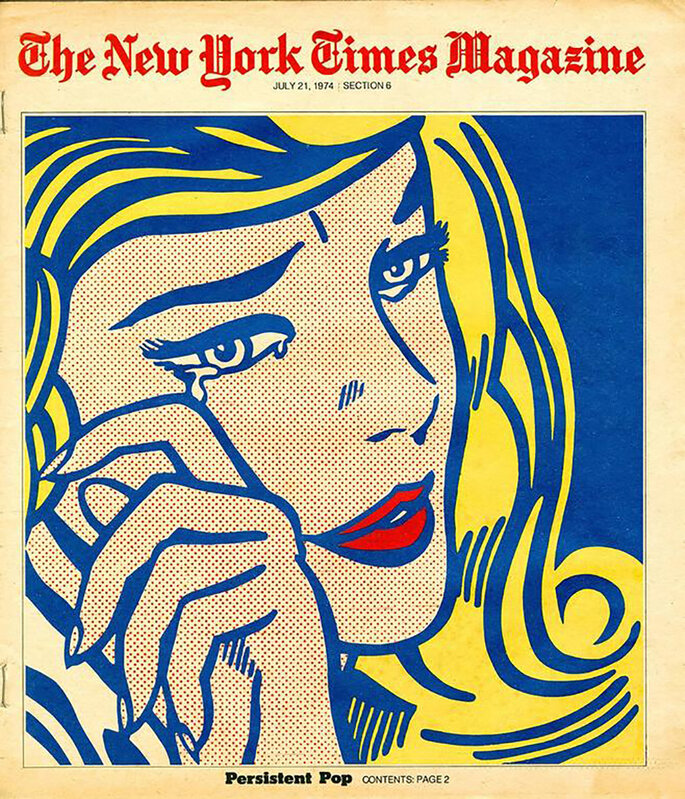
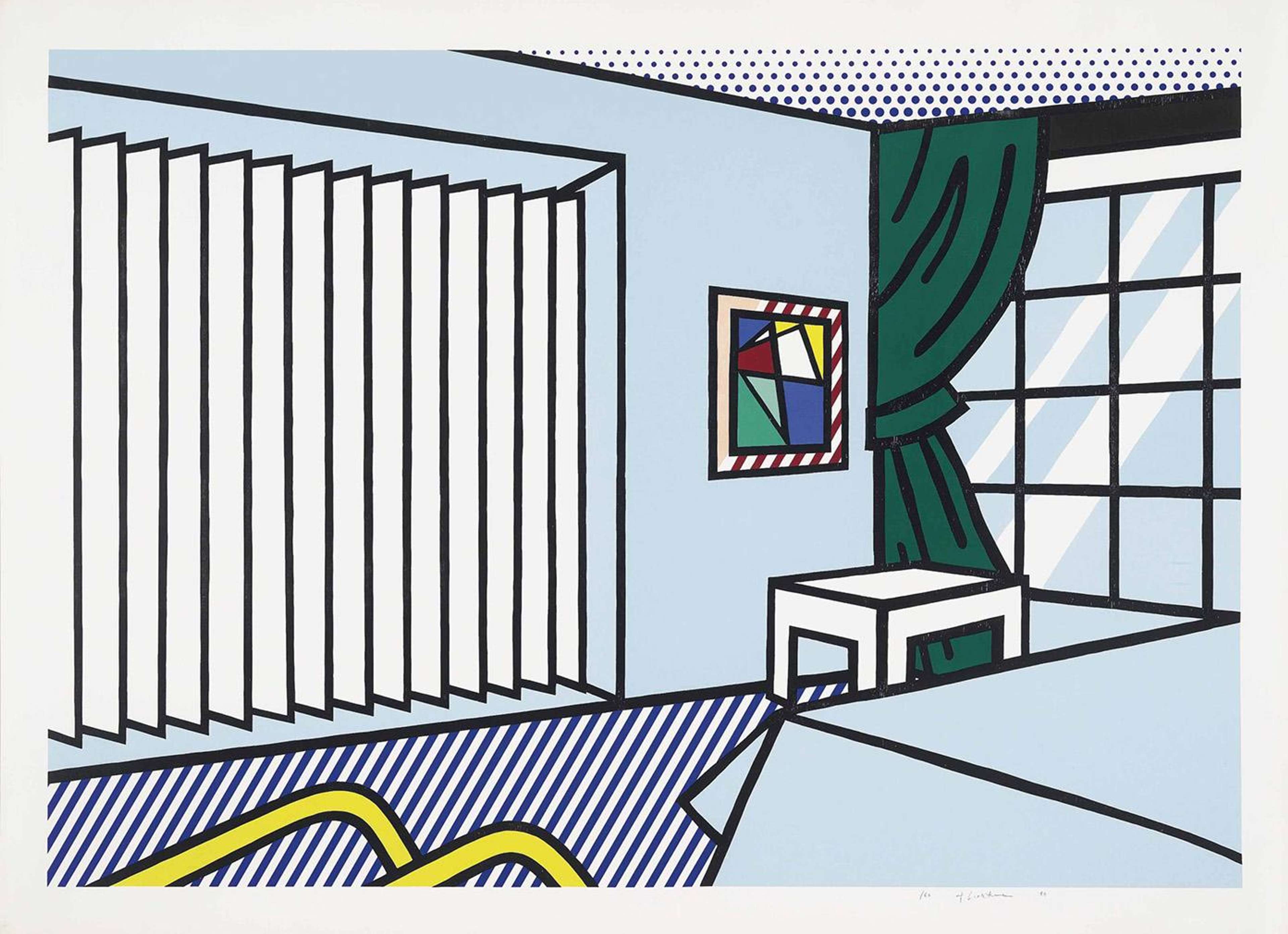
Core Collector ($50,000–$150,000) is where his best-known 1960s Pop imagery trades: Sweet Dreams Baby!, Crying Girl, and comparable single-image screenprints such as I Love Liberty, alongside landmark works from the Interior, Reflection, and Six Still Lifes series.
Established Collector ($150,000 and above) is where Lichtenstein's masterworks on paper live: Reverie, the strongest examples from the Nudes Series, and the stainless-steel Water Lilies.
Acquisition Strategies
Decade Focus concentrates specifically on Lichtenstein's 1961–1967 breakthrough period, when the Pop vocabulary that defines his reputation was first developed.
Dialogue Focus collects around Lichtenstein's engagement with art history specifically — the Brushstrokes, and works that rework Cézanne, Picasso, or Mondrian — for collectors drawn to that intellectual thread as much as the Pop imagery.
Subject Continuity follows a single recurring theme, such as his heroines, across whichever series or decade it appears in.
Quality-First sidesteps the framework entirely: buy the strongest available impression of any print that clears authentication, regardless of series or period, and let condition and rarity do the deciding rather than a theme.
Lichtenstein's Highest Auction Results
Lichtenstein's auction results for his major paintings, documented below in the top three sales, continue to set the benchmark and drive the print market.
Nurse (1964) — $95.4 million, Christie's, November 2015. A close-up portrait of a comic-book heroine, rendered in Lichtenstein's signature Ben-Day dots, and the current auction record for the artist.
Woman with Flowered Hat (1963) — $56.1 million, Christie's, May 2013. The final work in a four-painting series Lichtenstein based on Picasso, reworked entirely in his own Pop idiom.
Anxious Girl (1964) — $46.06 million, Christie's, May 2026. A recent result that reshaped the artist's top public sales, underscoring continued strength in his core 1960s period.
Is Roy Lichtenstein Still a Good Investment in 2026?
Lichtenstein's print market offers real range within a single, consistently in-demand artist — from accessible architectural screenprints to the rarest paper-based works from his core 1960s period. Whatever level a collection is being built at, the strongest move is to prioritise his core 1960s Pop imagery wherever budget allows, since it's precisely that combination — sustained institutional demand, a painting market that keeps setting new records, and a print catalogue Lichtenstein was personally, deeply involved in producing — that has delivered the strongest results across his market.
For more information on our original Roy Lichtenstein prints for sale or to sell your Roy Lichtenstein prints contact our team via info@alexyellop.com