
George Dyer was Francis Bacon’s lover and one of his most important subjects. From their meeting in 1963 until long after Dyer’s death in 1971, his face and body returned repeatedly in Bacon’s paintings. Through Dyer, Bacon explored how a portrait could convey the physical presence of someone intimately known, while also expressing the difficulty of holding that person still.
Their relationship produced some of the most compelling images in twentieth-century art. Understanding it changes how we see those works: the distorted features belong to a particular man, and the empty spaces around him acquire a personal weight.
Who Was George Dyer?
Born in 1934, Dyer came from London’s East End and had a background in petty crime. When he met Bacon, he was in his late twenties; Bacon, almost twenty-five years older, was already an internationally recognised painter.
Dyer’s appearance made a powerful impression. His sharply tailored suits, swept-back hair and substantial build gave Bacon a distinctive combination of formal elegance and physical force. Accounts of his character describe someone much less assured than that appearance suggested: sensitive, humorous and increasingly troubled by insecurity and alcohol dependence.
Dyer entered a world of exhibitions, collectors and celebrated acquaintances. He could take pride in being the subject of Bacon’s paintings, yet struggled to establish a place for himself beyond the relationship. The contrast between his visibility in the art and his uncertainty within the artist’s world became painfully pronounced.

How Did Francis Bacon and George Dyer Meet?
The familiar story has Dyer breaking into Bacon’s studio, only to find himself becoming the artist’s lover. Repeated in accounts of their relationship and dramatised in the film Love Is the Devil, it has become part of Bacon’s mythology.
Bacon also gave a more ordinary account: Dyer approached him in a Soho pub and offered to buy a drink. This is the version supported by the Sotheby’s article and the other accounts considered here.
Their relationship developed quickly. Dyer became a companion and a recurring presence in Bacon’s work, appearing in small portrait triptychs and large canvases. Although the partnership became increasingly strained, its artistic significance continued to deepen.
Why Did Bacon Paint George Dyer So Often?
Bacon found extraordinary possibilities in a familiar face. Dyer’s strong profile and recognisable silhouette provided a structure that could withstand considerable distortion without losing its identity.
In Three Studies for a Portrait of George Dyer, painted in 1963, the head changes across three small canvases. Features shift, flesh appears compressed and stretched, and the dark surroundings intensify the painted forms. Repetition allows Bacon to approach the same person through several different images, each retaining something the others cannot quite contain.
This helps explain the force of Bacon’s portraits. Recognition survives the disruption of appearance. A face can remain unmistakably someone’s even when its proportions have been radically altered.
Photography was central to this process. Bacon used photographs by John Deakin, together with memory, to develop portraits of people he knew closely. Working away from the sitter gave him freedom to change the image without the inhibitions of having that person watching.
The resulting paintings combine observation with recollection. They convey the experience of knowing someone over time, through changing expressions, gestures and moods.
What Do Bacon’s Paintings of Dyer Reveal?
Portrait of George Dyer in a Mirror, painted in 1968, offers a particularly revealing example. Dyer sits in a revolving chair opposite a mirror, his body and face subjected to the distortions characteristic of Bacon’s work.
The reflection complicates the picture. Although divided by a strip of light, it preserves a more recognisable profile than the figure before it. The mirror offers another version of Dyer, creating a tension between the body occupying the room and the image returned to it.
There is no need to assign a fixed psychological meaning to every element. The painting’s power lies partly in its refusal to resolve these different appearances into a single, stable likeness.
Across Bacon’s figure works, chairs, platforms and spare interiors give bodies a precise location. Against these controlled settings, the flesh appears exceptionally unstable. In the Dyer paintings, that tension becomes especially intimate: the figure has both an immediately recognisable identity and a troubling physical uncertainty.

How Did Dyer’s Death Change Bacon’s Art?
Dyer died in Paris in October 1971, shortly before the opening of Bacon’s major retrospective at the Grand Palais. His death from an overdose brought a devastating private loss into direct proximity with one of the artist’s greatest public achievements.
Bacon continued with the exhibition. In the paintings that followed, however, Dyer remained insistently present.
In Memory of George Dyer, painted in November 1971, began an extraordinary group of memorial works. Alongside Triptych August 1972 and Triptych May–June 1973, it forms the group commonly called the Black Triptychs.
In Triptych August 1972, dark openings surround the figures and seem to encroach upon their bodies. The central encounter is compressed and difficult to disentangle. The separation between the canvases adds another kind of distance: the figures occupy related spaces, but remain apart.
Triptych May–June 1973 confronts the circumstances of Dyer’s death more directly. Here, Bacon returns to an event through separate images rather than offering the reassuring continuity of a conventional narrative. The viewer encounters fragments that resist being comfortably assembled.
Dyer’s death also affected Bacon’s self-portraiture. Looking at himself became another way of approaching absence, ageing and the knowledge of his own mortality.

Why Does Dyer Matter to Collectors of Bacon’s Prints?
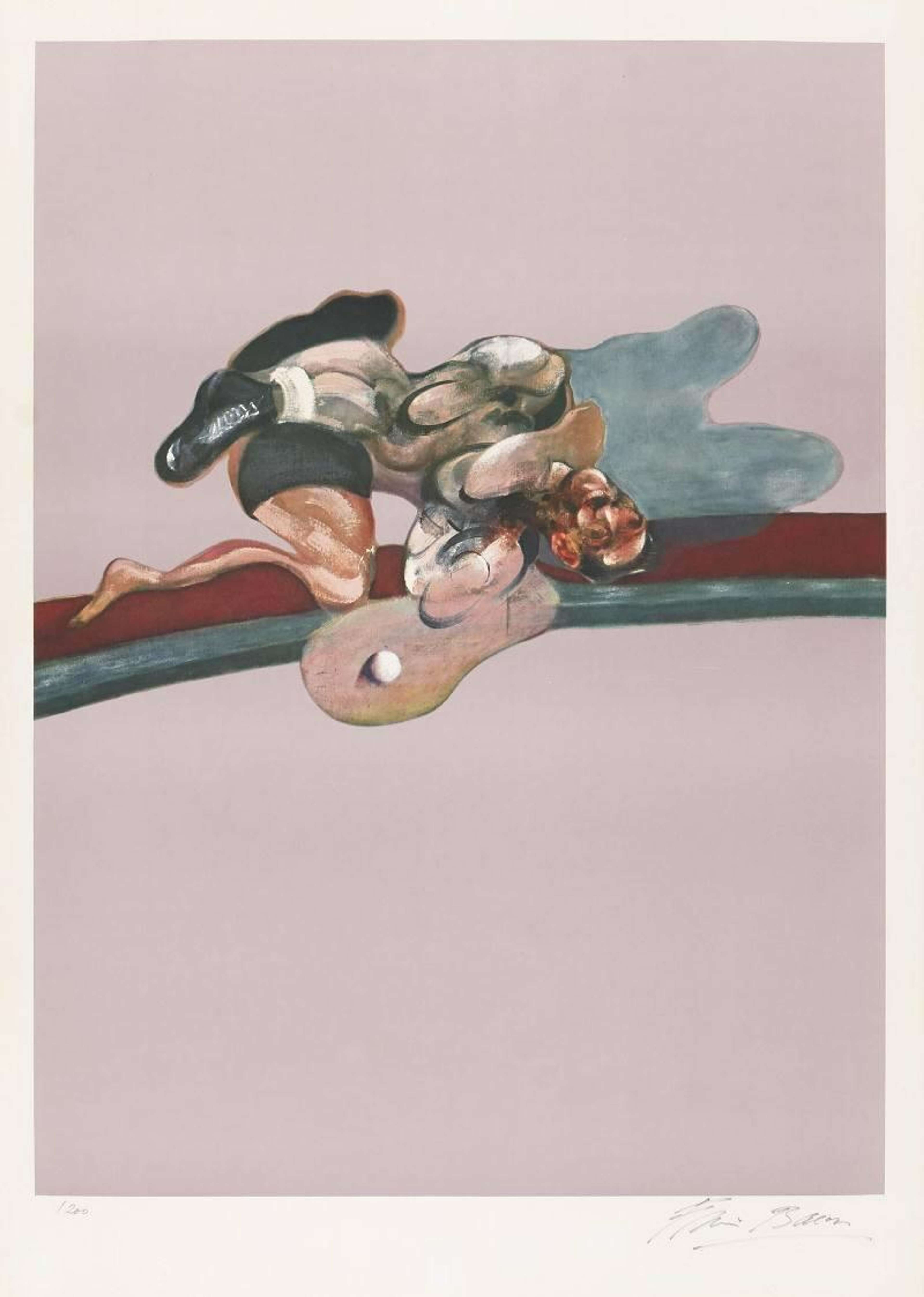
Dyer’s significance extends into Bacon’s printed editions, where images associated with the relationship reached a different scale and audience.
The 1975 Triptych in Memory of George Dyer, Left Panel translates part of the 1971 painting into an offset lithograph. Distinguishing those dates matters: one identifies the original painting, the other the later edition.
Seen independently, the panel directs attention towards the contorted figure and the surrounding expanse of colour. Knowledge of the larger composition adds context, while the individual image retains its own concentrated force.
Dyer gave Bacon a subject to whom he returned through desire, familiarity, estrangement and mourning. His importance rests in that sustained attention. Across the portraits and memorial works, a particular person remains recognisable even as his appearance changes—and remains present after his life has ended.
For more information or to buy Francis Bacon prints, please contact us. If you would like to sell Francis Bacon prints, we would be pleased to discuss your work.