
Authenticating a Jean-Michel Basquiat print requires an understanding of how the particular edition was produced, signed and published. A lifetime print carrying Basquiat’s own signature presents different evidence from an estate-authorised edition signed by his father or sisters.
The signature is important, but its meaning depends on that production history. Collectors should establish whose handwriting they are looking at, where the inscription should appear and how it relates to the numbering, publisher’s marks and supporting documentation.
A convincing assessment brings these details together with provenance and examination of the impression. Each should support the identification of the individual print.
Which Basquiat prints were made during his lifetime?
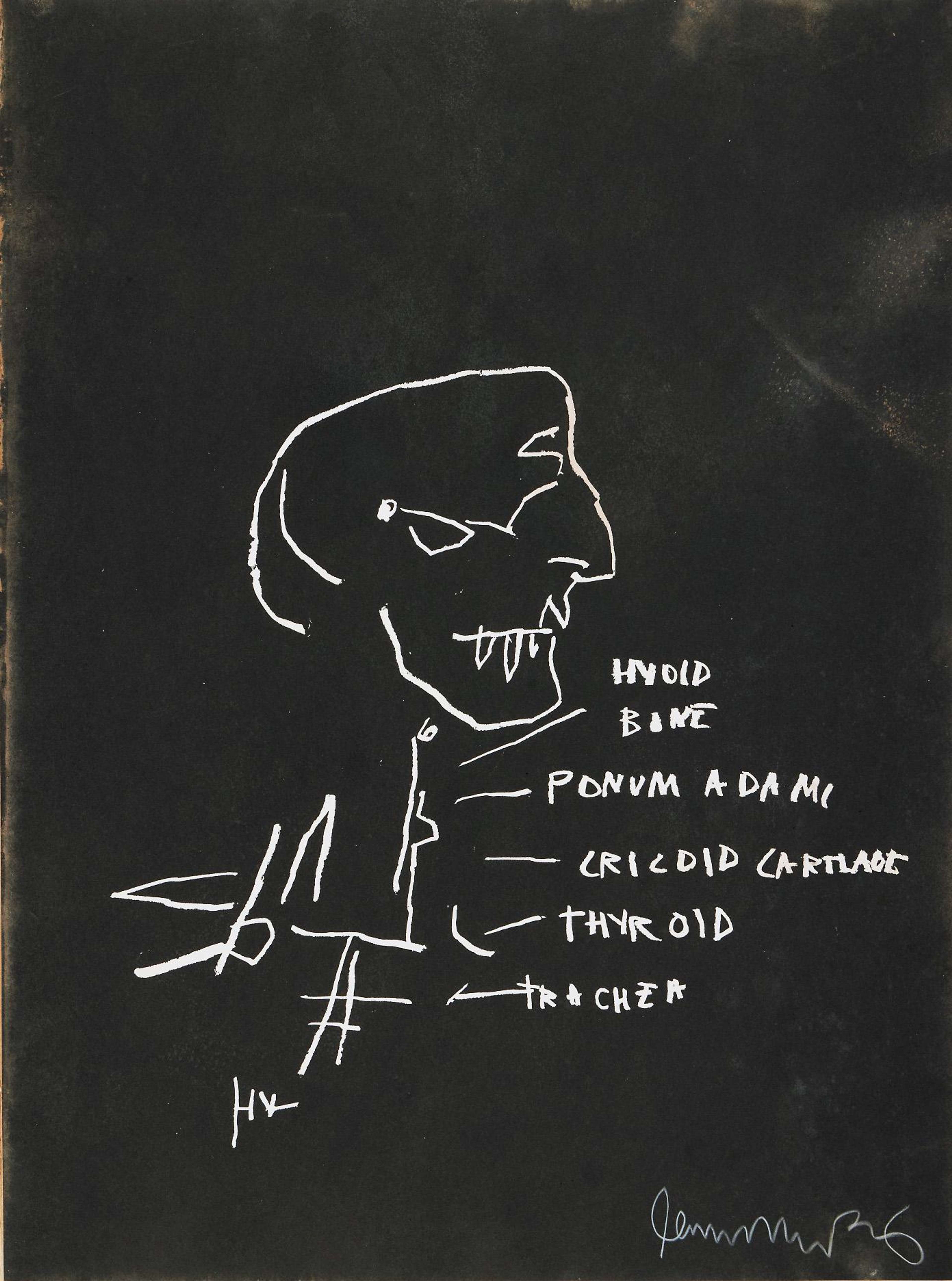
The Anatomy series, published by Annina Nosei Gallery in 1982, is an important example of Basquiat’s lifetime editions. Its anatomical imagery and handwritten terminology connect his interest in the body with his use of language.
Untitled, From Leonardo, published by New City Editions in 1983, is another lifetime project. Back of the Neck, also from 1983, combines screenprinting with hand painting.
These publications provide different reference points for authentication. Their signatures, numbering and production methods must be assessed according to the conventions of each edition.
That distinction extends to portfolios. Collectors should establish which sheets were signed and how the group was numbered, rather than assuming every sheet in a genuine portfolio must carry an identical signature.

What should Basquiat’s signature look like on a lifetime print?
There is no single signature template that can authenticate every Basquiat print. His handwriting should be examined against appropriate documented examples, with attention to the publication and period.
Documented Anatomy sets carry signatures at the lower right of the sheets and numbering on the reverse. White coloured pencil signatures are recorded on examples from the series.
For From Leonardo, documented portfolios carry numbering on the reverse of all five sheets, while signatures or initials appear on selected sheets. An unsigned sheet should therefore be assessed in the context of the portfolio and its supporting documentation.
A specialist considers the inscription’s writing material, placement, line quality and relationship to the paper. Photographs showing a broadly similar shape are insufficient. Handwriting can be imitated, while a printed signature may reproduce the appearance of an original inscription.
Basquiat’s compositions also contain names, words and dates. A name appearing within the image must be distinguished from a signature applied separately to the impression. The description should make clear which is being claimed.
Who signs estate-authorised Basquiat prints?
Estate editions can bear the signatures of Basquiat’s family members acting as estate administrators.
Earlier publications include examples signed by his father, Gerard Basquiat. Later releases carry the signatures of his sisters, Lisane Basquiat and Jeanine Heriveaux. The relevant names and signing arrangements should be checked against the specific publication.
Flexible, published by Flatiron Editions in 2016, is an example of an estate-authorised release signed by Lisane Basquiat and Jeanine Heriveaux.
On documented estate editions, administrators’ signatures can appear within an estate inscription or on a label attached to the reverse. The printed wording may identify the publication as an authorised limited-edition screenprint created from an original artwork by Basquiat.
This explains why a description such as “signed Basquiat print” needs clarification. A buyer should know whether the signature is Basquiat’s own or that of an estate administrator.
The administrator’s signature records their role in the authorised publication. It does not indicate that Basquiat personally signed or supervised the later impression.
Where are the signature and edition number usually found?
On many estate editions, the edition number appears on the front, while the estate stamp and administrator’s signature appear on the reverse. The reverse inscription may be printed directly on the sheet or included on an attached label.
Documented examples of Rinso and Flexible follow this general arrangement. The exact location should nevertheless be checked against records for the particular edition.
Lifetime prints often carry numbering on the reverse. This is documented for Anatomy, From Leonardo and Back of the Neck. Signatures may appear separately on the front, and the signing conventions can differ between sheets within a portfolio.
Collectors should therefore request photographs of both sides. An image showing only the front can leave out much of the evidence needed to identify the impression.
A framed work may conceal the reverse completely. Where inspection is necessary, professional handling can help reveal inscriptions without damaging the sheet or its mounting.
How should an estate stamp or label be assessed?
An estate stamp or label should be examined together with the signature, numbering and publication record.
Relevant details include the wording, layout, administrator’s name, date and publisher information. These should make sense for the edition being offered.
An earlier publication bearing Gerard Basquiat’s signature should be compared with appropriate examples from that release. A later edition signed by Lisane Basquiat and Jeanine Heriveaux requires its own comparison. One label design should not be treated as a universal model for all estate prints.
The relationship between the label and the object also matters. Does the documentation identify the same impression? Is any numbering consistent? Does the provenance support the claimed publication history?
A stamp or signature can be copied. Its presence provides evidence to investigate and compare, rather than an independent guarantee of authenticity.

Why do some Basquiat prints have two dates?
Two dates generally distinguish the original artwork from the subsequent print edition.
Flexible is described as 1984/2016: Basquiat created the painting in 1984, while the screenprint was published in 2016.
Similar distinctions apply when researching Basquiat’s Portfolio I and other estate publications. A listing may emphasise the source artwork’s date, the publication date or both.
This chronology is essential when interpreting a signature. A sheet manufactured after Basquiat’s death in 1988 cannot carry a signature he personally applied to that sheet. A signature reproduced as part of the image has a different status from a handwritten inscription.
Collectors should establish the print’s production date before drawing conclusions from any name or date appearing within the composition.

What should the edition number tell you?
The numbering should correspond to the documented publication, including any recorded proof categories.
A conventional fraction generally identifies the impression within the numbered edition. Other inscriptions may designate an artist’s proof, printer’s proof or hors commerce impression.
Those designations need supporting records. Describing an unusual inscription as a “rare proof” does not explain whether that proof was part of the documented publication.
Numbers should also be considered alongside the signature, estate markings and physical characteristics. A plausible fraction can be copied just as easily as handwriting.
For portfolios, the assessment should establish how the sheets relate to one another. All required images should be present, and their numbering and documentation should support the description of the group.
An assembled set of genuine impressions may have a different history from a portfolio preserved together since publication. That distinction should be explained wherever it is known.
What provenance should accompany a Basquiat print?
Provenance traces the ownership of the individual impression.
An original publisher or gallery invoice can be particularly useful when it identifies the title, edition number and purchaser. Later invoices, auction records, correspondence and photographs may extend that history.
The documents should correspond to the actual sheet. An invoice recording a numbered impression is more informative than one referring simply to a “Basquiat print”.
Auction descriptions also require careful reading. An exhibition reference may concern another example from the edition. A book illustration can support comparison without establishing that the impression being offered was itself published or exhibited.
Gaps in ownership history should be investigated alongside the remaining evidence. Their significance depends on the quality of the surviving records and how securely they identify the work.
Does a certificate of authenticity prove a Basquiat print is genuine?
A certificate should be assessed according to its issuer, purpose and connection to the impression.
Documentation supplied with an authorised publication may help establish its origin. A certificate issued later by a seller may record a transaction or an opinion. The phrase “certificate of authenticity” does not make these documents equivalent.
Collectors should check whether the document identifies the work precisely and whether its details agree with the sheet, including the edition number where recorded.
An estate authorisation inscription on the reverse should also be distinguished from a separate certificate and from historical authentication committee paperwork. Each has a different function.
The absence of a standalone certificate does not automatically invalidate an older print supported by substantial provenance and consistent physical evidence. Equally, a certificate cannot resolve incompatible materials or an unsupported signature.
Does the Basquiat estate still authenticate artworks?
The estate’s authentication committee was disbanded in September 2012 and no longer accepts applications for review.
That historical service is separate from the estate’s continued authorisation of editions and management of rights relating to Basquiat’s work.
A claim that a print is “estate authenticated” therefore needs explanation. It might refer to an authorised publication, an administrator’s signature or historical committee documentation.
The distinction matters because authorising an edition and assessing an artwork subsequently attributed to the artist are different activities. The seller’s wording should explain what evidence actually accompanies the print.

What should you gather before buying or selling?
Begin with clear photographs of the complete front and reverse. Add close details of the artist’s or administrator’s signature, edition number, estate inscription, publisher’s marks and any labels.
Record the sheet dimensions and gather invoices, certificates, correspondence and previous sale references. Ask for clarification wherever the description leaves unclear who signed the print or when it was published.
The strongest assessment explains how those details fit together. The signature must be appropriate to the edition, the impression must correspond to its publication record, and the provenance should support the history being presented.
For a broader introduction to lifetime editions, estate publications and portfolios, read our guide to collecting Jean-Michel Basquiat prints.
For information on Jean-Michel Basquiat prints for sale, or to discuss selling your Basquiat print, contact our team at info@alexyellop.com.