
A woman cries without disturbing her eyeliner. Another sings about lost love. A third fires a rifle. Decades later, women with remarkably similar faces appear naked in bright interiors, reading, thinking or passing time together.
Roy Lichtenstein’s women are among the most recognisable figures in modern art. Their blonde curls, red lips and immaculate contours have become almost inseparable from Pop Art itself. Yet familiarity can make them deceptively easy to read. The crying woman becomes a symbol of heartbreak; the nude becomes a decorative figure. Look longer, and their situations grow less certain.
Who is speaking? Who is being watched? How much freedom does a woman have inside a picture assembled from other people’s ideas about femininity?
Across Lichtenstein’s paintings and prints, these questions remain unresolved. That uncertainty gives the women a presence that survives well beyond the comic books and advertisements from which they emerged.
Why did Lichtenstein depict women this way?
Lichtenstein’s early Pop women generally began as images already circulating in popular culture. Their appearances had been shaped by illustrators, advertisers and publishers before he encountered them.
In Girl with Ball (1961), for example, he adapted a photograph from an advertisement for a hotel in Pennsylvania’s Pocono Mountains. The holiday setting offered an appealing combination of leisure, sunshine and female beauty. His painting made its artificiality harder to overlook: simplified features, emphatic outlines and a carefully arranged pose turn the woman into something close to a commercial emblem.
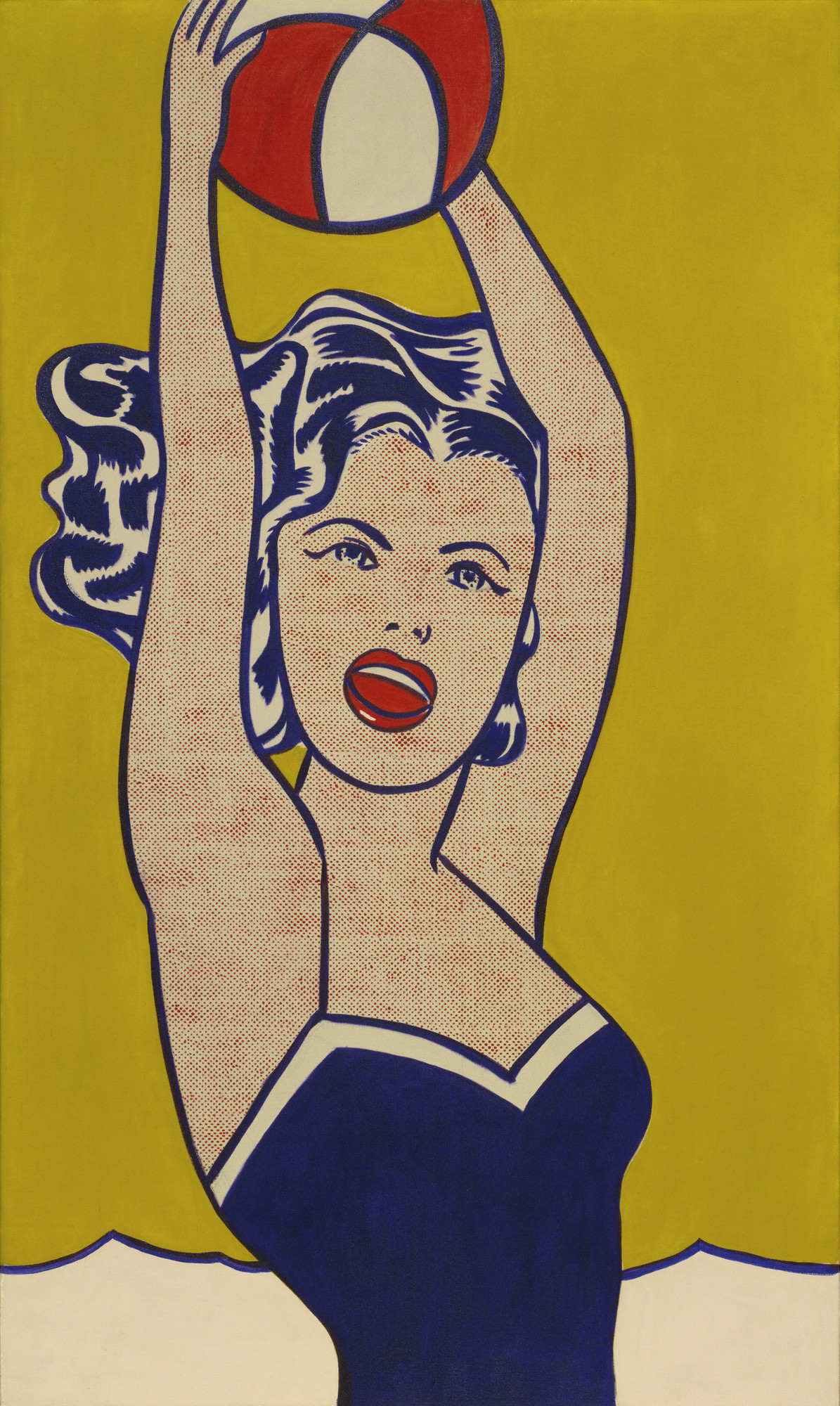
Lichtenstein understood that these images depended on conventions. A few black lines, red lips and areas of colour could communicate “beautiful woman” with extraordinary efficiency. Viewers accepted the result because they already knew the language.
His work makes that familiarity visible. The dots and contours insist that we are looking at a constructed image, even as we recognise an attractive face or respond to an expression. Our article on why Roy Lichtenstein used Ben-Day dots explores how this apparently impersonal technique became central to his art.
The ideal itself was narrow: predominantly young, white and conventionally beautiful. Bringing it into a gallery did not automatically dismantle it. Lichtenstein gave viewers an opportunity to examine its construction while continuing to benefit from its appeal.
The vignette: a story with its beginning and ending removed
A comic-book panel belongs to a sequence. Someone has said something before it; another event will follow. Lichtenstein frequently removed that surrounding narrative, leaving a moment that appears decisive without explaining precisely what has happened.
This is the peculiar power of his female vignettes. They offer enough information to invite a story, but too little to settle it.
In Crying Girl (1963), tears and a hand raised towards the face announce distress. Its cause remains outside the picture. We recognise the situation through gestures learned from films, advertisements and romance comics, then supply the missing circumstances ourselves.

The woman’s immaculate appearance complicates the encounter. Her suffering is visible, but it has been organised into an exceptionally controlled image. Even the tear becomes a graphic shape.
Does this make the emotion false? A performed or conventional expression can still move us. People routinely understand their own feelings through songs, films and familiar stories. Lichtenstein’s picture allows emotional recognition and awareness of artifice to occupy the same space.
Shipboard Girl (1965) creates a quieter uncertainty. Without a caption to direct us, the face becomes the focus of our attention. Is she expectant, reflective, troubled or simply looking? The title provides a setting, but leaves her thoughts to herself.

The absence of a complete narrative gives these women an unusual persistence. They remain caught in moments that we cannot finish for them.
Reverie: whose voice are we hearing?
In Reverie (1965), music enters the picture. The blonde woman’s parted lips, musical notation and accompanying words suggest a song, with the text referring to Stardust.
She appears to have a voice. Yet the words belong to a song already known and performed by others. Her expression, too, comes through the familiar language of the romance comic.
That layering gives the work more depth than a straightforward image of a lovelorn woman. We encounter a figure expressing herself through material that culture has prepared for her.

It is a recognisable experience. A song can articulate something we cannot quite say ourselves; its familiarity may make an emotion more personal rather than less. Reverie holds open that possibility. The woman may be performing an inherited role, but the feeling need not be empty.
There is also a distinction between hearing her and understanding her. Lichtenstein gives us the suggestion of a voice without providing the history behind it. We know the emotional register, but not the woman.
How much agency do Lichtenstein’s women have?
Agency concerns a person’s capacity to act, choose and influence events. Lichtenstein’s women complicate the question because they often dominate the image while appearing constrained by the stories available to them.
Drowning Girl (1963) makes this especially clear. Lichtenstein adapted an illustration by Tony Abruzzo, removing the boyfriend and capsized boat visible in the original comic-book scene. The woman remains alone in the water, refusing to call Brad for help.

Her refusal is a decision. It also places her in danger. The absent man continues to organise the emotional situation even after Lichtenstein has removed him from view.
It would be too simple to call her either powerless or liberated. Her resistance is unmistakable, but the alternatives offered by the picture are brutally limited.
Elsewhere, a woman’s speech can suggest a different kind of control. In Oh, Jeff... I Love You, Too... But... (1964), the unfinished sentence leaves open the possibility of refusal. An expression of affection may lead towards a separation rather than submission. The viewer arrives before the decision has been fully spoken.
These distinctions matter. A tear does not prove passivity, just as a speech bubble does not guarantee independence. The question is what choices the image allows us to imagine.
CRAK!: the woman who takes action
CRAK! (1963–64) interrupts any account of Lichtenstein’s women as exclusively romantic victims.

Here, the female figure handles a rifle. The composition directs attention along the weapon, while the explosive title makes the act of firing almost audible. Her presence belongs to the action and authority of the war comic.
Placed beside Reverie, the difference is striking. One woman’s experience is communicated through song and longing; the other’s through a weapon and a command. Both are immediately legible because their gestures belong to established genres.
The armed woman nevertheless retains the polished appearance familiar from Lichtenstein’s other female figures. Beauty survives the change of role. Her apparent departure from feminine convention therefore raises another question: how far can she move beyond the stereotype while still being required to look the part?
CRAK! gives her force and purpose. It also reminds us that popular culture can package female aggression as efficiently as female vulnerability.
Why do the women sometimes feel like Stepford wives?
There is something faintly unsettling about the perfection of Lichtenstein’s women. Hair remains arranged, lips remain defined, and even distress rarely disturbs the clarity of the design.
The comparison with The Stepford Wives is useful here, provided the chronology remains clear. Ira Levin’s novel appeared in 1972 and the first film adaptation in 1975, after Lichtenstein’s early Pop women. This is a retrospective comparison, rather than a claim that Stepford inspired those works.

The resemblance lies in the pressure to conform to an ideal. Stepford turns the fantasy of the beautiful, compliant wife into horror. Lichtenstein’s pictures can evoke a related unease through their polished surfaces and repeated visual conventions.
The women appear almost too perfectly available to recognition. We know how to identify their beauty before we know anything about them.
Their emotions, however, complicate that perfection. Tears, uncertainty, longing and refusal suggest lives that exceed the pleasing appearance. The image may be controlled, but the situation is often uncomfortable.
This is where the Stepford comparison becomes most interesting: the flawless exterior offers little assurance that everything beneath it is in order.
Reflections on Girl: looking without full access
By the time Lichtenstein made Reflections on Girl (1990), the comic-book blonde was also an established feature of his own artistic vocabulary.

The print returns to that familiar face while placing visual interruptions across it. Bands and patterns suggest reflections on a surface between the viewer and the image.
Recognition happens quickly; a clear view proves harder to obtain.
The source figure came from the romance comic Falling in Love. Lichtenstein altered her appearance, including changing her hair from brown to blonde. The finished work therefore revisits both a popular stereotype and the image of femininity audiences had come to associate with him.
The obstructions can be read as a frustration of the viewer’s desire for easy access. We can identify the woman as a familiar type, but cannot see her without interruption. The picture draws attention to the conditions of looking.
What changed when Lichtenstein turned to the Nudes?
In the 1990s, Lichtenstein returned to the female figure through his Nudes. The women were inventions drawn from his archive of comic-book imagery, with clothed figures transformed and, in some compositions, elements from different sources brought together.
The move connects his Pop vocabulary with a much older artistic subject. The female nude had occupied generations of painters before him. Lichtenstein approached it with figures whose bodies and expressions already carried the conventions of commercial illustration.
The resulting women inhabit interiors that can feel both inviting and curiously staged. Furniture, patterns and bodies form carefully balanced arrangements. Dots sometimes cross boundaries between figure and surrounding space, making it difficult to treat the body as an isolated, solid presence.
Yet the narrative atmosphere has changed. These women are not invariably caught at a moment of romantic crisis.
In Roommates (1994), the presence of two women allows us to imagine a relationship and a shared domestic life beyond the frame. Their occupation of the same room becomes the subject of speculation.
Thinking Nude (1994) offers a different invitation. The title attributes thought to the figure without telling us its content. Her body is visible; her mind remains inaccessible.

That separation is significant. Looking at someone does not amount to knowing them.
It would nevertheless be too easy to describe the Nudes as a final liberation. Removing clothes does not remove the conventions governing how women are represented. These remain female bodies composed by a male artist and presented for viewing.
Their interest lies partly in that unresolved relationship between apparent intimacy and distance. Our article on why Roy Lichtenstein painted Nudes considers the late series in greater detail.
Are Lichtenstein’s women being celebrated or objectified?
The pictures permit both readings, sometimes simultaneously.
Lichtenstein made the conventions of female beauty conspicuous. He enlarged and isolated images whose assumptions might otherwise have passed unnoticed. At the same time, he continued to circulate those ideals in objects of considerable visual appeal.
Exposing a stereotype does not prevent an image from repeating it. Nor does recognising that stereotype cancel every emotional response to the woman depicted.
For collectors, these tensions offer a richer way to compare works. Reverie invites us to consider voice and borrowed expression. CRAK! gives a woman physical authority. Shipboard Girl withholds a clear account of her thoughts. The Nudes introduce different forms of intimacy while retaining the distance of an invented image.
Lichtenstein’s women endure because the pictures leave room for these competing responses. Their faces are familiar, but their circumstances remain incomplete. They can attract, unsettle and resist our attempts to explain them, all within a single frame.
For more information about Roy Lichtenstein prints for sale, or to discuss selling a Roy Lichtenstein print, contact our team at info@alexyellop.com.