
Yayoi Kusama uses pumpkins because they connect her art to some of her earliest experiences of comfort, humour and the natural world. Their rounded bodies and irregular shapes appealed to her long before they became internationally recognisable sculptures. Over decades, the pumpkin also proved an exceptionally versatile subject: something she could observe closely, cover with patterns, enlarge or multiply through mirrors.
Its familiarity is part of its strength. We recognise the vegetable immediately, even when Kusama makes it enormous, fluorescent or strangely animated. The subject remains approachable while carrying ideas about identity, repetition and infinity.
To understand Kusama’s pumpkins, it helps to begin with the ordinary plant that first caught her attention.

A childhood surrounded by plants
Kusama grew up in Matsumoto, Japan, in a family that operated a seed nursery. Fields, flowers and cultivated plants formed part of her daily surroundings, and drawing them became an early occupation.
The pumpkin held a particular fascination. In her autobiography, she recalled encountering one while visiting a seed-growing ground with her grandfather as a primary-school child. She described it as speaking to her, giving the encounter the imaginative intensity that runs through her recollections of childhood.
What remained important was her affection for its character. Kusama praised the pumpkin’s “generous unpretentiousness” and the sense of stability she found in it. Its appeal lay in being ordinary, substantial and slightly comical.
That attachment distinguishes the pumpkin from some of the frightening visions she described elsewhere. Her relationship with the subject was nurturing. It offered something she could return to with pleasure.
When did pumpkins first appear in Kusama’s art?
Kusama exhibited a painting titled Pumpkin in 1946, while still a teenager. The subject therefore predates her move to the United States, her involvement in New York’s avant-garde and the mirrored installations that later attracted enormous audiences.
Her early work involved sustained observation. She studied the surface, contours and small irregularities of pumpkins with considerable concentration. The vegetable was a subject through which she developed her attention to form.
Pumpkins became increasingly prominent again from the late 1970s and into the 1980s. By this stage, the subject could absorb the dots and net patterns central to her mature work.
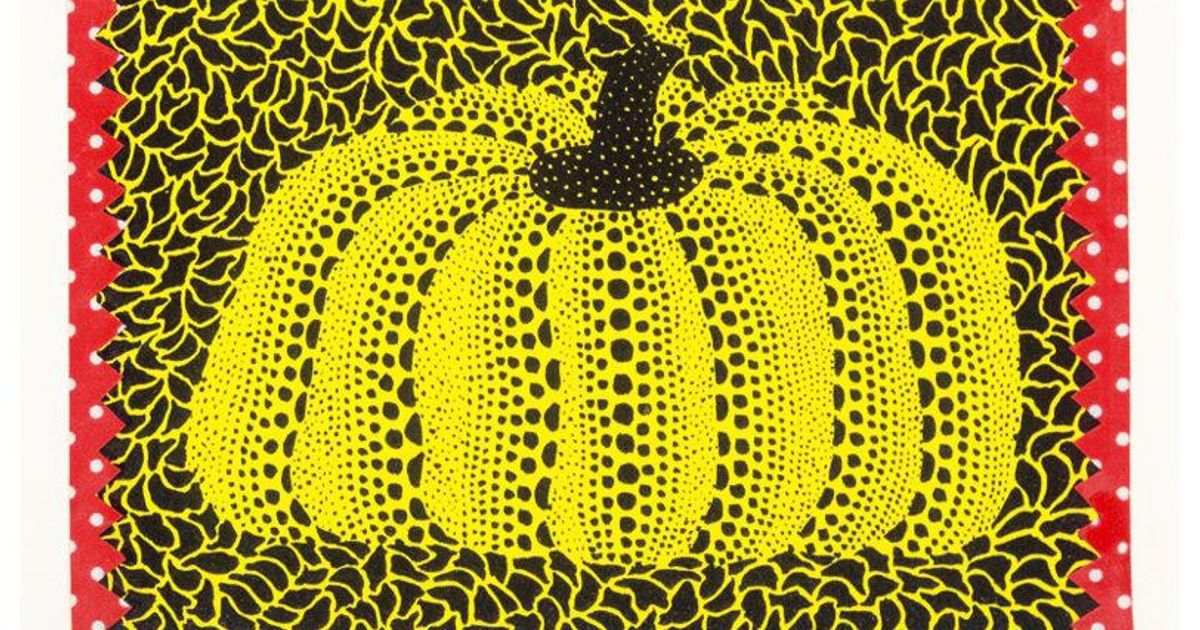
Pumpkin, 1982 shows how distinctive that combination had become. Its yellow body is covered with varied black marks, while a restless pattern fills the surrounding space. Red borders introduce another layer of colour and decoration.
The familiar vegetable already has a forceful identity, but its surface remains wonderfully irregular.
What does the pumpkin represent?
For Kusama, the pumpkin carries associations of comfort, resilience and the pleasure of being alive. She admired its humble character and the individuality of its shape.
Those qualities help explain why pumpkins can feel almost like personalities in her work. They are sturdy without appearing imposing, and their uneven proportions give them a human awkwardness. A bent stalk or swollen lobe can make one seem reserved, exuberant or faintly mischievous.
Museums have also interpreted her pumpkins as alternative self-portraits. This does not mean that each vegetable represents a particular episode in her life. Rather, the subject became a way of expressing qualities with which she identified: persistence, eccentricity and an ability to remain unmistakably itself.
The pumpkin’s emotional significance gives the work a foundation beyond its visual appeal. Its warmth comes from a relationship developed over many years.
Why does Kusama cover pumpkins with dots?
Dots give Kusama’s pumpkins their distinctive surfaces, but they also help describe their volume.
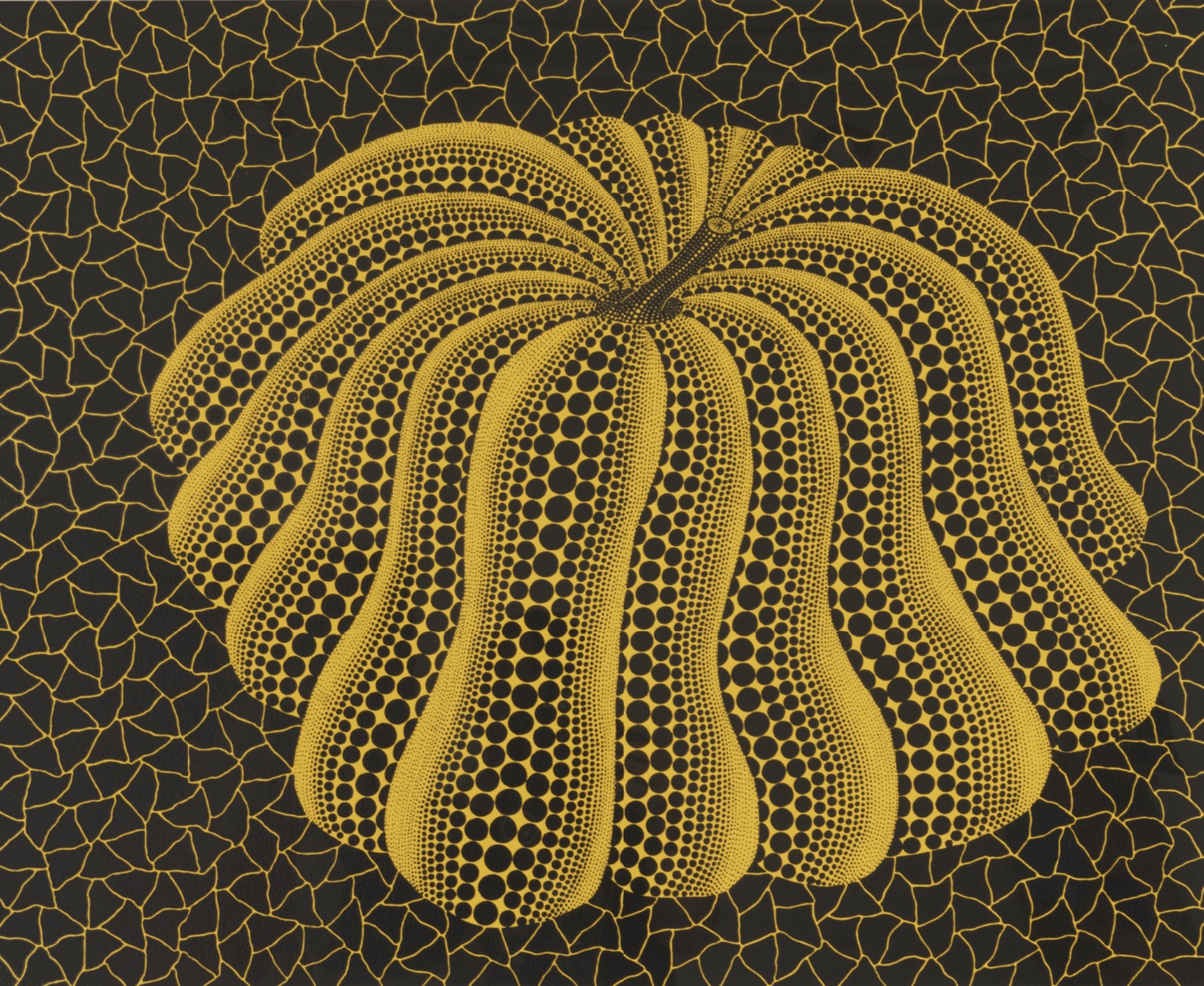
The marks change in size and spacing as they follow the ridges. Larger dots can make a section appear to swell towards us, while smaller ones gather along narrower passages. Our eyes follow these sequences around the body, reading curves through the pattern.
This is particularly effective in her prints, where a flat sheet can convey a strongly rounded form without conventional shading.
At the same time, the dots connect the pumpkin with Kusama’s wider exploration of repetition. She associated repeated patterns with the relationship between the individual and an immeasurably larger universe. Covering a recognisable object with countless marks allows that object to participate in something extending beyond itself.
The result holds two experiences together: a substantial vegetable with a clear outline, and a surface that seems capable of continuing indefinitely.
How do pumpkins connect with Infinity Nets?
Many pumpkin works place the dotted vegetable against a tightly patterned background. The contrast between the body and its surroundings is essential to their effect.
The dots follow the pumpkin’s curves, while the net-like field spreads across the remaining space. Both areas are active. The eye moves between the solid object and the dense pattern around it, making the image feel more unsettled than a conventional still life.
This connects the subject to the concerns explored in Kusama’s Infinity Nets: accumulation, repetition and the possibility of a pattern continuing beyond the limits of the artwork.
The pumpkin gives those ideas a familiar centre. We can recognise and locate it, even while the surrounding activity complicates our sense of depth.
Its accessibility helps bring the larger ideas within reach.
Napping, dancing and changing character
Returning to the same subject allowed Kusama to explore differences within it. Her pumpkins vary in proportion, posture, colour and the organisation of their surfaces.
Napping Pumpkin, 1993 gathers its lobes into a drooping, folded form. The title encourages us to read that shape as a resting body. Rows of dots trace each section, giving the vegetable a gently animated presence.
In Dancing Pumpkin, 2004, the form becomes more expansive. Its lobes sweep outward in broad, uneven curves, with the dot patterns guiding the eye around each movement.

The comparison makes the humour of the subject apparent. A vegetable can seem sleepy or energetic without acquiring a face or limbs.
It also demonstrates the range available within a repeated motif. Kusama could retain the pumpkin’s identity while changing its rhythm and emotional character.
How did pumpkins become part of the mirrored rooms?
Mirrors allowed Kusama to turn a group of pumpkins into an apparently limitless environment.
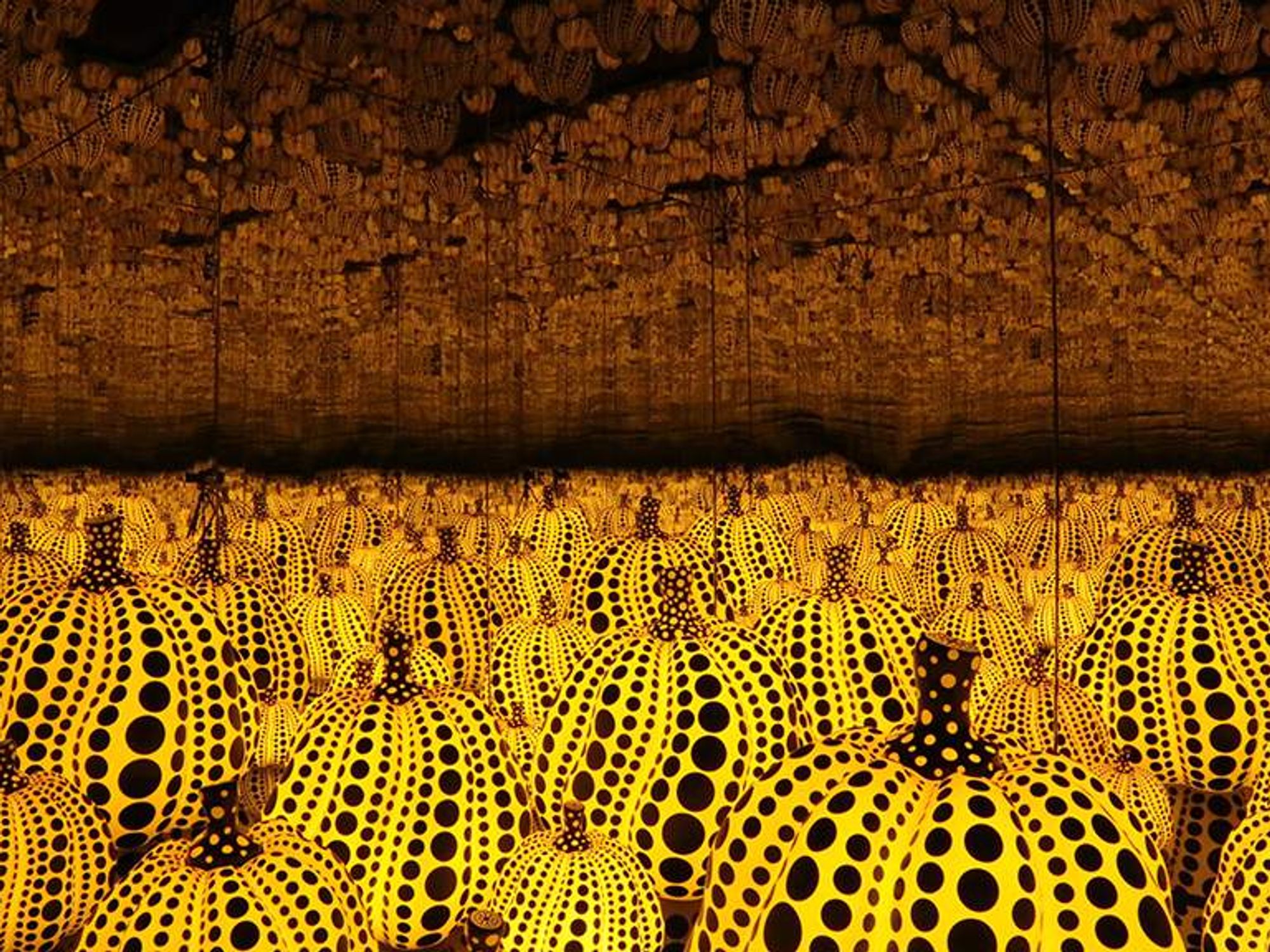
Her Mirror Room (Pumpkin), made in 1991, became the centrepiece of her presentation in the Japanese Pavilion at the 1993 Venice Biennale. Within a yellow-and-black dotted setting, a mirrored cube made the pumpkins appear to proliferate indefinitely.
The installation brought together two important aspects of her practice. The pumpkin supplied the familiar, reassuring object; reflection transformed that object into an experience of repeated space.
The Venice presentation also helped encourage international reassessment of her career. A subject rooted in her childhood occupied the centre of an exhibition affirming her importance within post-war art.
Later installations, including Infinity Mirrored Room—All the Eternal Love I Have for the Pumpkins (2016), developed the encounter further. Glowing pumpkins surrounded the viewer through repeated reflections, giving her attachment to the subject an immersive form.
Why is the Naoshima pumpkin so famous?
The yellow-and-black pumpkin first installed on Naoshima in 1994 gave Kusama’s subject a striking outdoor setting. Positioned at the end of a pier, its rounded silhouette stood against the sea and distant landscape.
That relationship between sculpture and setting is central to its appeal. The pumpkin is visually assertive, yet its organic form allows it to belong to the landscape in an unexpected way. It can appear playful, solitary or quietly monumental depending on the viewpoint.
Over time, it became closely associated with the island itself.
After the original sculpture was severely damaged during a typhoon in 2021, a newly created pumpkin was installed at the same location in October 2022. Its return demonstrated how deeply the image had entered the public’s attachment to Naoshima.
The sculpture had become more than an artwork encountered during a visit. It was part of how people remembered the place.
From a familiar vegetable to a lasting artistic identity
The pumpkin’s recognisability has helped it travel across paintings, prints, sculpture and popular culture. Yet its importance begins with Kusama’s sustained attention to a subject she loved.
Its rounded form accommodates pattern. Its irregularities invite humour. Its associations with childhood provide emotional depth. Changes in scale allow it to move from an intimate image to a public landmark without losing its character.
That combination helps explain why Kusama continued returning to it. The pumpkin gave her a dependable subject through which to keep experimenting.
Our article on Yayoi Kusama’s influence and legacy places that achievement within her wider career. For readers considering an acquisition, our guide to collecting Yayoi Kusama prints introduces the principal subjects and considerations involved in choosing a work.
For more information about Yayoi Kusama prints for sale, or to discuss selling a Yayoi Kusama print, contact our team at info@alexyellop.com.