
Ed Ruscha moved from Oklahoma City to Los Angeles in 1956 to study commercial art, and the things he encountered on the road west and in the city itself became subjects he would return to throughout his career. Petrol stations, roadside signs and words lifted from advertisements were familiar features of American life, but Ruscha saw possibilities in the way they looked and sounded. He could give a service station the drama of a film still or make a single word strange enough to hold a canvas on its own.
More than sixty years after Ruscha made his early word paintings, those works still dominate the top of his auction market. In 2014, Smash took his record above $30 million; five years later, Hurting the Word Radio #2 cleared $50 million. The current record belongs to a painting of a petrol station and a torn Western magazine, which sold for $68.26 million in 2024, the year his retrospective ED RUSCHA / NOW THEN travelled from the Museum of Modern Art in New York to the Los Angeles County Museum of Art.
We explore the ten Ed Ruscha paintings that have fetched the most at public auction, looking at the works themselves and the sales that established their place at the top of his market.
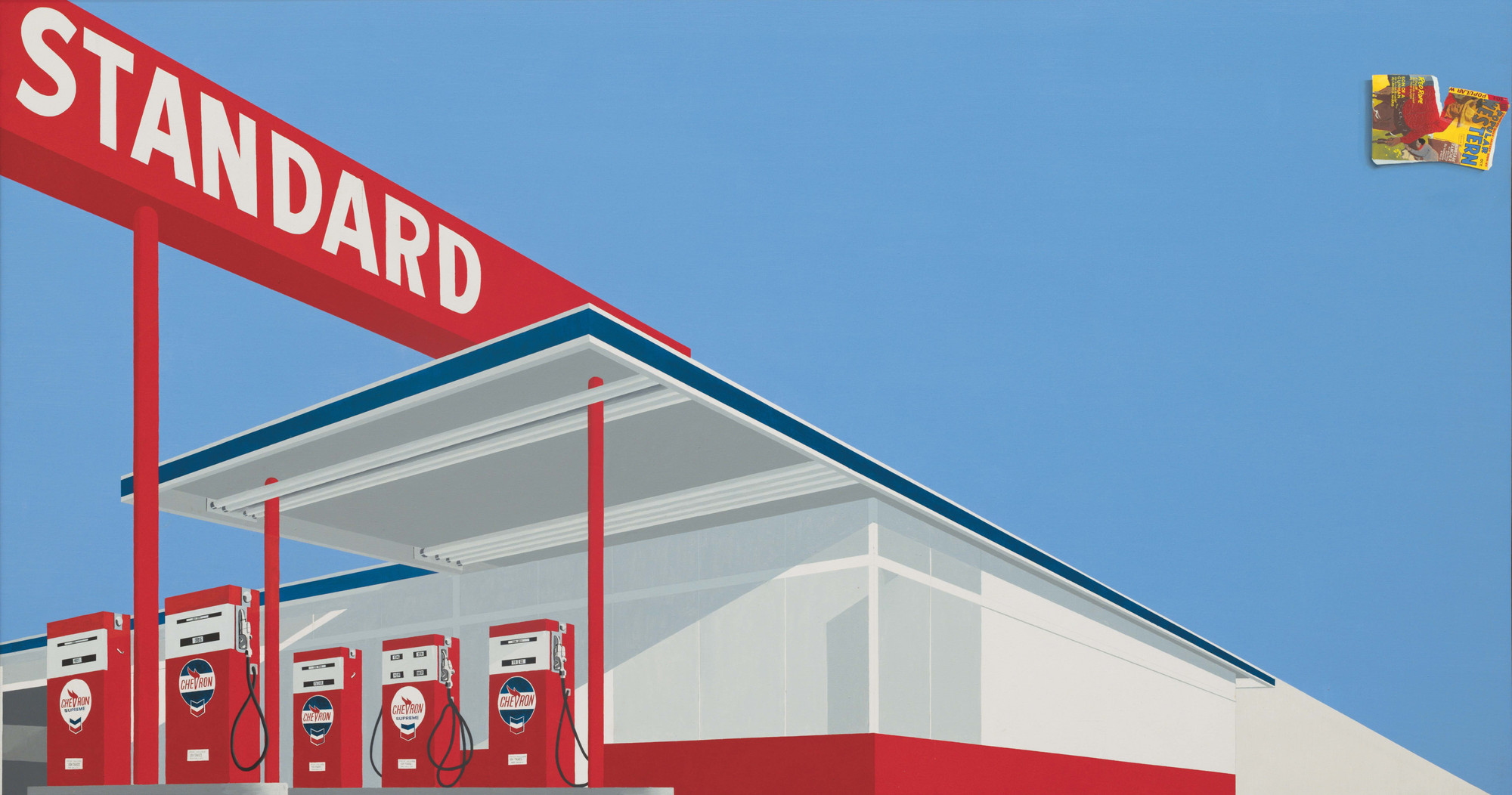
1. Standard Station, Ten-Cent Western Being Torn in Half (1964) — $68,260,000
Christie’s, New York, November 2024
The sharp diagonal of the service station gives the painting the scale and drama of a film still, even though its subject is a building most motorists would pass without a second glance. In the upper right, a Western magazine is being torn in half, a small interruption that brings two versions of the American West into the same picture: the one motorists saw from the highway and the one sold to them in stories.
The painting had been in private hands since 1970 before setting a new auction record for Ruscha in 2024. He also returned to the image in print, and our article on why Ed Ruscha’s Standard Station is important looks at how the composition developed across his work.
2. Hurting the Word Radio #2 (1964) — $52,485,000
Christie’s, New York, November 2019
Ruscha paints RADIO in yellow against blue, with clamps fastened to the first and last letters. The joke is in how seriously he treats the idea: once the letters appear to be under pressure, it becomes difficult to look at the word without wondering what it might be made of. The lettering is as legible as a shop sign, even as the clamps make it behave like something that could bend or break.
The painting sold above its $40 million high estimate and held Ruscha’s auction record for five years.

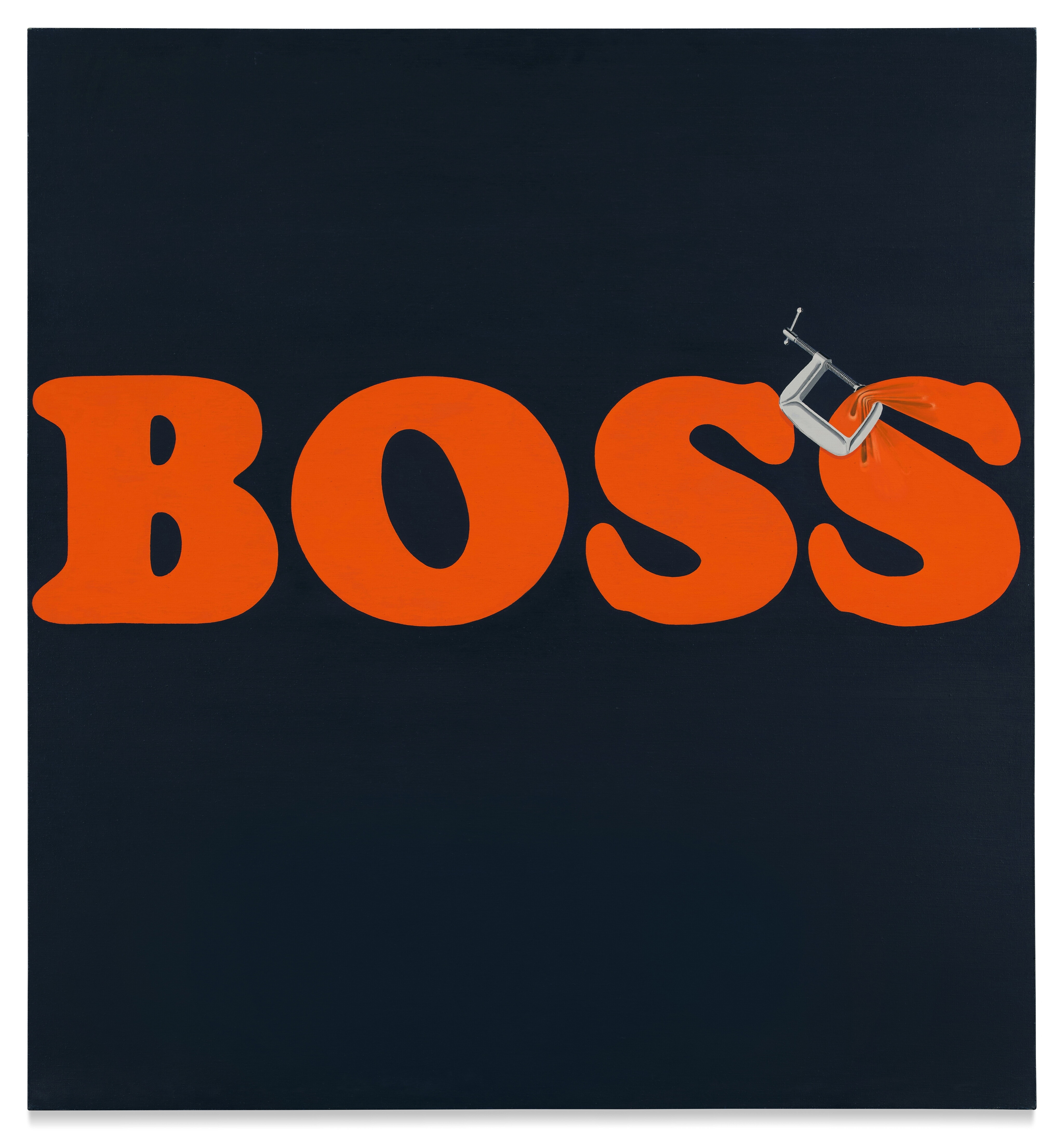
3. Securing the Last Letter (Boss) (1964) — $39,400,500
Sotheby’s, New York, November 2023
Ruscha uses a similar device in Securing the Last Letter (Boss), this time turning his attention to the final S. The title makes the action sound like a practical task, though it leaves unexplained why anyone would need to secure a letter. There is also a joke in the choice of word: BOSS suggests authority, yet the word itself seems unable to hold its own end in place.
The painting sold as part of the Emily Fisher Landau collection. It was made in the same year as the two works above it, placing three paintings from 1964 at the top of Ruscha’s auction market.
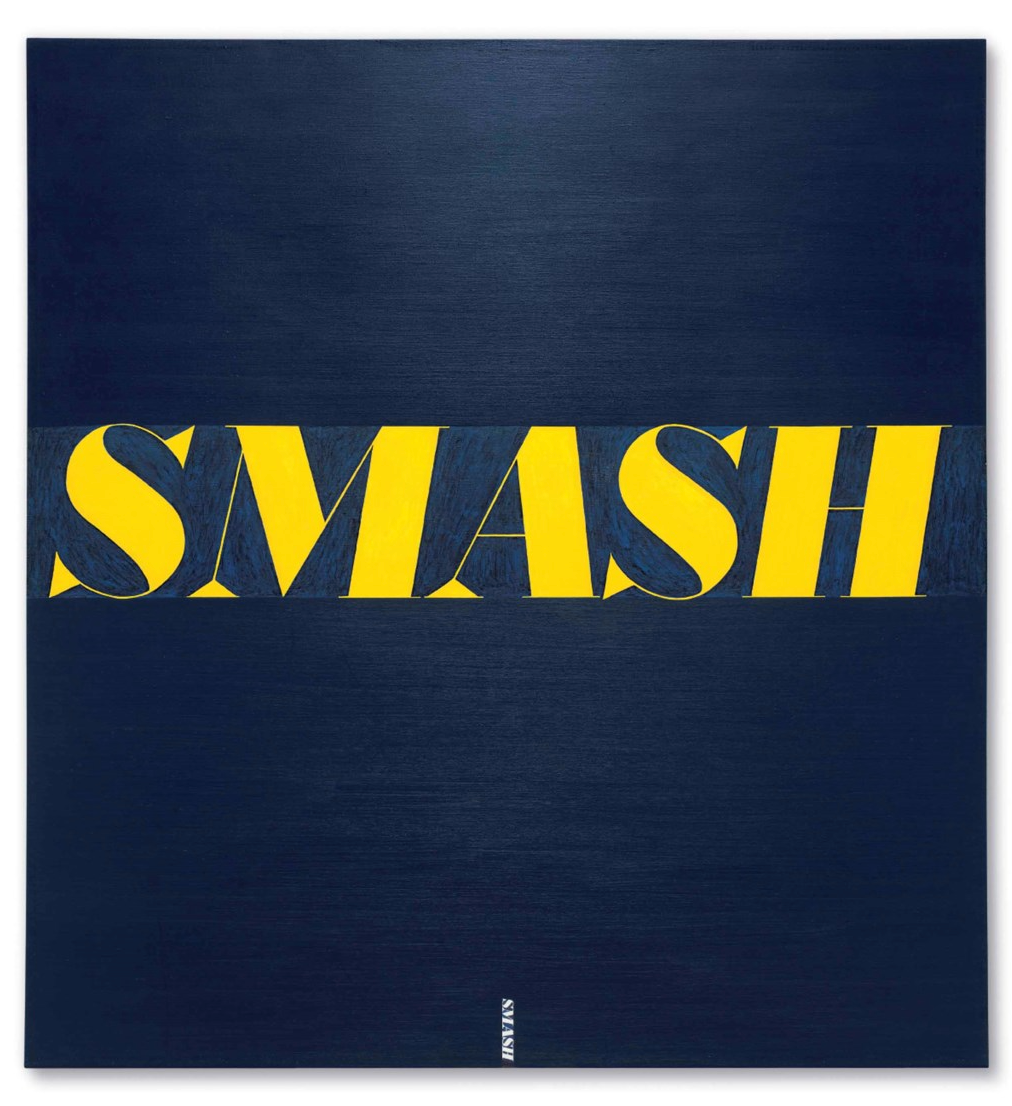
4. Smash (1963) — $30,405,000
Christie’s, New York, November 2014
The yellow letters of Smash stretch across a deep blue canvas. The word suggests noise and impact, yet the lettering is carefully arranged and remarkably still. A comic strip might put the same word beside a crash; Ruscha leaves the event to the imagination, making the sound and the sight of the word the subject of the painting.
The result exceeded the $20 million high estimate and set a record that stood until Hurting the Word Radio #2 sold in 2019.
5. Annie (1962) — $22,975,000
Christie’s, New York, July 2020
Ruscha borrowed the lettering from Little Orphan Annie, painting the name in red against yellow above a broad expanse of blue. That empty lower half is as consequential as the familiar logo at the top. The name looks as if it should introduce a story, but with nothing below it to read, attention returns to the lettering itself and the way Ruscha has placed it on the canvas.
He revisited the name in Annie, Poured from Maple Syrup, making the letters look as though they had been poured onto the canvas. The two paintings show how much character Ruscha could draw from the same few letters.
6. Burning Gas Station (1966–69) — $22,260,000
Christie’s, New York, May 2023
Ruscha returns to the steep perspective of Standard Station, but the flames change the character of the building. Its architecture remains sharply defined, and the sign is still legible even as the station appears to be going up in smoke. The effect is oddly matter-of-fact: Ruscha gives the fire the same cool attention he gives the building.
Two gas-station paintings feature in the top ten, and the contrast between them explains why the subject was worth revisiting. In one, a torn magazine interrupts the view; in the other, the disruption is happening to the building itself.

7. Ripe (1967) — $20,970,000
Christie’s, New York, November 2021
In Ripe, four red letters appear to have pooled on a yellow-green surface. Their rounded edges and highlights give the impression that they might spread if left alone. The word makes the colour seem richer: before we have quite worked out what the letters resemble, we are already thinking of fruit, sweetness or the point at which something is about to spoil.
The painting belongs to Ruscha’s liquid-word works of the 1960s. Where Hurting the Word Radio #2 makes letters look hard enough to clamp, Ripe makes them look as though they might lose their shape.

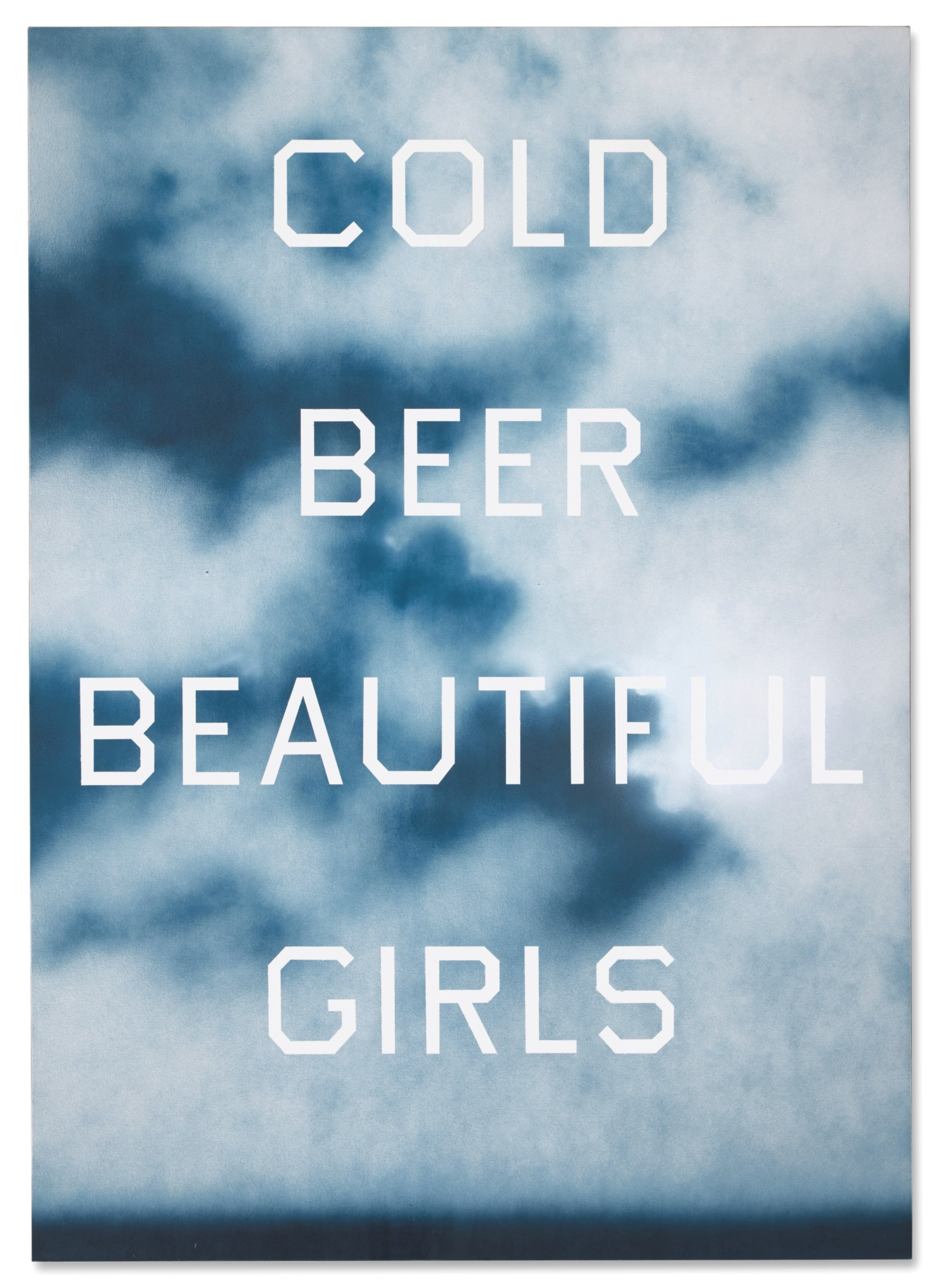
8. Cold Beer Beautiful Girls (1993) — $18,823,400
Sotheby’s, New York, May 2022
The phrase has the rhythm of an advertisement that promises a whole evening in four words. Ruscha gives it the scale of a major painting, leaving the viewer to consider how much an ordinary sales pitch assumes about the person reading it. There is enough familiarity in the line to make it funny, and enough distance in the way Ruscha presents it to leave the joke open.
The result makes it the highest-priced painting from the 1990s in this ranking, an indication of how far demand at the top of Ruscha’s market extends beyond the early Pop years.
9. Truth (1973) — $14,785,000
Christie’s, New York, May 2024
The fiery colour and large capital letters of Truth give it the force of a declaration. Ruscha supplies no statement to test, though, and the longer we look, the more the painting seems to be about the appearance of certainty. The word commands attention through its size, colour and placement, even as its meaning remains open.
The painting sold well above its $10 million high estimate, six months before Standard Station set the current record.
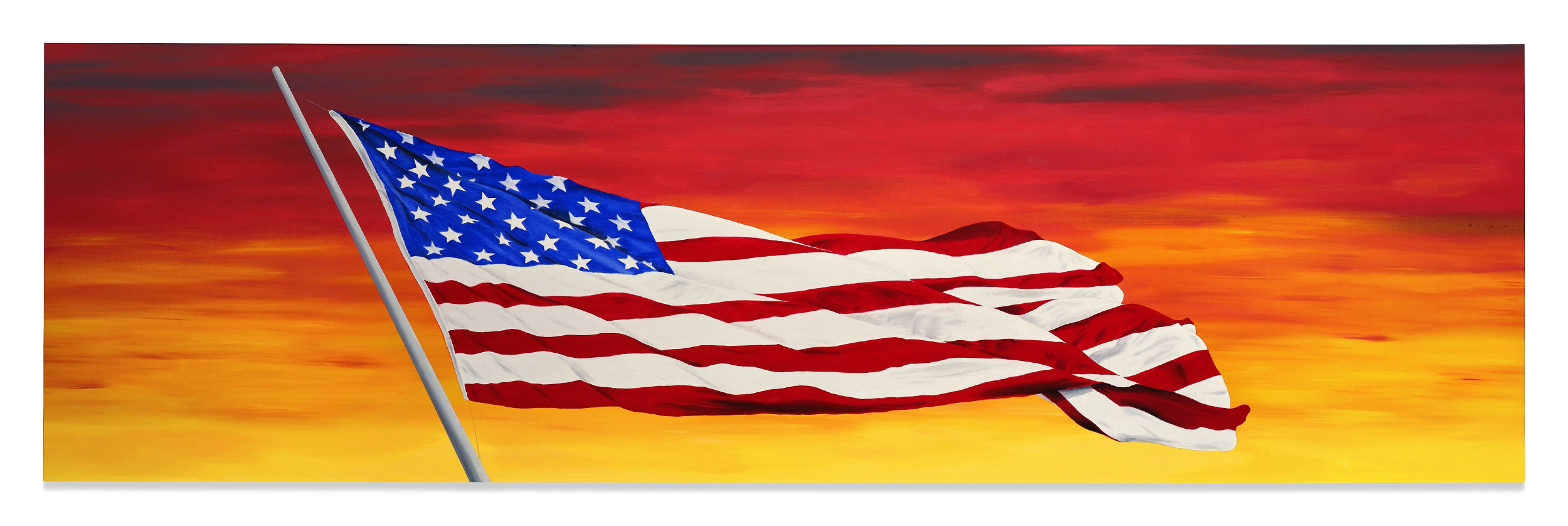
10. Georges’ Flag (1999) — $13,650,000
Sotheby’s, New York, November 2024
An American flag billows against a deep red sky in this late painting. Ruscha gives it the dramatic lighting and scale of a cinematic image, while the title makes it sound like something that belongs to somebody. That shift from national emblem to personal possession gives the painting an ambiguity that is easy to miss on first viewing.
It sold the evening after Standard Station set Ruscha’s auction record. Seen together, the two paintings show how consistently he returned to familiar American imagery and how little he needed to change for it to look different.
Looking for more on Ruscha? Explore why he kept returning to the Hollywood sign or read our guide to collecting Ed Ruscha prints.
For more information about Ed Ruscha prints for sale, or to discuss selling an Ed Ruscha print, contact our team at info@alexyellop.com.