
Key Takeaways
- Haring's print market turnover has more than doubled since 2015, from roughly $2.24 million to $4.71 million in 2024, with prints now making up around 60% of all Haring auction sales.
- Value depends on a combination of the image and motif itself, whether it's a single or part of a set, and the edition size — not era or signature alone.
- Haring's lexicon of imagery exits both within and outside of sets, as single works allowing collectors access to iconic images across pricing levels.
- Pop Shop and Icons offer both singles and sets at different price points; Andy Mouse, Fertility Suite, Flowers, and Growing sets sit at the established end of the market.
- Three practical collector levels apply: a starting tier under roughly $40,000, a core tier from $40,000 to $95,000, and an established tier above $95,000 where complete sets and the rarest works sit.
Keith Haring turned prints, paintings, and public art in roughly equal measure into a single body of work during his short career. Nearly four decades on, that work has only grown in reach — it moves as easily through fashion, music, and street culture today as it did through 1980s New York, a rare kind of staying power that few artists of any era achieve.
This Keith Haring Collecting Guide moves through Haring's life and imagery, what factors determines Haring's print prices, the series and portfolios worth knowing, where the market stands today, how to authenticate and time a purchase, and three collector levels to help place any acquisition within the wider market.
Who Was Keith Haring
Keith Haring was born in 1958 in Reading, Pennsylvania, and began drawing cartoons as a child alongside his father, an amateur cartoonist. He moved to New York in 1978 to study at the School of Visual Arts. In late 1980, he noticed a blank black paper panel in the Times Square subway station, left in place where an expired advertisement had been removed, bought a stick of chalk, and drew directly onto it. Over the following five years he produced thousands of these drawings across the subway system, working fast and without preparation to finish before transit police could intervene. The practice earned him the nickname "the Chalk Man" and a genuine public following before a single gallery had shown his work.
By the early 1980s he was exhibiting alongside Jean-Michel Basquiat and Kenny Scharf as part of the same downtown scene, and his imagery — the radiant baby, the barking dog, dancing figures — had become recognisable across the city. In 1986 he opened the Pop Shop in SoHo, selling shirts, posters, and objects printed with his work at accessible prices, extending his imagery to a public far beyond gallery collectors. He was diagnosed with AIDS in 1988 and died in 1990 at 31, having spent his final years creating some of his most openly political work and establishing the Keith Haring Foundation to support AIDS organisations and children's charities.
His print output began in earnest in the early 1980s and continued until his death, produced primarily through Tony Shafrazi Gallery and published chiefly by Martin Lawrence Limited Editions. Since his death, the Keith Haring Foundation — led for over three decades by his close friend and studio manager Julia Gruen until her death in 2023 — has continued the artist's legacy.
Understanding Haring's Visual Language
Haring worked from a concentrated, recurring set of figures — the radiant baby, crawling on all fours and surrounded by lines of energy; the barking dog, dancing and embracing figures, often stacked or interlocking; flying saucers, televisions, and pyramids as recurring props within his invented mythology — closer to hieroglyphics than a conventional visual style, each figure functioning as a symbol. Colour and line carried as much weight as the figures themselves: flat, saturated primaries, unbroken black outlines, and radiating marks around a figure — vibration lines, energy fields — that gave even a static image a sense of motion and urgency.
His subject matter grew increasingly direct as the decade went on: nuclear anxiety, apartheid, capitalism, and, from the mid-1980s onward, the AIDS crisis itself. Haring treated activism as a legitimate, central subject for fine art rather than a departure from it, using the same bold, immediate line he'd developed on the subway to make urgent political statements as legible as his earlier, more playful work.

Why Haring Still Matters
Haring collapsed the distance between street art and the gallery system faster and more completely than almost anyone in his generation, and did it while insisting the two didn't need to be opposites — a mural, a subway drawing, and a gallery painting could carry the same imagery and the same weight. His line rarely lifted from the page, and that unbroken, continuous quality — developed under real time pressure on the subway — became inseparable from the energy his work is known for; galleries and street corners alike could carry the same immediacy.
His paintings continue to command major auction results worldwide — Untitled (1982) set the current record at $6.5 million at Sotheby's in 2017, and The Last Rainforest achieved $6 million at Sotheby's in 2024 — a level of sustained demand that keeps his prints, drawn from the same visual world, firmly in view for serious collectors.

What Drives Value
What determines how much a Keith Haring print costs?
- The image. The radiant baby, the barking dog, and dancing figures are Haring's most recognisable motifs, and they command the strongest prices.
- Standalone print or part of a series. A series carries more than the sum of its individual prints.
- Edition size. Smaller editions sell for more than larger ones of the same image.
- Condition and provenance affect price at every level.

Major Series and Portfolios
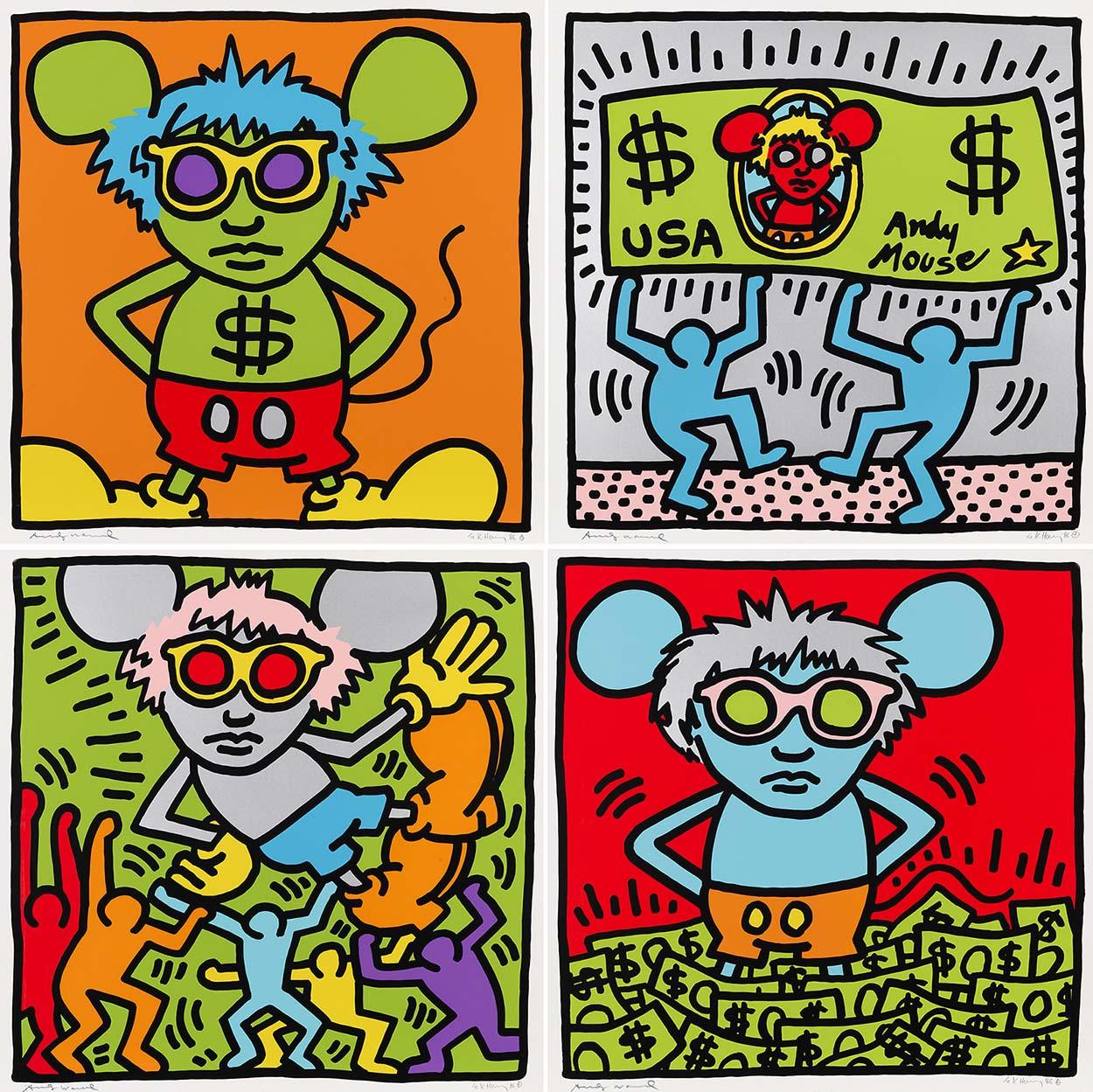
Andy Mouse (1986) is a four-print portfolio made in homage to Andy Warhol, drawing from Haring's personal relationship with the artist, and is dual-signed by both Warhol and Haring. A complete set reached £991,182 at Christie's in September 2023, the current record for a Haring print.
Icons (1990) was Haring's final major print series, completed the year he died: five prints, each isolating a single symbol from his personal lexicon — the radiant baby, angel, flying devil, three-eyed monster, and barking dog — in flat, saturated colour that strips each symbol down to its essential line and leaves nothing to soften its energy. Individual prints have sold for up to £98,063, and a companion series, White Icons, reproduces the same five symbols as colourless embossings on white paper at a considerably more accessible price point.
Fertility Suite (1983) was Haring's first serious print series and reflects the social and political tensions of the era. Richard Polsky, the well-known Pop art authenticator, has specifically singled it out as the strongest starting point for a serious collection.
Flowers and Growing are among Haring's most sought-after complete portfolios, built around his recurring imagery of natural growth and transformation — with sweeping lines, bold colours and energy radiating outward from a central point. A complete Growing set achieved $762,000 at Sotheby's in 2025.
Pop Shop spans the widest range of the market: single prints, Quads (four images on one sheet), and complete sets, published across multiple series through the late 1980s. It offers genuine access to Haring's imagery at a range of price points, from accessible singles to more substantial complete sets.
Untitled (Red and Black Woodcut) (1983) is among Haring's earliest and most physically distinctive prints — a large-scale woodcut of two dancing figures set against a field of hieroglyphic-style marks, made using a technique he rarely returned to. Later works such as Untitled (Cup Man) (1989) and Untitled (Medusa) (1986) extend this same appetite for unconventional formats and mythological imagery within his print catalogue.
The Market in 2026: Current Demand
Demand for Haring's prints is broad rather than concentrated in a handful of trophy results. Works priced above roughly $115,000 account for the largest share of total sales value, but meaningful trading activity also runs through the $20,000–$40,000 and $40,000–$95,000 brackets. Buying a single print from a well-known set is a genuine way to own some of Haring's strongest imagery without paying complete-set prices, which is part of why this market has real depth across every level rather than depending on headline results alone.
Interest in his work has also broadened well beyond his traditional American collector base, with strong participation from European and Asian buyers drawn to the combination of instantly legible imagery and genuine art-historical significance behind it.
Authentication and Provenance
How can I tell if my Keith Haring print is authentic? Confidence comes from checking a few things together: the publisher against known records for that specific series (most authentic prints were released through Martin Lawrence Limited Editions, with certain Pop Shop works carrying an Iguana blindstamp), the edition details against the official Keith Haring Editions on Paper 1982–1990 catalogue published by Rizzoli, and the signature style against genuine examples from the correct period. A documented ownership history closes the picture. A Certificate of Authenticity from the Foundation's Authentication Committee, where one exists, adds a further layer of confidence.
.jpg)
Collecting by Tier
How much does a Keith Haring print cost? Haring's prints span a wide range even within a single series — from accessible Pop Shop singles to hand-signed complete portfolios reaching well into six figures. Price depends primarily on the image itself, whether it's a single or a set, and edition size, with 1982–1985 work generally commanding the strongest prices as his most formative period.
Starting a Collection (Sub-$40,000) is where Pop Shop singles, individual prints from White Icons, and smaller-format works sit — genuine, documented Haring material at a price point that suits a first acquisition.
Core Collector ($40,000–$95,000) is where strong individual prints and certain sets trade, including examples from the Icons series, Untitled (Cup Man), Fertility Suite, Growing, and Pop Shop Quads or sets.
Established Collector ($95,000 and above) is where complete sets and the rarest formats live: full matching portfolios, and — at the very top — Andy Mouse, Untitled (Medusa), and small-edition rarities such as Untitled (Dog on Podium), 1989.
Acquisition Strategies
Set Completion pursues full portfolios rather than a scatter of unrelated single images, since complete sets typically anchor the strongest long-term positions in this market.
Era Concentration builds specifically around Haring's 1982–1985 work, his most formative and historically significant period, rather than mixing across his full career.
Icon Focus collects around Haring's most recognisable single symbols — the radiant baby, the barking dog, dancing figures — wherever they appear across different series, rather than committing to one portfolio.
Rarity Focus pursues small-edition and unconventional-format prints specifically, such as the woodcuts or Haring's shaped and small-run editions from the late 1980s.
Quality-First remains the most straightforward approach: acquiring the strongest available example that clears authentication and condition standards, regardless of series, prioritising long-term value over thematic coherence.
Haring's Highest Auction Results
These are unique paintings rather than editioned prints, but they set the ceiling that gives the rest of the market its context.
Untitled (1982) — $6.5 million, Sotheby's, May 2017. A large-scale work on vinyl tarpaulin featuring Haring's radiant baby and barking dog motifs against a black ground, and the current auction record for the artist.
The Last Rainforest (1989) — $6 million, Sotheby's, 2024. Painted in the final year of Haring's life, this large environmentally themed canvas is widely regarded as his last great masterpiece, drawing together nearly every recurring motif and concern from across his career.
Untitled (1982) — roughly $6.1 million, Christie's, 2022. A dancing figure rendered in vivid Day-Glo green against an orange ground, with a provenance rooted in New York's early-1980s downtown and hip-hop scenes.
Is Keith Haring Still a Good Investment in 2026?
Haring's print market offers a genuine combination of broad accessibility and real depth at the top, anchored by imagery that remains as culturally present today as it was in the 1980s — the radiant baby, the barking dog, dancing figures instantly identifiable decades after they first appeared. Whatever level a collection is being built at, the strongest move is to prioritise the strongest examples of Haring's most recognisable imagery and, where budget allows, complete sets over unrelated singles — since it's precisely that combination that has consistently delivered the strongest results across his market.
For more information on our latest Keith Haring prints for sale or to sell your Keith Haring prints, contact our team via info@alexyellop.com