A crown, a skull, a word crossed out so heavily that you lean closer to read it. Jean-Michel Basquiat’s art is immediately recognisable, yet its meaning often takes longer to emerge. His paintings draw the eye through crowded surfaces where anatomical diagrams, historical references and fragments of language compete for attention.
These recurring symbols connect some of his central concerns: Black achievement, cultural ownership, money, identity and the vulnerability of the body. Understanding them opens up the work, particularly when we look at how they interact within individual compositions.
What does Basquiat’s crown mean?
Basquiat’s three-pointed crown is among the most recognisable signs in contemporary art. It can function as a signature, confer importance on a figure or assert the artist’s own authority.
Its association with Black musicians and athletes is especially significant. Basquiat repeatedly honoured people whose achievements existed alongside racism and exclusion. A crown could give these figures the status traditionally reserved for rulers and saints in European painting.
The gesture also raises a question about who decides whose life deserves commemoration. Basquiat brought his own heroes into an artistic tradition that had frequently marginalised them.
Yet the crown does not always offer uncomplicated celebration. Power creates hierarchies, and recognition can bring exposure as well as prestige. Depending on its surroundings, the same mark can suggest ambition, triumph or the precariousness of being placed above others.
That flexibility helps explain its enduring force. A few quick lines carry ideas that become more complex as we examine the painting around them.

Why did Basquiat paint skulls and anatomical figures?
Basquiat’s interest in anatomy began early. While recovering from a childhood traffic accident, he received a copy of Gray’s Anatomy from his mother. Medical illustrations became an important source throughout his career, alongside his study of art and other visual material.
Bones, teeth, organs and labelled body parts gave him a way to look beneath outward appearances. In the Anatomy series of 1982, this interest takes a concentrated form, bringing anatomical structures and handwritten terminology into stark compositions.
His skull-like heads are more ambiguous. In Untitled, the 1981 painting in The Broad’s collection, teeth and exposed internal structures coexist with eyes, an ear and indications of hair. The image moves between a living face, a skull and a mask.
Mortality is one possible reading, but it does not exhaust the work. The head is also where thought, identity and expression reside. Basquiat makes its interior seem visible while leaving its emotional state difficult to settle.
The marks themselves matter, too. Changes of colour, dense passages and abruptly exposed areas keep the image active. What initially appears to be a blunt emblem of death becomes a complicated representation of human presence.

Why did Basquiat cross out words?
Crossed-out words are among Basquiat’s most distinctive devices. They interrupt reading and make apparently cancelled information unusually conspicuous.
Basquiat explained that obscuring a word encouraged people to look at it more closely. The line through the text becomes a way of directing attention. We find ourselves trying to recover what appears to have been withheld.
This is particularly effective in Hollywood Africans, painted in 1983. Basquiat places himself alongside fellow artists Toxic and Rammellzee within a field of words referring to racial stereotypes and the entertainment industry.
The painting connects their contemporary presence in Los Angeles with the restrictive ways Black people had been represented on screen. Its words are circled, repeated, emphasised and struck through, creating different levels of visibility.
Language also shapes the composition. A large word can hold an area of the canvas; a repeated phrase can establish rhythm; a scratched-out passage can slow the eye. Reading and looking become inseparable.
What do Basquiat’s copyright symbols mean?
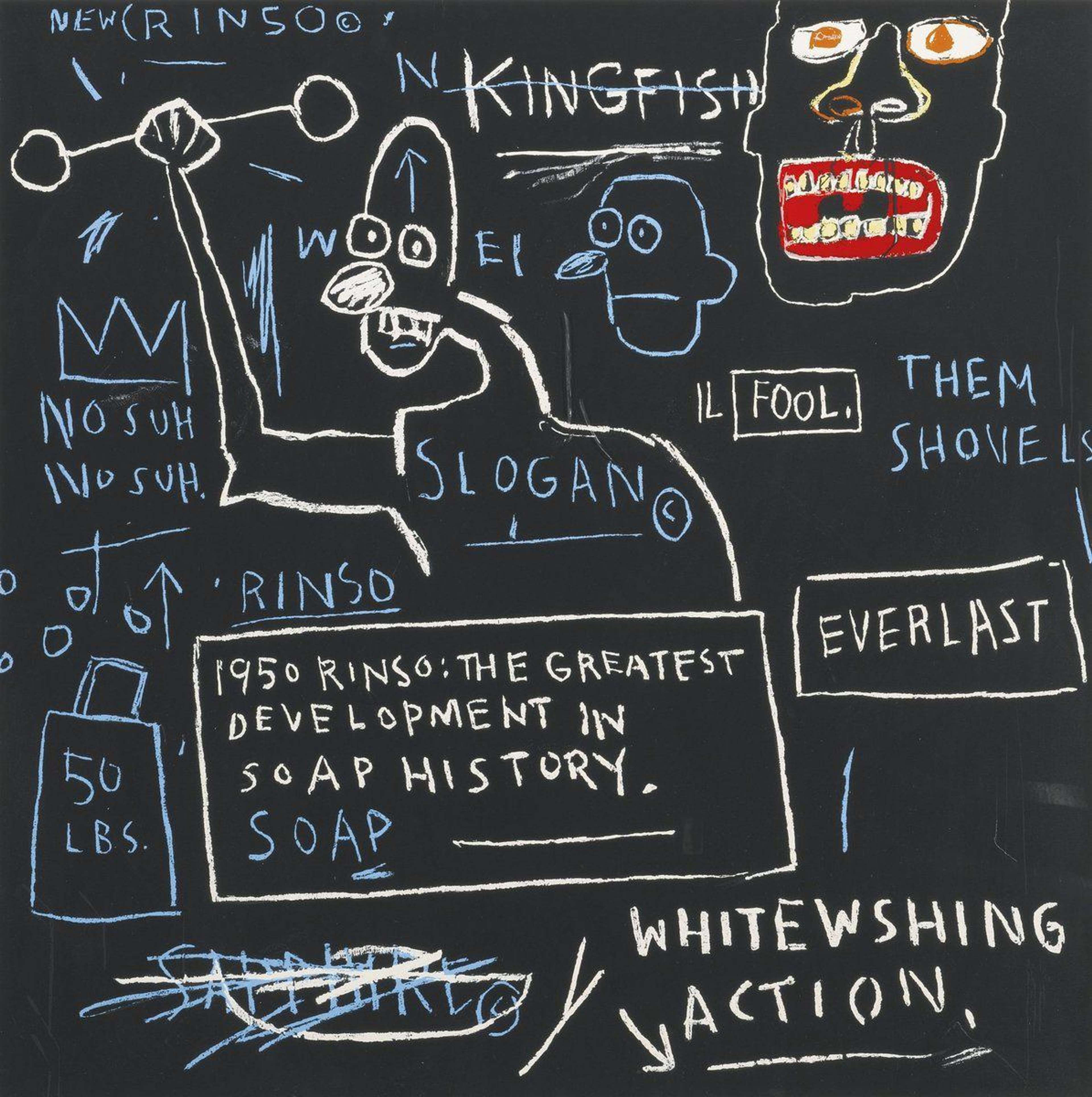
The copyright sign introduces the language of ownership into Basquiat’s paintings and drawings. Attached to names, phrases and images, it can suggest authorship, branding and the conversion of ideas into things that circulate commercially.
In Untitled (World Famous), a 1983 drawing, the crown and copyright sign accompany an assertion of artistic ambition. Together they connect recognition with a claim to intellectual ownership.
Elsewhere, the sign becomes more questioning. In Farina, from 1984, Basquiat reworks a commercial image associated with the Cream of Wheat brand. Copyright marks sit within a composition concerned with representation and advertising.
Seen in this context, the small symbol invites larger questions: who produces a cultural image, who controls it, and who benefits from its repetition?
Those questions remain relevant to an artist whose imagery now circulates so widely. They were already embedded in the work itself.

Why do musicians and athletes recur in his art?
Basquiat’s references often build portraits without relying on conventional likeness. A name, instrument, date or repeated phrase can summon a person and the history surrounding them.
Horn Players, painted in 1983, pays tribute to Charlie Parker and Dizzy Gillespie. Faces and musical references appear alongside repeated words, drawing the viewer into a composition that rewards knowledge of its subjects.
Jazz offers a useful way of thinking about Basquiat’s handling of repetition. A word or image returns with changes, gaining emphasis through its relationship to everything around it. The surface holds several lines of activity at once.
His attention to Black cultural figures also gives the work historical specificity. These are people with achievements, reputations and individual stories. Recognising those references adds depth to the symbols without closing down other readings.

How should collectors approach Basquiat’s symbols?
Start with the whole composition. Notice where a crown sits, which words surround a head, and how colour or empty space changes their emphasis. A familiar symbol can perform a different role each time it appears.
Comparing works can be especially rewarding. The images brought together in Portfolio I offer opportunities to explore relationships between figures, language and signs across several compositions. These later estate editions should be distinguished from prints produced during Basquiat’s lifetime, a distinction covered in our guide to collecting Basquiat prints.
Basquiat’s symbols reward familiarity because they keep changing in company. The crown draws us towards questions of recognition; the skull towards the body and identity; the crossed-out word towards something we have been prompted to overlook. Their relationships give each work its particular intelligence and energy.
For more information or to buy Jean-Michel Basquiat prints, please contact us. If you would like to sell Jean-Michel Basquiat prints, we would be pleased to discuss your work.


