
Andy Warhol could make a star out of someone who had barely appeared on screen, and he could take a woman whose face was already known around the world and make her seem unknowable again. Both things happened in the 1960s, when he filmed Edie Sedgwick in her Manhattan apartment and made some of his most celebrated portraits from a studio publicity photograph of Marilyn Monroe. Sedgwick was there, talking, smoking and getting dressed; Monroe had already died when Warhol started working with her image. The distance between those two encounters tells us more about Warhol’s fascination with fame than either one does alone.
The people loosely described as Warhol’s muses played very different parts in his life. Some supplied the wit, style or presence that made his films worth watching. Others worked alongside him or came to him with audiences of their own. And then there were the stars he knew through photographs, whose faces had already been shaped by publicists, studios and years of circulation. You can see those differences in the work itself: the long stretches of ordinary life Warhol filmed with Sedgwick, the precision of Debbie Harry’s public image, and the way Marilyn’s expression seems to change even when the photograph stays the same.
Edie Sedgwick and the making of a Factory superstar
Edie Sedgwick’s time at the Factory was brief, but few people are more closely associated with its image. Her cropped hair, heavy eye make-up and oversized earrings made her immediately recognisable, and her rapport with Warhol helped turn their appearances together into events. The films give a better sense of why he kept coming back to her than the photographs of them arriving at parties.
In Poor Little Rich Girl (1965), Warhol films Sedgwick in her apartment as she goes about her morning. For a substantial part of the film, she is out of focus, an odd thing to find in a work built around someone so visually distinctive. Yet the longer the camera stays with her, the more the small choices become the performance: how she talks, what she puts on, how she occupies the room. The film would have little hold without Sedgwick’s ability to make ordinary behaviour watchable. Warhol gave her the time and space to do it.
There is a tension in the title, too. Poor Little Rich Girl sounds like a part written for Sedgwick in advance, but the film lets her drift in and out of it. She can be funny, distracted or self-conscious, sometimes within the same stretch of conversation. The image of Edie that survived the Factory years is so fixed that it is easy to forget how much of her appeal on screen came from being unpredictable.

Nico, Candy Darling and the women who made the Factory films
Nico came into Warhol’s circle with experience as a model and actress, but it was her voice that made her indispensable to one of the projects most closely associated with him. Warhol helped bring her together with the Velvet Underground, and the contrast between her low, measured singing and the band’s sound is part of what makes The Velvet Underground & Nico so distinctive. The banana on the cover is Warhol’s most recognisable contribution to the record; the music shows what could happen when he brought people together and left room for their differences.
Candy Darling brought something else to the Factory: a close understanding of old Hollywood glamour and a sense of how to play with it. In Women in Revolt, directed by Paul Morrissey, she performed alongside Jackie Curtis and Holly Woodlawn. All three had careers and ambitions of their own, a distinction that can disappear when they are grouped under the label of Warhol’s superstars. Watching the films makes their contribution harder to overlook. Their timing, delivery and understanding of the camera give the work a character that cannot be credited to Warhol alone.
The term muse fits Brigid Berlin even less comfortably. Berlin was a performer and artist who made her own Polaroids and audio recordings. In a circle famous for being watched, she was often the person doing the watching. Put beside Sedgwick or Darling, Berlin makes it harder to think of the Factory as a place where one artist simply gathered interesting subjects. Some of the people around Warhol were making their own record of the same world.
Debbie Harry, from downtown New York to the computer screen
Debbie Harry recalled first meeting Warhol while waiting tables at Max’s Kansas City. By the time he photographed and painted her in 1980, Blondie had made her famous in her own right. Harry already understood how to use a recognisable look across music, fashion and photography, which made her a different sort of subject from someone just finding an audience at the Factory.
In 1985, they appeared together at Lincoln Center for the launch of the Commodore Amiga. Warhol worked on a digital portrait of Harry onstage, using her image to show what the new computer could do. Instead of starting with a publicity image that had already circulated, he made the act of producing the image part of the publicity. Harry’s presence made the experiment legible to an audience that might otherwise have been watching a software demonstration.
Her face and hair were familiar enough to remain recognisable as Warhol changed the colours on screen. More than twenty years after he began working with Marilyn’s image, he was still asking how far he could alter a famous face before it stopped looking like itself.

Marilyn, Liz and the women Warhol knew as images
Marilyn Monroe and Elizabeth Taylor occupy a different place in the story. What Warhol worked with was the public face already familiar from films, magazines and publicity. In Monroe’s case, he returned to a photograph made to promote Niagara. The pose holds steady while the colours change, and those changes can make the same expression feel flirtatious, remote or worn out. Once the face is repeated, it becomes harder to separate what we see in it from what we already know about her.
That effect is especially clear in the complete Marilyn Monroe portfolio of 1967. Look at any one print and the colour can seem inseparable from her expression; look across all ten and it becomes obvious how much of that expression we have supplied ourselves. The same smile can seem warmer or more brittle depending on what Warhol does with the lips, hair and skin. The brighter combinations do not always feel like the most cheerful ones.
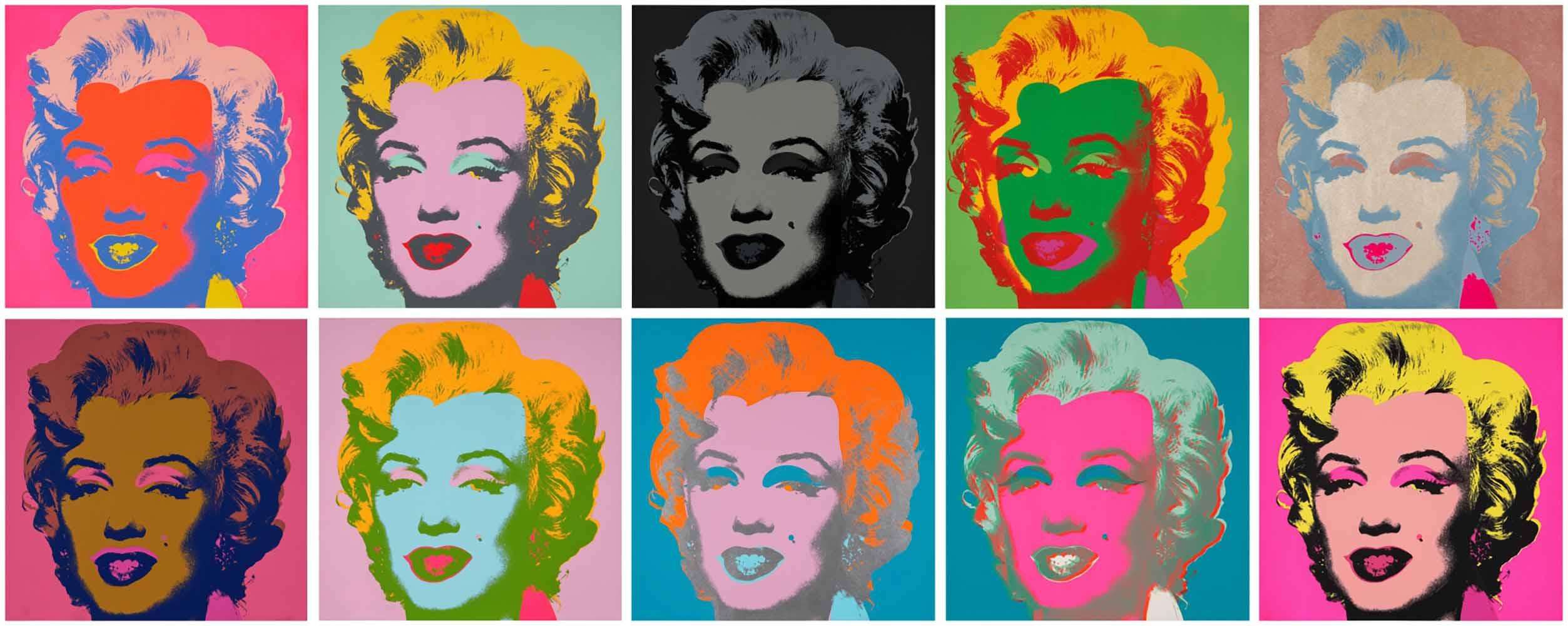
In Liz (1964), Elizabeth Taylor meets the viewer more directly. The closely cropped face and emphatic make-up are enough to bring the star into focus without any suggestion of the film she might be in or the character she might be playing. Where the Marilyn portfolio allows us to compare the effect of colour across ten versions, Liz achieves its impact in a single image. Together, the two show why Warhol kept returning to publicity photographs: the studios had already worked out how to make a face instantly recognisable, which gave him room to see what else that face could convey.
The later portraits of Grace Kelly and Ingrid Bergman show how long he remained interested in the difference between a person and the image a public comes to know. For the Ingrid Bergman portfolio, he drew on film stills as well as a portrait of Bergman as herself. An actress can be remembered as a character, as a star or as some combination of the two, and Warhol made that distinction part of the portfolio.

Jon Gould and the private life behind the portraits
Jon Gould, a Paramount executive and Warhol’s partner in the 1980s, belongs to a more personal side of this history. Warhol photographed him frequently, and the pictures sit differently from the portraits based on images made for mass circulation. Their interest comes in part from familiarity: Gould appears as someone Warhol spent time with and wanted to photograph again.
Repetition means something different in those photographs. In the Marilyn portfolio, Warhol starts with an image the public already knows and shows how many ways it can be seen. With Gould, the accumulation of photographs tells us that Warhol kept looking at one person over time. The Factory helped him turn looking into a public event, but the people who passed through his life also gave him reasons to look that had little to do with fame.
Looking for more on Warhol? Explore his ten most expensive paintings at auction, see how he experimented with colour in his trial proofs, or read our guide to collecting Andy Warhol prints.
For more information about Andy Warhol prints for sale, or to discuss selling an Andy Warhol print, contact our team at info@alexyellop.com.