
In the early 1980s, Andy Warhol worked with theatre producer Lewis Allen on a show in which a life-size robot would appear in his place. The idea made sense for an artist who had spent years turning famous people into images that could circulate without them. Warhol’s own appearance was by then familiar enough to repeat: the pale wig, the glasses, the way he spoke. If a machine could reproduce those things, how much of the experience of seeing Andy Warhol would an audience actually miss?
The show never went ahead, but the idea gives us a way to understand Warhol’s relationship with technology. At the Factory, he used commercial processes to reproduce images and see how they changed from one impression to the next. Later, he experimented with what a computer could do to a face. Decades after his death, the makers of The Andy Warhol Diaries approached the same territory from the other direction, using artificial intelligence to give his words a voice that sounded like his own.
Warhol had already made repetition part of the work
Photographic screenprinting allowed Warhol to return to the same image without redrawing it. The complete Marilyn Monroe portfolio of 1967 shows what he gained from that process. All ten prints use the same publicity photograph, yet the combination of colours in each one can change the way we read Monroe’s expression. Her smile might look inviting in one print and strained in another, even though the photograph has given us the same smile every time.
Warhol could also leave the flaws of reproduction visible. Colour might sit slightly apart from the image it was meant to fill, or a printed area might come through unevenly. Those differences make it possible to see the photograph and the means of reproducing it at the same time. They also help explain the interest of his trial proofs, where changes in colour can give a familiar image a markedly different character.

Could a robot take Andy Warhol’s place?
The robot took the idea of a self-portrait further than a photograph or a painting could. It was built for a planned stage production, where a mechanical likeness would have to hold an audience’s attention as Warhol himself might have done. It could reproduce some of the things that made him recognisable in public, but whether recognition would be enough was the premise of the show.
There was a joke in asking an audience to come and see a celebrity who would be absent from his own performance. There was also something familiar in the arrangement. Most people knew Warhol through photographs, interviews and appearances on screen. The robot would have made that distance unusually apparent by placing another version of him in the room.

What Warhol did with a home computer
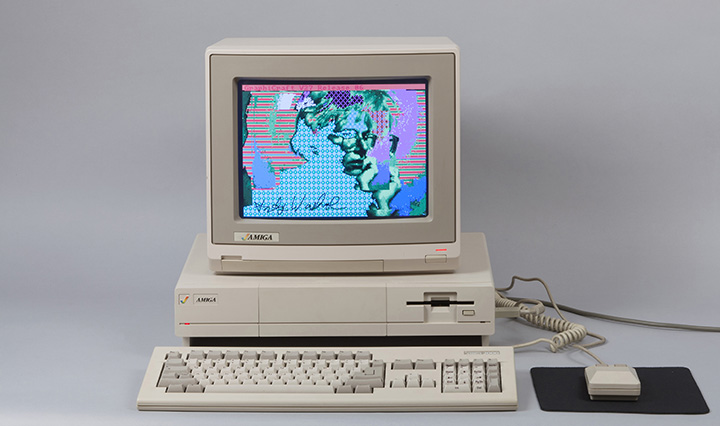
In 1985, Commodore put Warhol onstage at Lincoln Center to demonstrate its new Amiga computer. His subject was Debbie Harry, whom he had already photographed and painted. Working in front of an audience, he used the software to introduce areas of colour to an image of her face. It was a good choice for a demonstration: Harry was recognisable enough that viewers could concentrate on what happened to the picture as Warhol worked.
He went on to try the computer with subjects he knew well, including a Campbell’s soup can and flowers. He also worked with an image from Botticelli’s Birth of Venus, giving Venus a third eye. The results have the rough edges of early computer graphics, which become especially noticeable when the subject is as familiar as a Campbell’s label. Warhol had spent years testing what happened when he transferred an image from one medium to another. Now he could watch the changes appear on a screen as he made them.
Warhol expressed an interest in printing the digital images, but he did not release them as prints. In 2014, a team working with the Andy Warhol Museum recovered files from floppy disks in its archive. The distinction matters when looking at his work from 1985: Apple, from the Ads portfolio, is a screenprint of a computer company’s logo. The Amiga images are works he made using a computer. In the same year, he was interested in the machine both as a tool and as something being sold to the public.
When AI gave Warhol’s diaries a voice
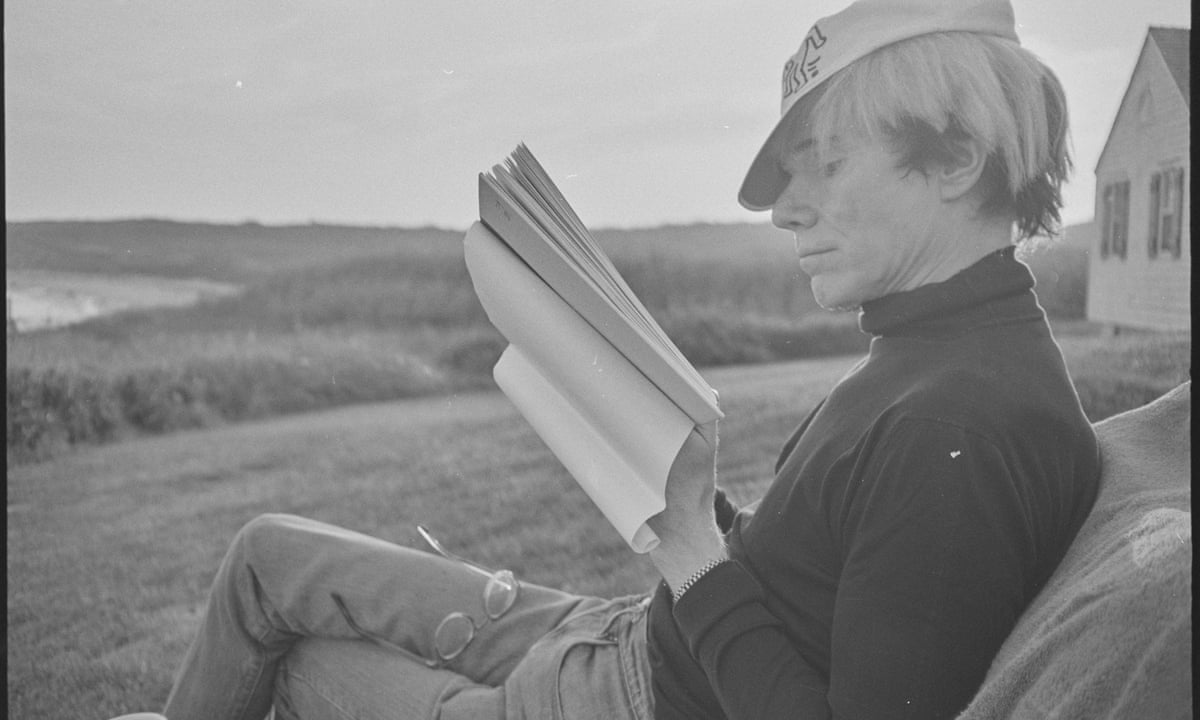
For the 2022 Netflix series The Andy Warhol Diaries, director Andrew Rossi wanted the audience to hear passages from the diaries Warhol dictated to Pat Hackett. With permission from the Andy Warhol Foundation, the production combined recordings by actor Bill Irwin with AI to create a voice resembling Warhol’s.
The robot and the recreated voice ask related questions, though Warhol had a say in only one of them. In the planned stage show, he was involved in deciding how his likeness might appear before an audience. In the documentary, other people decided how his words would sound. The words are his; the phrasing, pauses and delivery we hear belong to a performance made decades later. That distinction is easy to lose because a voice can feel more intimate than a photograph, especially when it seems to be telling us something private.
The most revealing link between the two projects is how little it takes to make us feel we recognise someone. Warhol understood that a handful of details could carry a famous face through ten changes of colour. The robot tested what else a likeness might carry, and the documentary did something similar with his voice. Both leave us with a question his portraits had been asking all along: when someone seems familiar, how much of that feeling comes from the person, and how much from the way we have been shown them?
Warhol’s Grave, Live Around the Clock
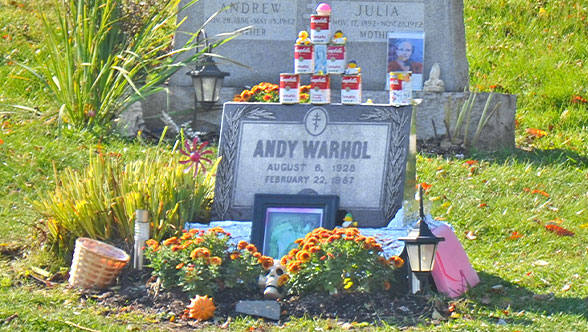
In August 2013, on what would have been Warhol’s 85th birthday, the Andy Warhol Museum and EarthCam switched on a camera at his grave outside Pittsburgh. The project, Figment, streams the gravesite 24 hours a day. Its name comes from a remark Warhol made about his own tombstone: he imagined leaving it blank, then wondered whether it might simply say “figment”.
Most of the time, there’s very little to see. Then someone comes by and leaves flowers, a Campbell’s soup can or a bottle of Coca-Cola. The camera catches a small reversal: Warhol took familiar things off supermarket shelves and made them part of his public image, and visitors now bring those same things to his grave to pay their respects.
The robot was meant to give an audience the feeling that Warhol was in the room, and the Netflix series brought that feeling back through his voice. The webcam does something different. It leaves the camera running and lets us see what people do in his absence.
Looking for more on Warhol? Explore his ten most expensive paintings at auction or read our guide to collecting Andy Warhol prints.
For more information about Andy Warhol prints for sale, or to discuss selling an Andy Warhol print, contact our team at info@alexyellop.com.