
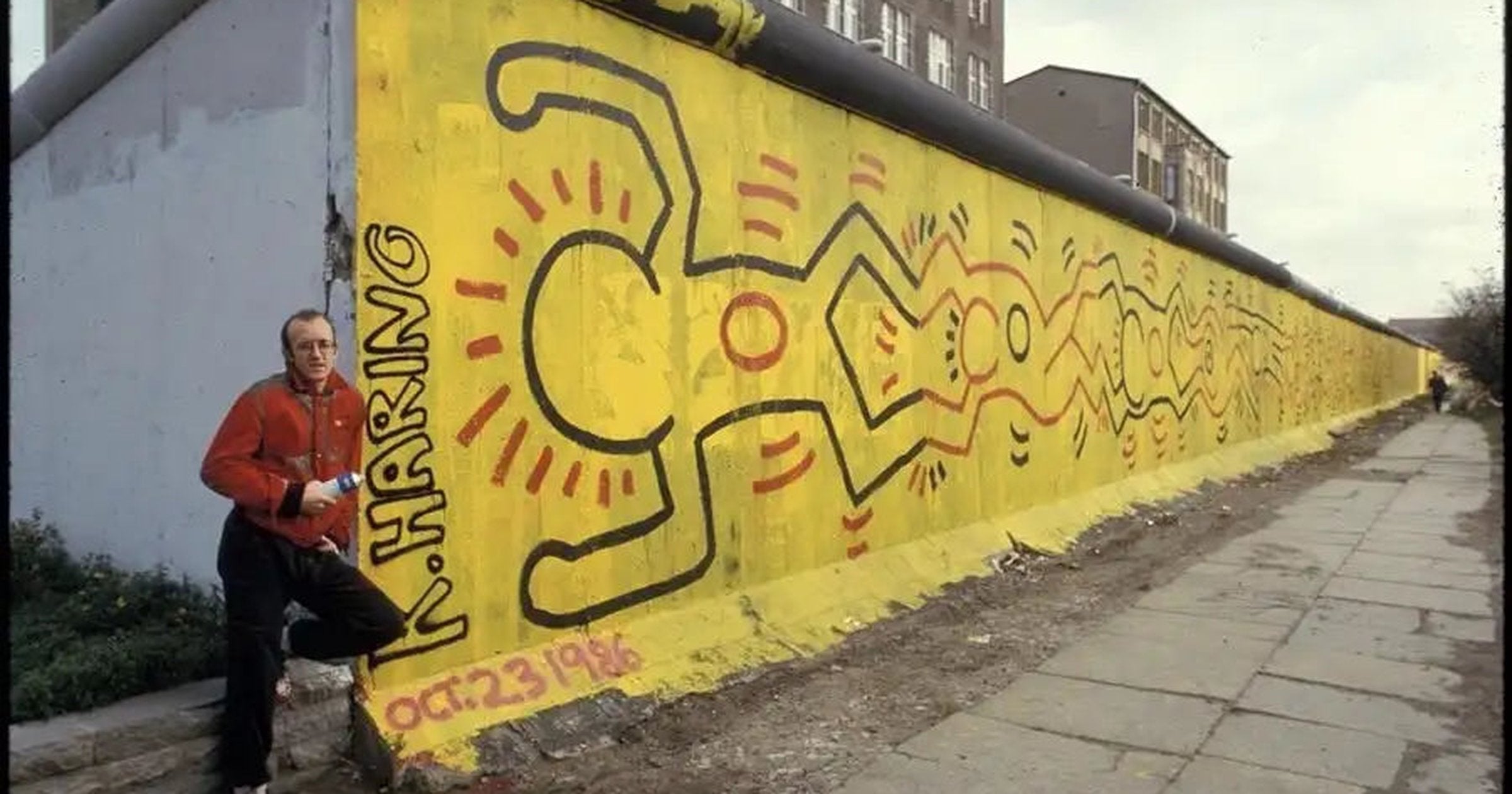
On 23 October 1986, Keith Haring painted a chain of interlocking figures on the western face of the Berlin Wall near Checkpoint Charlie. A photograph from the day shows an East German border guard looking down from the other side as Haring works. The two men were close enough to see one another, yet the barrier between them was part of a system that had kept people from moving freely across the city for twenty-five years. Haring’s image was simple enough to take in at a glance: one figure joined to the next, across a wall built to keep people apart.
Haring opened his New York Pop Shop that same year, but Berlin shows another side of his commitment to making art in public. The shop brought his work within reach of people who might never have visited a gallery. At Checkpoint Charlie, he chose a place where the meaning of the work depended on what was happening around it. He wanted to challenge the authority of the Wall by making people look at it differently.
The invitation from Checkpoint Charlie
The museum at Checkpoint Charlie had been inviting artists to paint the Wall since 1984. Its project was called Overcoming the Wall by Painting It, a name that captures the ambition behind the invitation. The artists could do nothing to open the border, but they could use the western face of its most visible barrier to express ideas the people who built it had no control over.
Haring had spent years drawing on unused advertising panels in the New York subway, where he learnt to hold the attention of people who had somewhere else to be. Berlin called for a similar directness, on a very different scale. Museum assistants prepared the surface with yellow paint, and Haring completed the figures in a single day. He described the act to reporters as an attempt to destroy the Wall psychologically. The idea was to make it possible, for a moment, to imagine the city without it.

Why the figures link up
Haring painted the figures in red and black against yellow, using the colours common to the flags of East and West Germany. That choice tied an image that could have worked almost anywhere to the particular history of Berlin. In a city governed by two states, the colours were a reminder of something the people on either side still shared.
The figures make their point through what they do together. Each one is joined to the next, so the chain carries the eye along the concrete. The length of the Wall had always been part of its force: it made the division difficult to avoid. Haring used that same length to make a picture about connection. The mural could be understood without a translation or a label, an advantage in a place where its audience included residents, visitors and people watching from across the border.
At the press conference, Haring wore a Free South Africa T-shirt of his own design. He had already made prints opposing apartheid, and wearing the shirt in Berlin brought that cause into view without asking the mural to stand for both histories. It offers a concrete example of how he worked as an activist: a public appearance in one place could draw attention to a struggle elsewhere.
What happened to the mural?
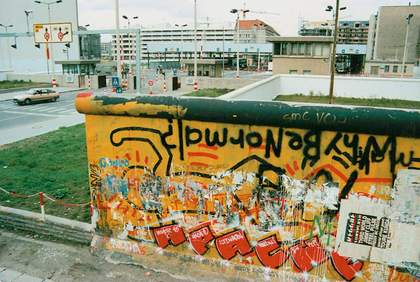
The mural began to disappear almost immediately. Large sections were painted grey that night or by the following morning, and other artists and graffiti writers subsequently worked over parts of it. The reason for the first covering is uncertain. By the time the border opened in November 1989, Haring’s mural had long since ceased to be visible as he had painted it. It survives in photographs and filmed footage.
Its short life distinguishes it from the murals visitors see at the East Side Gallery today, which were painted after the border opened. Haring worked while the Wall still served its original purpose. That fact gives the photographs their lasting force: the figures are already linked, and the guard is still on the other side.
Looking for more on Haring? Read ten facts about Keith Haring’s Pop Shop, explore his most popular print series, or discover the ten Keith Haring works that fetched the most at auction. For a closer look at the editions, read our guide to collecting Keith Haring prints.
For more information about Keith Haring prints for sale, or to discuss selling a Keith Haring print, contact our team at info@alexyellop.com.