
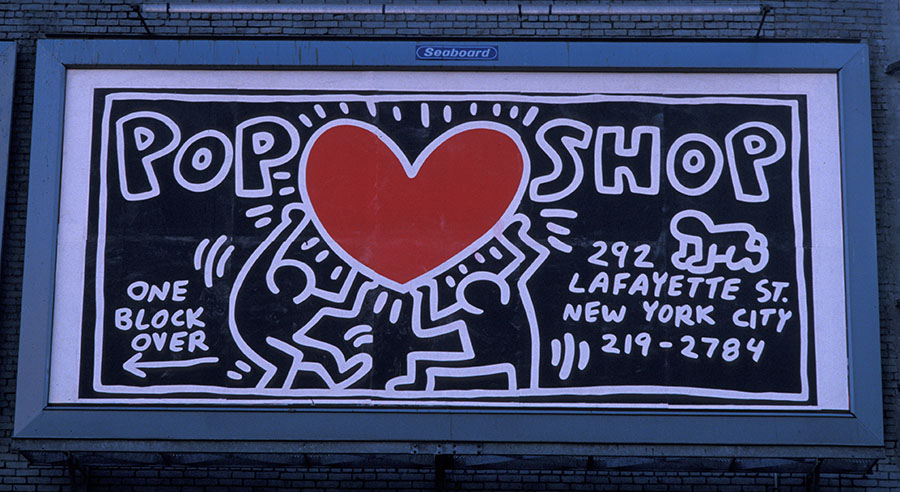
Keith Haring opened the Pop Shop in 1986 so that people who knew his work from the New York subway could take something of it home. The shop sold T-shirts, badges and other everyday objects, but Haring also painted the interior and developed a body of drawings that fed into his printmaking. A year after the shop opened, the first Pop Shop portfolio appeared. The storefront and the prints shared a name and a visual language, but each offered a different way to encounter his art.
1. The first Pop Shop opened at 292 Lafayette Street
Haring chose a storefront in SoHo, where galleries were already showing his work and where a shop could bring him into contact with a different audience. A visitor could stop in, look around and buy something without knowing anything about contemporary art. That informality mattered to Haring, who had spent years making drawings in places where people encountered them as part of their daily lives. The shop gave that public a permanent address.

2. Haring saw the shop as a continuation of his subway drawings
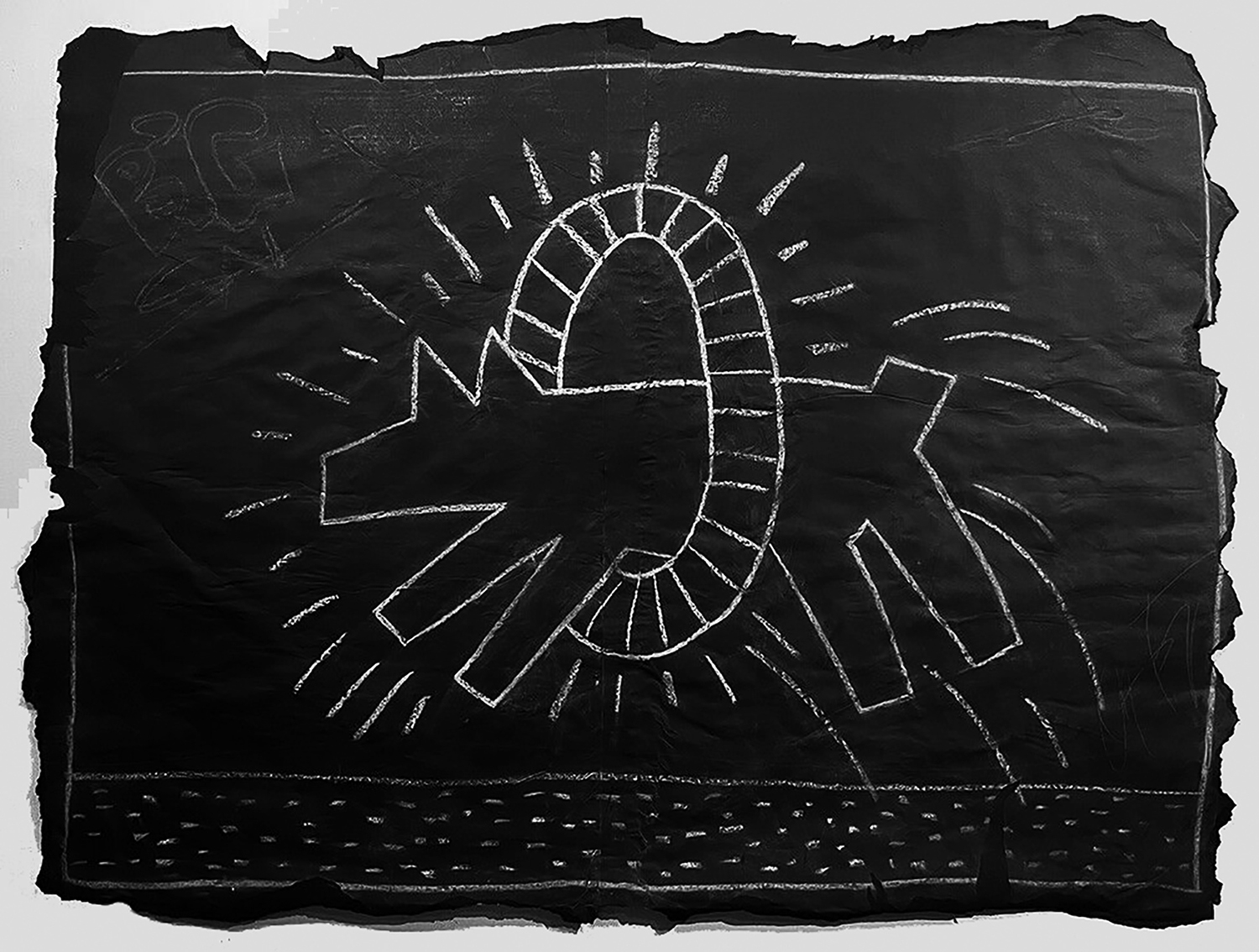
In the subway, Haring drew in white chalk on the black paper used to cover vacant advertising panels. The drawings were made to be seen in passing, and the people who saw them included commuters, children and transit workers. The Pop Shop kept that breadth of audience while changing the terms of the encounter. A drawing on a platform might disappear before the next journey; a badge or shirt could carry one of his images into someone else’s life.
3. Andy Warhol encouraged Haring to go ahead
Haring was aware that opening a shop might give critics an excuse to dismiss his work as too commercial. Warhol, who had built a career out of taking commercial imagery seriously, encouraged him when he had doubts and made a T-shirt for the shop. That support helps explain why the Pop Shop belongs in the story of American Pop Art as much as in the story of 1980s retail. Haring took a question Warhol had posed in galleries—what happens when art and commerce share the same imagery?—and gave it a storefront.

4. The interior was part of the artwork
Haring covered the interior with interlocking black lines on white, carrying the design across the walls and ceiling. Rather than hanging a few works around the merchandise, he made the room itself recognisably his. The effect was almost the reverse of looking at one of his prints: instead of following the action inside the border of a sheet, visitors stood inside a drawing that continued above and around them.

5. The first print portfolio came a year after the shop opened
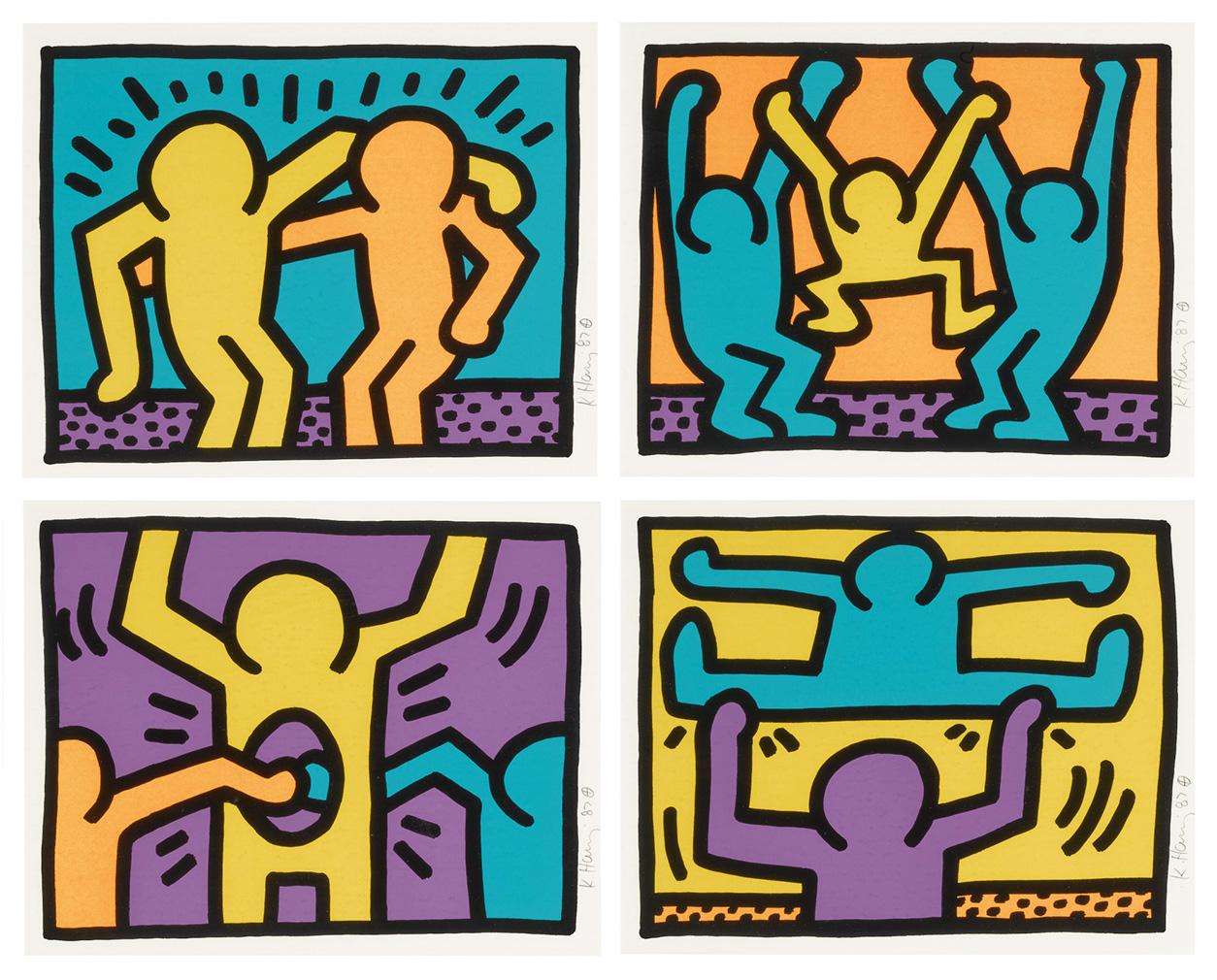
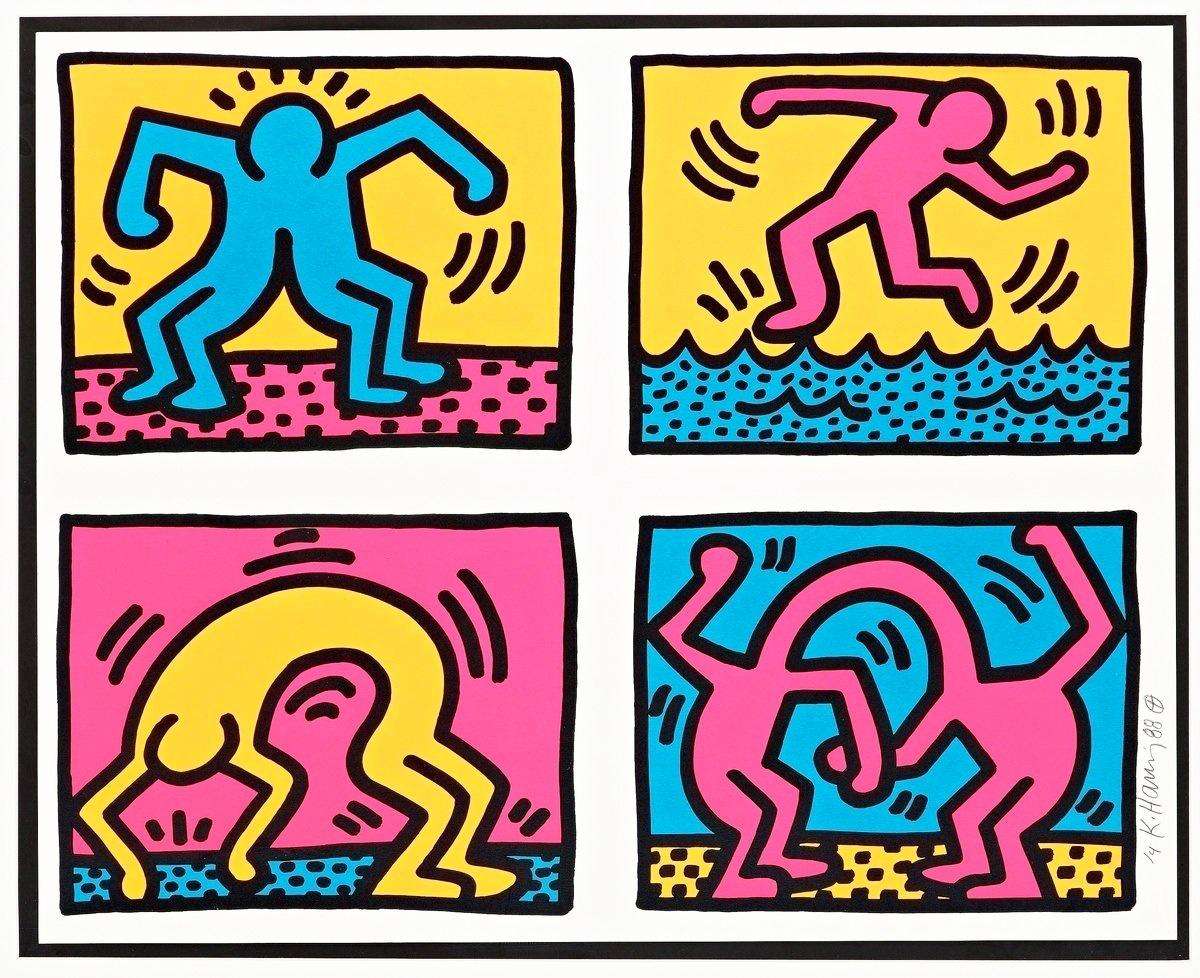
Pop Shop I appeared in 1987. Its four prints brought the directness of the shop’s imagery into compositions with bold outlines and broad areas of colour. Across Pop Shop II, Pop Shop III and Pop Shop IV, and into the final portfolios, Pop Shop V and Pop Shop VI, the imagery remains immediately recognisable. Looking across the series makes it easier to see how much a change in colour or in the marks around a figure can alter the mood of a print.
6. Haring opened a second Pop Shop in Tokyo
The Tokyo branch opened in 1988 in the Aoyama neighbourhood. Built from shipping containers, it gave Haring a very different space to work with, and he painted its interior as he had in New York. The Tokyo shop closed that same year, but its brief run was a striking test of one of Haring’s ideas: drawings developed on the streets and platforms of New York could speak to people in a city on the other side of the world.
7. The Quads bring four compositions onto one sheet
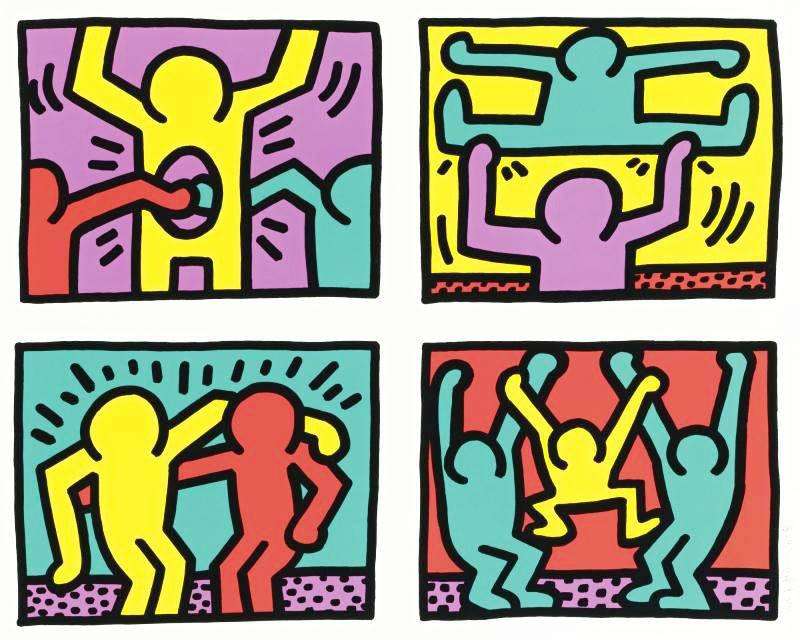
A Pop Shop portfolio presents its four compositions as separate prints. The Pop Shop Quads bring the corresponding compositions together in a grid on a single sheet, so the colours and gestures can be read in relation to one another at a glance. The difference is easy to appreciate with Pop Shop I: an individual print gives one composition your full attention, while the Quad makes the shifts between all four part of the experience.
8. Haring signed the first two Quads himself
Pop Shop Quad I and Pop Shop Quad II were signed by Haring. The later Quads, III through VI, were issued with estate authentication rather than Haring’s own signature. Collectors comparing examples should know that the estate stamp and executor’s signature can appear on the reverse, where they may be hidden by the frame. The distinction is particularly useful because the imagery and format remain recognisably part of the same series, even though the way the works were signed changed.
9. The New York shop stayed open for fifteen years after Haring’s death
Haring died in 1990, but the Keith Haring Foundation kept the Lafayette Street shop open until September 2005. Its longevity meant that a generation who had never seen Haring draw in the subway could still visit a space he had conceived and painted. After it closed, the ceiling was preserved and entered the collection of the New-York Historical Society. Tate Modern later reconstructed aspects of the shop for its 2009 exhibition Pop Life, giving visitors a sense of what was lost when the storefront closed.
10. The prints still carry the idea that made the shop distinctive
Collectors can approach Pop Shop through a single image, a complete portfolio or a Quad, and each rewards a different kind of looking. The appeal of an individual sheet might be a particular combination of colours or the movement in a figure; with a portfolio or Quad, part of the pleasure is seeing what happens when those images sit together. All three formats retain something of the shop’s original character: the pictures are clear enough to catch the eye straight away, with enough invention to keep it there.

Looking for more on Haring? Read about why Keith Haring opened the Pop Shop, explore what Haring’s symbols mean, or discover how to collect Keith Haring prints.
For more information about Keith Haring prints for sale, or to discuss selling a Keith Haring print, contact our team at info@alexyellop.com.