
A face could be drawn with a few lines, assembled from overlapping shapes or pressed into the surface of a ceramic plate. A guitar could become a painting, a collage or a construction made from sheet metal. For Pablo Picasso, choosing a material was part of deciding what an artwork could become.
Across painting, drawing, printmaking, sculpture and ceramics, he repeatedly tested how far a familiar subject could be transformed while remaining recognisable. Sometimes he built an image through patient revision. Elsewhere, a decisive cut or an unexpected combination of objects supplied the solution.
Understanding Picasso’s techniques helps explain the extraordinary variety of his work. It also offers a rewarding way to look at individual pieces: through the decisions, materials and collaborations that brought them into being.
That willingness to change direction connects Picasso with innovators beyond the art world, as we explore in Picasso and the Beatles: The Art of Reinvention.
Drawing: a place to think
Drawing ran throughout Picasso’s career, connecting works that can initially seem very different. Pencil, charcoal, ink and other drawing materials allowed him to investigate a pose, adjust a composition or follow an idea through successive variations.
His sketchbooks contain studies for major paintings, including Les Demoiselles d’Avignon. Yet drawing also had an independent life. A sheet could hold a fully resolved image, with the balance of a few marks carrying everything necessary to describe a body or establish a mood.

Paper itself invited experimentation. Picasso cut, pasted, folded, tore and sometimes burnt it. A material associated with preparatory studies became a means of making sculptures and ambitious finished compositions.
These exchanges between media are central to his practice. An idea explored in a drawing might be reconsidered in paint, developed on a printing plate or given physical form in sculpture.
Painting through revision and transformation
Picasso’s paintings reveal a willingness to change direction as an image developed. Drawing, painting over, removing and rearranging forms could all contribute to the finished composition.
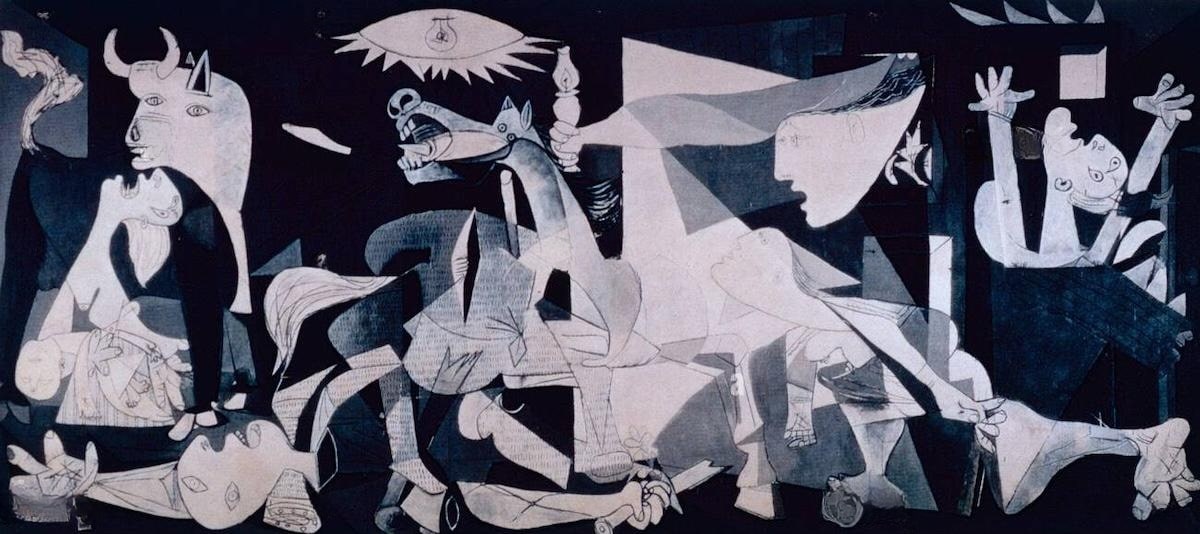
Guernica, painted in 1937, provides unusually clear evidence of this process. Dora Maar’s photographs document the painting as Picasso worked, recording changes to figures, poses and the relationships between them. Elements were altered or eliminated as he clarified the composition.
The photographs allow us to see how much decision-making lies behind the apparent force of the final image. Its impact emerged through sustained adjustment.
Colour was another means of organising a painting’s emotional character. The restricted blue palette of the Blue Period gives figures and their surroundings a shared atmosphere. Later works could use sharply contrasting colours and assertive outlines to produce a very different intensity.
There was no single Picasso paint surface or brushstroke. His handling changed with the demands of the picture, ranging from controlled description to broad, conspicuous marks.
Cubism: changing how a picture represents space
Developed with Georges Braque in the years before the First World War, Cubism transformed Picasso’s approach to depicting objects and figures.
Traditional perspective offered the illusion of looking into a scene from a fixed position. Picasso and Braque investigated what happened when different views could coexist within the same picture.
An object might be broken into facets, its contours interrupted and its surroundings drawn into the same network of planes. A face could combine features associated with a frontal view and a profile.
During the phase known as Analytic Cubism, restrained browns, greys and blacks helped direct attention towards these relationships. Recognising the subject could require time: fragments of a guitar, glass or figure gradually emerge through the composition.
These experiments gave ordinary objects considerable importance. Bottles, instruments and tabletops became subjects through which Picasso could rethink space. That continuing interest makes his still-life prints particularly rewarding to explore alongside his wider work.
Collage: bringing everyday materials into art
Around 1912, Picasso and Braque began incorporating cut and pasted papers into their compositions. Newspaper, wallpaper and other printed materials introduced surfaces that already carried associations from everyday life.
In Picasso’s Bottle and Wine Glass on a Table, 1912, newspaper appears alongside drawn marks. The materials participate in constructing the image, allowing a fragment of printed paper to suggest something beyond itself.
Collage changed the relationship between the depicted object and the surface carrying it. A viewer could recognise a bottle or a glass while remaining conscious of the paper from which the image was assembled.
It also brought text into the picture. Newspaper fragments introduced words, typography and references to contemporary events, creating possibilities beyond the purely descriptive.
Associated with Synthetic Cubism, this approach favoured larger, more clearly defined shapes. Cutting, positioning and combining materials became creative acts with consequences as significant as those of applying paint.
Sculpture: building an image in three dimensions
Picasso extended these investigations into sculpture, using construction and assemblage alongside modelling.
His sheet-metal Guitar, 1914, creates an instrument through joined planes and wire. Openings and projecting elements establish volume, while real shadows contribute to its appearance. Space becomes part of the construction.
The work demonstrates how a sculpture could be built from separate components. Its structure remains visible, inviting the viewer to understand how those components produce the impression of an object.
Bull’s Head, 1942, offers a particularly economical example of Picasso’s ability to recognise new possibilities in familiar things. A bicycle saddle becomes the animal’s face; handlebars supply the horns.

Both identities remain available. We see the bull and recognise the bicycle parts. The transformation depends on the relationship between objects and the imaginative act that brings them together.
That capacity to discover one form within another would also become important in Picasso’s ceramics.
Printmaking: exploring line, tone and successive versions
Printmaking gave Picasso several distinct ways to develop an image. He worked with specialist printers whose technical knowledge helped him investigate possibilities across etching, aquatint, lithography and linocut.
In etching, a line is drawn through a protective ground on a metal plate. Acid bites into the exposed areas, creating recesses that hold ink. Under pressure, dampened paper receives the image.
The process suited Picasso’s command of line, allowing figures and spaces to emerge through marks that could remain delicate or become densely worked. His etchings and aquatints also show how line could be combined with broader tonal effects.
Sugar-lift aquatint, explored through his association with Roger Lacourière, enabled brush-drawn marks to be translated into printed tone. It opened a connection between the movement of painting and the possibilities of the metal plate.
The printing process also encouraged Picasso to revisit an image. Proof impressions allowed him to assess changes and develop further states, preserving evidence of a composition’s evolution.

For collectors, understanding these processes provides a useful starting point when comparing works. Our guide to collecting Picasso prints explains how to approach the different areas of his printed work.
Lithography: drawing for the press
Lithography offered another relationship between drawing and printing. An image is made using greasy materials on a prepared surface, traditionally stone. During printing, the process exploits the resistance between grease and water to distinguish the image from the surrounding area.
Picasso’s collaboration with the Mourlot workshop became an important setting for experimentation. Lithography accommodated different qualities of mark, from assertive contours to softer, more tonal passages.
Its capacity for revision appealed to an artist accustomed to reconsidering images. A composition could be worked on and assessed through successive impressions.
His lithographs belong within the same sustained exploration of faces, figures and objects found throughout his career. Across his portraits of Jacqueline Roque, the return to a familiar sitter provided opportunities to test different approaches to likeness and form.

Linocut: making colour through cutting
Linocut brought a different physical action into Picasso’s printmaking. The artist cuts into a linoleum block; the raised areas receive ink and transfer the image to paper.
Working with printer Hidalgo Arnéra, Picasso explored the medium’s capacity for strong colour and clearly defined shapes.
His Buste de Femme d’après Cranach le Jeune, 1958, required six separate blocks for its colours. The difficulty of aligning multiple blocks helped prompt a different approach.

In the reduction process developed with Arnéra, a single block could be cut and printed repeatedly, with further material removed between colour stages. Earlier printed layers remained on the sheets while the block continued to change.
This required planning: once a section had been cut away, it could no longer print from the block. Colour accumulated through an irreversible sequence of decisions.
Picasso’s linocuts make that interaction between cutting, layering and colour central to their appeal. Jacqueline au Bandeau, 1962, offers another example of his engagement with the medium, bringing technical experimentation together with one of his most frequently revisited subjects.
Ceramics: letting the object suggest the subject
Picasso’s sustained involvement with ceramics developed at the Madoura pottery in Vallauris, following his encounter with the workshop in 1946.
Working with Suzanne and Georges Ramié and the workshop’s craftspeople, he explored decorating, incising and reshaping ceramic forms. Slips, oxides, glazes and firing introduced effects different from those available in conventional painting.
A vessel’s existing shape could suggest the subject. A jug might become an animal, its handles contributing to the transformation. The hollow of a dish could accommodate a face, while the circular surface of a plate offered a setting for a bullring.

Decoration and form worked together. Picasso could follow a curve, emphasise a projection or introduce marks that changed how the object was understood.
His ceramics bring painting, sculpture and everyday pottery into close contact. They demonstrate the same curiosity evident elsewhere in his work: what could this material do, and what might this familiar shape become?
Looking at Picasso through his techniques
Picasso’s range becomes easier to understand when we follow these connections. Drawing leads into painting; collage opens possibilities for construction; a brush mark finds another expression in print; a vessel becomes a figure.
Familiar subjects gave him room to experiment. Returning to a face or a still life allowed him to discover how a change of process could produce a different image—and a different experience for the viewer.
For collectors, looking closely at technique brings that inventiveness into focus. The character of a line, the relationship between printed colours or the way decoration follows a ceramic form all reveal something of Picasso’s decisions. Each work offers a particular encounter between an idea and the means he found to express it.
For information on Pablo Picasso prints for sale, or to discuss selling a Picasso artwork, contact our team at info@alexyellop.com.