
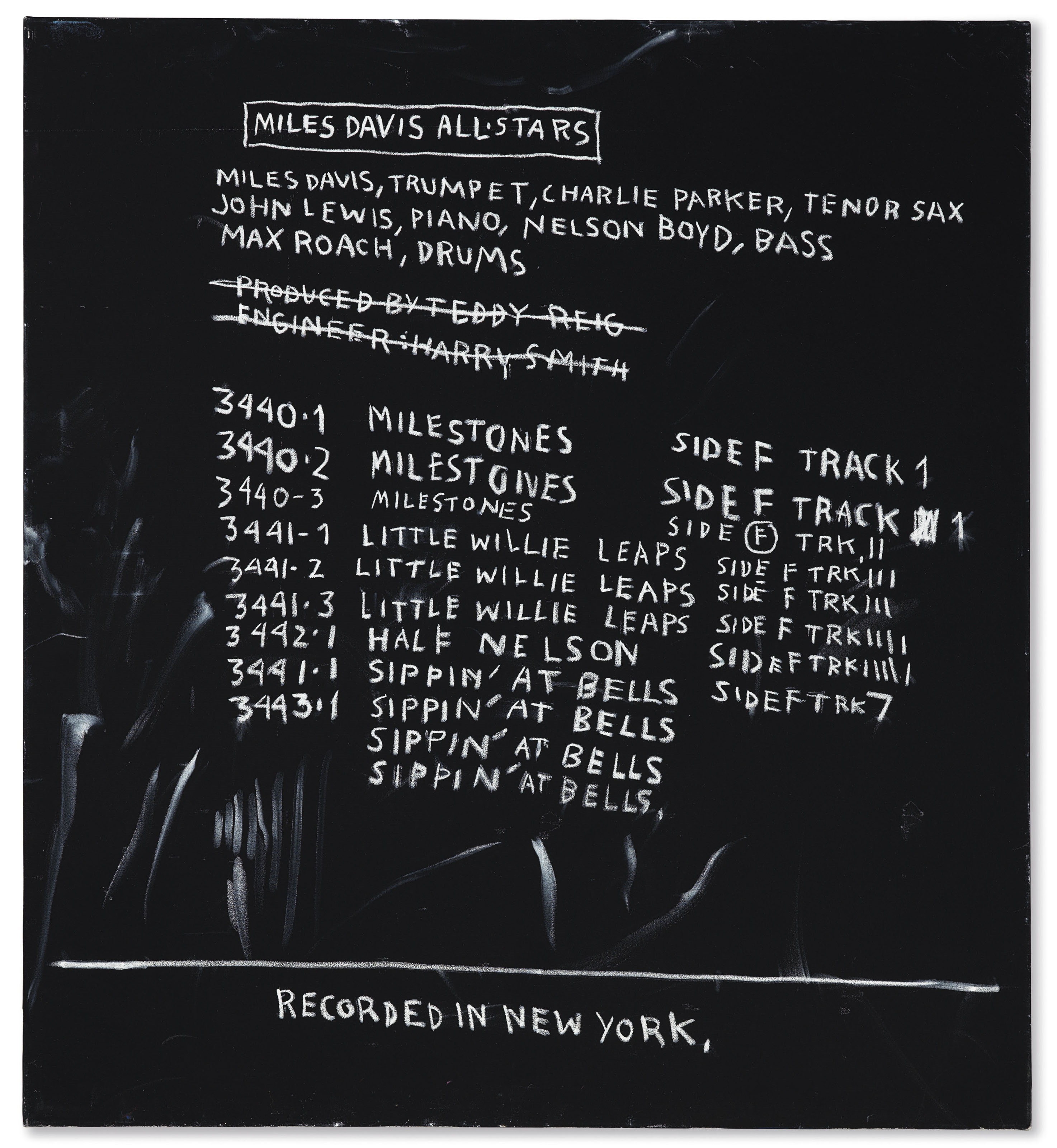
Jean-Michel Basquiat paid attention to the names on a record sleeve. In Discography Two, he brings the credits and titles associated with recordings by Charlie Parker and Miles Davis into the painting, giving information usually printed in small type the prominence of a portrait. In Horn Players, he sets Parker’s saxophone against Dizzy Gillespie’s trumpet, with words and fragments of faces moving between them. And in Max Roach, a drummer takes centre stage. The works show how closely Basquiat listened, and how much he noticed about the people who made the music.
Jazz gave Basquiat more than a set of subjects. It offered a way to think about how a composition could hold together while changing direction, and it gave him a history of Black artists whose innovations had transformed American culture. Those two interests meet in his paintings: the musicians are worth commemorating partly because of what they made possible.
The musicians Basquiat put on canvas
Charlie Parker is the figure Basquiat returned to most often, but the paintings take in a wider world of musicians. Gillespie shares Horn Players with Parker, and Discography Two brings Miles Davis into the picture. Basquiat also devoted a painting to Max Roach, whose drumming helped define bebop. Roach’s presence is a reminder that a history told chiefly through famous soloists can miss the musicians who changed what was possible around them. By putting a drummer at the centre of a painting, Basquiat gives a different part of the music its due.
The record sleeve mattered because it gave Basquiat a way to show music as the work of several people. A conventional portrait might tell us what a musician looked like; a list of players can show who was in the room and how careers intersected. In Discography Two, details a listener might ordinarily glance over become things to read and return to. The painting conveys the pleasure of someone who wants to know how a record came together, as well as how it sounds.
Repetition and Improvisation in Horn Players
In Horn Players (1983), Parker and Gillespie occupy opposite sides of a three-panel painting, with a dense exchange of words and marks between them. One of the most telling inscriptions is ORNITHOLOGY, the title of a bebop standard Parker recorded in 1946 and a play on his nickname, Bird. Basquiat could evoke a musician with a face, an instrument or a word that opened onto a whole piece of music. In this painting he uses all three.
The comparison with jazz becomes more interesting when we follow how the painting moves. The panels suggest a sequence, but a word or a figure can send the eye back in the direction it came from. A fragment that looks incidental on the first pass takes on more weight when it reappears in different company. Something similar happens in bebop when a musician returns to a phrase and changes its timing or emphasis: recognition is part of the pleasure, because it lets the listener hear the difference.
That does not make Horn Players a picture of a particular performance. What jazz helps explain is how a painting can feel improvised and still have a structure. The faces, instruments and repeated words give the eye places to return to, even when the route between them is unpredictable. Basquiat uses the same freedom elsewhere in his crowns, skulls and written inscriptions, where a familiar sign can change meaning according to what he puts beside it.

Jazz and the question of who gets remembered
Jazz also gave Basquiat a way to think about recognition. American audiences celebrated Black musicians whose lives and careers were shaped by segregation and racism. Some performers made those conditions the subject of their work: Billie Holiday sang about lynching in Strange Fruit, while Charles Mingus took aim at segregation in Fables of Faubus. These works help place Basquiat’s paintings in a wider tradition of Black artists confronting American history. Their relevance lies in that shared tradition; a painting needn’t contain a reference to a particular song to belong in the conversation.
Basquiat’s Charles the First, later issued as a screenprint in Portfolio II, brings the question of recognition into the picture itself. The title and crowns give the Parker tribute a royal register, but the warning about young kings having their heads cut off unsettles the tribute. The painting grants its subject stature while leaving room for a more difficult thought: being celebrated can come with dangers of its own.
In Now’s the Time (1985), Basquiat makes another kind of tribute. The black disc resembles a record and carries the title of Parker’s composition in white. Placed alongside the crowded Horn Players, it shows how spare Basquiat could be when the subject called for it. The title and shape are enough to send a viewer back to the recording. The painting leaves the music to do the rest.

From collecting records to making one
Jazz was one part of a much wider musical life. Basquiat performed with Gray, an experimental band that played in downtown New York, and in 1983 he produced Beat Bop, a single by Rammellzee and K-Rob, and designed its sleeve. The sleeve makes a good counterpart to Discography Two: in the painting, the material that comes with a record becomes art; on Beat Bop, Basquiat’s art becomes part of how listeners first encounter the record.
Music also appears in works without an explicit tribute to a jazz musician. Piano Lesson, later published as part of the Superhero Portfolio, carries music into the title through the ordinary act of learning to play. It sits at some distance from the famous performers of Horn Players, which is part of what makes it a useful companion.
Put on one of the records and come back to the paintings. Parker and Gillespie give Horn Players a different point of entry; listening to Roach makes the choice to paint a drummer feel especially apt. What comes through across the works is the care Basquiat took over whose names appeared, how often they returned and how much room he gave them on the canvas.

Looking for more on Basquiat? Explore how Picasso influenced his art or read our guide to collecting Jean-Michel Basquiat prints.
For more information about Jean-Michel Basquiat prints for sale, or to discuss selling a Basquiat print, contact our team at info@alexyellop.com.