
When Garçon à la pipe sold for $104.2 million in 2004, it became the first artwork to pass $100 million at auction. The painting came from Picasso’s Rose Period, when he was still a young artist finding his feet in Paris. Eleven years later, a Picasso painted half a century after it took his auction record to $179.4 million. By then, the artist had helped invent Cubism and changed the course of modern painting; in Les Femmes d’Alger, he was using the freedom he had earned to take on Delacroix.
The prices tell their own story about the longevity of Picasso’s market. The ten paintings below were made between 1901 and 1955, and their auction sales stretch from 2004 to 2023. Four of the ten, however, date from a single year: 1932. In those paintings, Marie-Thérèse Walter appears upright in a chair, seated beside a window or stretched out in forms that barely resemble a conventional portrait. Seeing them together makes clear why collectors distinguish so closely between works made even a few months apart.
We explore the ten highest prices paid for Picasso paintings at public auction, looking at the works themselves and the sales that established their place in his market.
1. Les Femmes d’Alger (Version ‘O’) (1955) — $179,365,000
Christie’s, New York, May 2015
Picasso made fifteen paintings after Eugène Delacroix’s Women of Algiers, returning to the arrangement of figures in an interior and changing it from one canvas to the next. In the last version, O, the room is crowded with competing angles and passages of strong colour. The figures are still there, but the space around them no longer behaves as it does in Delacroix. Picasso was using the older painting to see how far he could push ideas he had been working with since Cubism.
Victor and Sally Ganz bought the series as a group in 1956. Version ‘O’ sold at Christie’s in 1997 for $31.9 million and returned to the same auction house in 2015, where it set Picasso’s current auction record.
Working in variations was central to Picasso’s practice. The fifteen versions of Les Femmes d’Alger make that especially clear: a change in the position of a figure or the balance of colour can alter the whole room. That same appetite for reworking a subject runs through his lithographs and linocuts, where successive versions let us follow how an image takes shape.
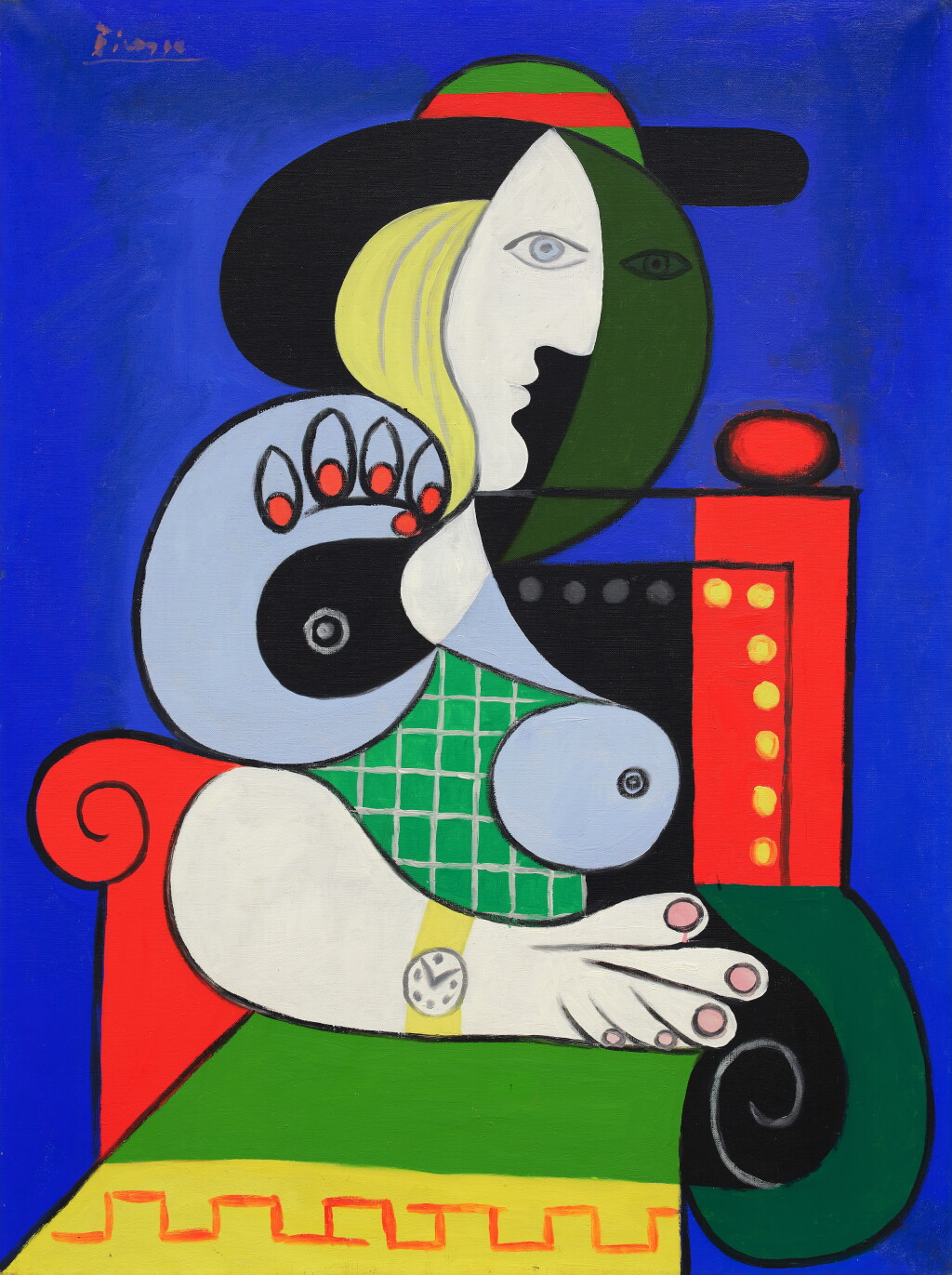
2. Femme à la montre (1932) — $139,363,500
Sotheby’s, New York, November 2023
Marie-Thérèse Walter sits upright in a chair, with the watch that gives the painting its title visible at her wrist. It is a small detail in a portrait that otherwise takes considerable liberties with the body. Her rounded profile and the broad areas of colour give the figure a composure quite different from the reclining Marie-Thérèse of Femme nue couchée, painted in the same year.
Emily Fisher Landau acquired the painting in 1968 and kept it for 55 years. When it came to Sotheby’s in 2023, it fetched the second-highest price paid for a Picasso at auction and was the most expensive artwork sold at auction that year.
3. Fillette à la corbeille fleurie (1905) — $115,000,000
Christie’s, New York, May 2018
The young flower seller stands almost straight on, holding a basket that supplies one of the few bright passages in the painting. The figure’s posture and direct gaze give the work an unsentimental quality. It is a Rose Period picture, but there is little of the sweetness that label might suggest.
Its ownership traces a route through some of the most important collections of early modern art. Leo and Gertrude Stein bought it in 1905, the year Picasso painted it. It later entered the Rockefeller collection and was among the leading works in Christie’s sale of the collection of Peggy and David Rockefeller in 2018.

4. Nude, Green Leaves and Bust (1932) — $106,482,500
Christie’s, New York, May 2010
Picasso gives Marie-Thérèse two forms in the same painting: a reclining figure in the foreground and a sculpted head above it. The bust, the leaves and the curve of the body all compete for attention. It is one of the clearest examples in the ranking of how freely Picasso moved between painting and sculpture, allowing the two to inform the way he pictured the same person.That exchange between image and object also runs through Picasso’s ceramics, where the curve of a plate or the shape of a jug can determine how he draws a face or arranges a figure.
Sidney and Frances Brody acquired the canvas in 1950 and held it for six decades. Rarely seen in public during that time, it came to Christie’s in 2010 and set a new auction record for Picasso.

5. Garçon à la pipe (1905) — $104,168,000
Sotheby’s, New York, May 2004
A young man in blue holds a pipe, with a garland on his head and flowers behind him. The arrangement is too deliberate to feel like a casual likeness, but Picasso leaves the relationship between those details open. The sitter has something of the reserve of the girl with the flower basket, even though the two paintings, made in the same year, are composed very differently.
The work came to Sotheby’s from the collection of Mr and Mrs John Hay Whitney. Its sale in 2004 marked the first time a work of art crossed the $100 million threshold at auction, a benchmark that makes this result significant well beyond Picasso’s own market.

6. Femme assise près d’une fenêtre (Marie-Thérèse) (1932) — $103,410,000
Christie’s, New York, May 2021
The window and chair give this portrait a firm architectural structure, against which Marie-Thérèse’s profile and shoulders take on a pronounced curve. Compare it with Femme à la montre: both are seated portraits, but here the space around the sitter does more to determine how we see her. The result feels poised without being still.
This was one of the few works in the ranking with a recent auction price to compare. It had sold in London for £28.6 million in 2013. Eight years later, it passed $100 million in New York.

7. Dora Maar au chat (1941) — $95,216,000
Sotheby’s, New York, May 2006
Dora Maar sits in a chair with a small black cat behind her shoulder. The cat is easy to miss beside the hat, the angular face and the long fingers. Maar was a photographer and artist in her own right, and there is a force to the way Picasso presents her: even with so much happening around her, she commands the painting.
Painted in 1941, during the German occupation of Paris, it has a sharper, more compressed feel than the portraits of Marie-Thérèse from 1932. When it sold in 2006, it became the second most expensive painting then sold at auction, behind Garçon à la pipe.

8. Femme au béret et à la robe quadrillée (Marie-Thérèse Walter) (1937) — £49,827,000
Sotheby’s, London, February 2018
Five years after the portraits that dominate this ranking, Picasso was still finding new ways to paint Marie-Thérèse. In this canvas, the beret and checked dress give the eye familiar details to hold on to while the face is divided into sharply contrasting shapes. The clothes are almost easier to make sense of than the person wearing them.
The painting was made in the year of Guernica and appeared at auction for the first time in 2018. Its £49.827 million result, equivalent to about $69 million at the time, is the only London sale in the top ten.

9. Femme nue couchée (1932) — $67,475,000
Sotheby’s, New York, May 2022
In this reclining nude, Marie-Thérèse takes on a form closer to a sea creature than to the seated figure in Femme à la montre. Her interest in swimming gives the comparison a biographical point of departure, but the painting is worth looking at for how completely Picasso reorganises the figure. The limbs and body are recognisable just long enough for their relationships to become strange.
The work made its auction debut in 2022. Its result puts four paintings from 1932 in the top ten, even though the four share remarkably little in the way they pose, frame or describe the same sitter.
10. La Gommeuse (1901) — $67,450,000
Sotheby’s, New York, November 2015
The earliest painting in the ranking comes from the beginning of Picasso’s Blue Period. The figure’s subdued colouring and inward expression give the front of the canvas a withdrawn quality, while the reverse contains something quite different: a caricature of Pere Mañach, Picasso’s early dealer. The second image was discovered during conservation in 2000.
That contrast makes La Gommeuse an unusually good place to end the list. The two sides preserve different impulses from the same moment in the young artist’s career. At auction in 2015, it fetched just $25,000 less than Femme nue couchée would seven years later.

Looking for more on Picasso? Explore how Pablo Picasso created his art or read our guide to collecting Pablo Picasso prints.
For more information about Pablo Picasso prints for sale, or to discuss selling a Picasso artwork, contact our team at info@alexyellop.com.