
Francis Bacon distorted faces because a faithful likeness could only tell him so much. A photograph could record where the eyes and mouth sat, how the head turned or what expression a person wore for a fraction of a second. Bacon wanted a portrait to convey the force of encountering someone he knew. That might mean pushing the mouth out of line, letting one side of the face run into shadow or painting the same person three times without settling on a single likeness. The test was whether the sitter still had a presence after Bacon had taken such liberties with their appearance.
Francis Bacon’s portraits are particularly striking when the sitter was someone close to him. George Dyer, Isabel Rawsthorne and Lucian Freud all sat for photographs that Bacon could use in the studio. Those photographs give us a way to see where he began and how far he was willing to go. They also complicate the idea that the distortions were simply expressions of anguish. Sometimes a turn in a painted face began with something as ordinary as a fold or a tear in a photograph.
A likeness could be accurate and still miss the person
In his interviews with David Sylvester, Bacon described wanting to distort an image so far that it brought him back to the facts of what he was painting with greater force. That sounds contradictory until we consider the difference between recognising a person in a photograph and remembering what it was like to be around them. The photograph fixes an expression. Memory is less orderly: a turn of the head or the way someone holds their mouth can stay with us more clearly than the exact shape of their features.
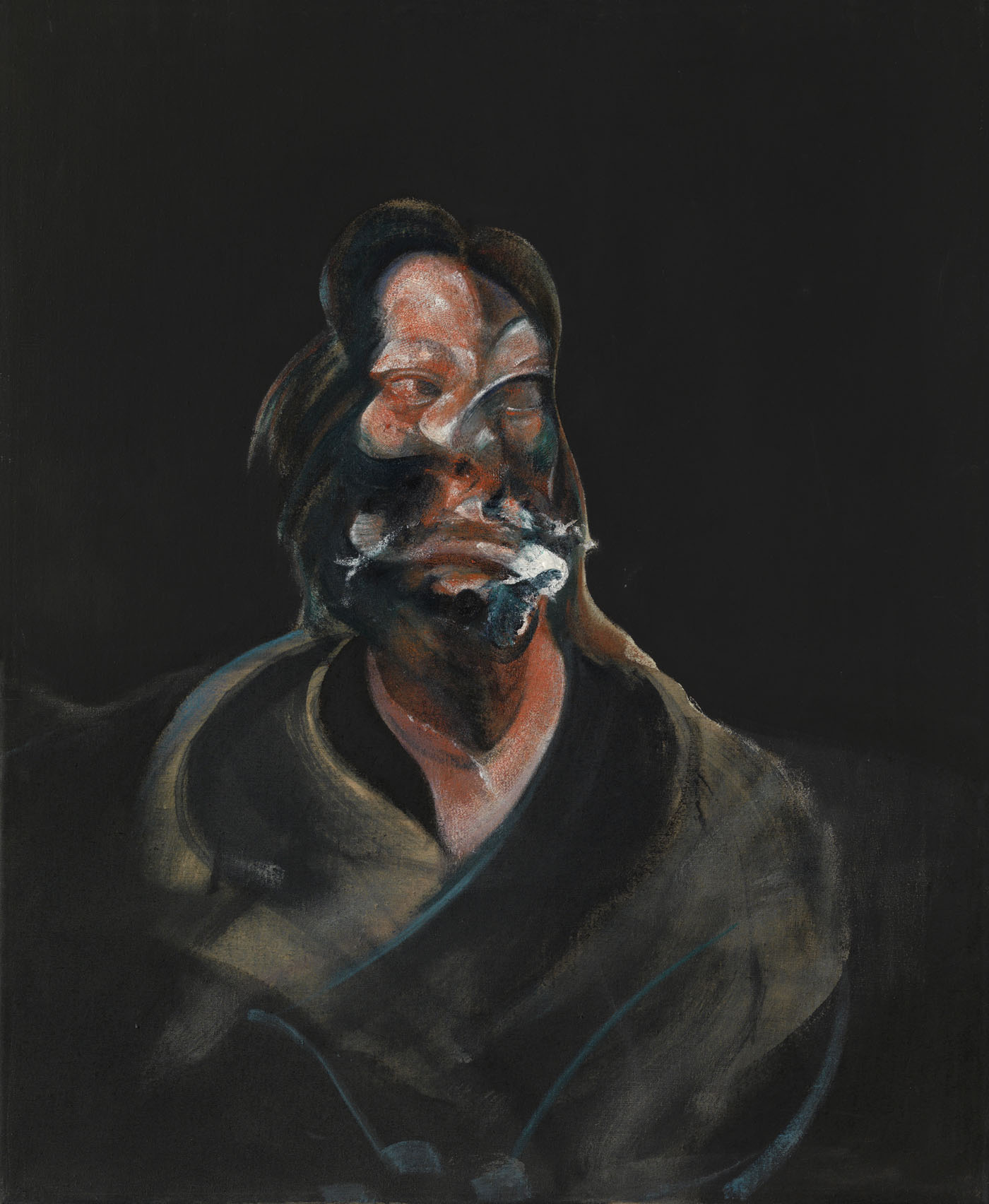
Bacon could preserve one of those details while changing almost everything around it. In Portrait of Isabel Rawsthorne (1966), the face is pulled out of alignment, yet the head still has the bearing of a particular person. The distortion works because something holds against it. Take away every trace of the sitter and the face could belong to anyone; preserve every feature at equal strength and the picture might lose the thing Bacon remembered most vividly.
That is one reason the portraits repay a longer look. The first impression may be of a face coming apart. After a while, it becomes possible to see how firmly Bacon has held on to certain features, and how much of the likeness depends on those choices.
What John Deakin’s photographs gave Bacon
In the 1960s, Bacon asked the photographer John Deakin to photograph people in his circle, including Rawsthorne, Freud, Henrietta Moraes and Dyer. Working from photographs let him paint without having the sitter in front of him. He could return to a pose as often as he liked, combine what he saw with what he remembered, and change a face without the pressure of having its owner watch him do it.
Some of the photographs that survived in his studio are creased, torn or worn away. One fragment of a Deakin photograph of Dyer preserves little more than the eyes, nose and mouth. In the middle panel of Three Studies for Portrait of George Dyer (on light ground) (1964), the division between lighter and darker parts of the face and the way the hair breaks into two levels invite comparison with that damaged print. It is impossible to know exactly when every tear appeared, but the comparison shows why the physical state of Bacon’s source material matters. A broken edge could give him an arrangement of features he would have been unlikely to find by looking at the sitter directly.

Our article on who George Dyer was and why he mattered to Francis Bacon follows that relationship through the paintings. The 1964 studies make an especially useful starting point for looking at the faces: Bacon was already finding ways to interrupt Dyer’s likeness years before the memorial triptychs.

Why Bacon painted the same face more than once
A triptych let Bacon keep several versions of a person in view at once. Each panel could give a different emphasis to the head or body, with no need for one image to resolve the others. A shift that might seem arbitrary in a single portrait becomes easier to follow when the sitter appears again beside it.
In Three Studies of Lucian Freud (1969), Bacon paints Freud seated in all three panels. The repeated chair and the lines around the figure give the eye something stable to return to as Freud’s posture and head change. The panels can suggest movement, but they also show how much a portrait depends on which aspect of the sitter the painter chooses to hold still. The three views belong together precisely because none can do the work of the other two.
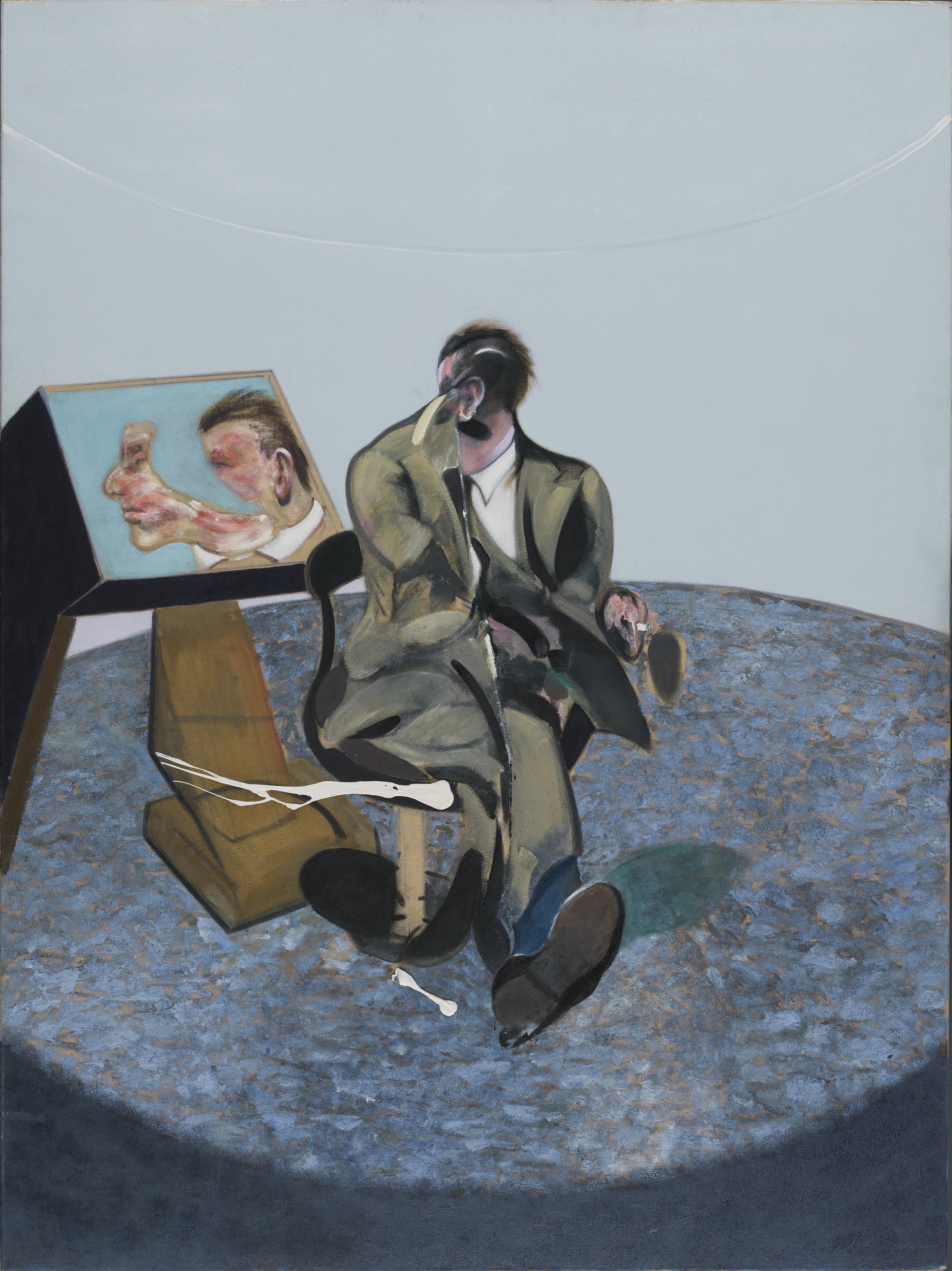
Bacon could make a related point within a single painting. In Portrait of George Dyer in a Mirror (1968), the mirror gives the face another place to appear and another chance to change. A mirror normally offers a second view that helps confirm what is in front of us. Bacon makes the relationship between figure and reflection less reassuring: the more views we have, the harder it is to decide which one should count as the likeness.
Accident gave Bacon something to work with
Bacon valued the way paint could produce an unexpected mark. A stroke across the cheek might suggest a turn of the head he had not planned, or an uneven passage might give the mouth more life than a carefully drawn outline. The important decision came afterwards, when he had to judge whether the mark belonged in the portrait and what the rest of the face needed to do around it.
The photographs make it harder to treat chance as the whole explanation. Bacon had already made choices about whom to photograph, what pose to use and which parts of the image to carry over. Some of his most abrupt distortions bear a relationship to the material in his studio. What looks like a sudden attack on the likeness can turn out to have a source, even if the final form only emerged in paint.
The detail that survives a distortion is often what makes the sitter recognisable: the line of a jaw, the turn of a head or the way someone holds their mouth. Look for those details in Bacon’s portrait prints, where the tension between likeness and distortion carries over from the paintings. For more on how Bacon’s paintings became editions and what to look for when buying one, read our guide to collecting Francis Bacon prints.
For more information about Francis Bacon prints for sale, or to discuss selling a Francis Bacon print, contact our team at info@alexyellop.com.