
Keith Haring opened the Pop Shop in 1986 because he wanted people to enjoy his art without having to afford a painting. At 292 Lafayette Street in New York’s SoHo, visitors could buy T-shirts, posters and badges carrying the same figures they recognised from his subway drawings and gallery exhibitions, bringing his work into their everyday lives.
The venture drew criticism from those who saw merchandise as a threat to his credibility, but Haring regarded the shop as an extension of the public encounters that had established his reputation. As demand pushed his paintings beyond the reach of much of his audience, he wanted to preserve a connection with the people who had responded to his work from the beginning.
With encouragement from Andy Warhol, Haring created a space that brought art, shopping and social exchange together, challenging assumptions about who art was for and how people should experience it.
From Subway Walls to Lafayette Street
Haring’s interest in reaching people outside galleries took shape in New York’s subway stations, where he began drawing in white chalk on the black paper covering unused advertising panels in 1980. Commuters encountered his figures during their daily journeys, often watching him work or stopping to ask what the drawings meant.
These exchanges gave Haring something a studio could not provide: an immediate response from people of different ages, backgrounds and levels of interest in art. The subway became a place to develop his imagery while discovering how people interpreted it, with recurring figures becoming familiar through their appearance across the city.
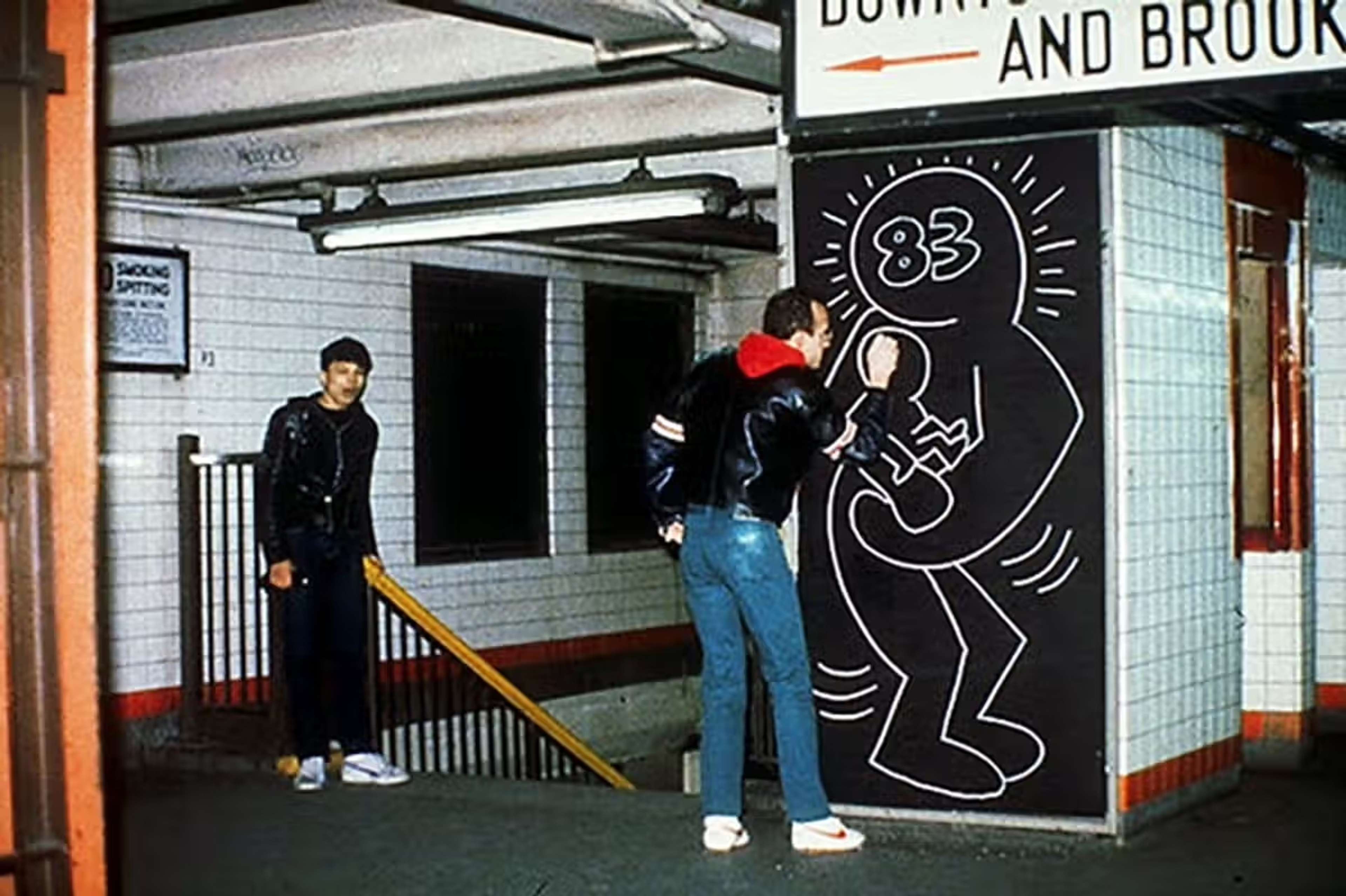
Growing recognition eventually disrupted that relationship. Haring recalled that his drawings were being removed within hours and offered for sale, taking them away from the public for whom they had been made. Meanwhile, his increasing success in galleries meant that owning his work required considerably more money.
The Pop Shop offered a way to continue that public relationship under circumstances he could control, giving visitors somewhere to encounter his art and buy something at a price they could afford.
Step Inside Haring’s Pop Shop
Haring painted the shop’s interior with black-and-white figures and patterns, covering the walls, ceiling and floor to create an environment visitors could enter. The drawing extended around the merchandise, making the space itself as memorable as the objects on its shelves.
T-shirts, posters, badges, magnets and other inexpensive items carried his imagery, alongside designs by artists including Kenny Scharf and Andy Warhol. The range reflected Haring’s wish to welcome different kinds of visitors, from established collectors to young people discovering his work for the first time.
That openness mattered in SoHo, where the growing concentration of galleries had made the neighbourhood an important centre of the contemporary art market. The shop gave Haring another way to participate in that world, providing a welcoming space in which someone could spend very little and still leave with something connected to his work.
Its appeal also depended on the experience of visiting. Surrounded by his drawing, customers could understand how a figure on a small object belonged to a much larger body of art.
Selling Art or Selling Out?
Haring’s decision exposed a tension that had followed Pop Art for decades: how closely could an artist engage with consumer culture before being accused of surrendering to it?
For some critics, the repeated appearance of his figures on merchandise risked reducing the work to a logo. Their concern was that widespread recognition might replace close attention, encouraging people to recognise a Haring without considering what the image expressed.
Haring understood the criticism, yet questioned why selling expensive paintings should be considered more respectable than selling affordable objects. Commercial exchange already shaped the gallery market, and limiting his work to that system would have excluded many of the people he wanted to reach.
His position involved more than enthusiasm for reproduction. He remained concerned with the quality of the objects and the circumstances in which his imagery appeared, seeing the shop as an artistic project whose accessibility needed to coexist with care over its presentation.
The debate remains relevant because Haring’s images are now so widespread. Familiarity can introduce people to his art, while also making it easier to overlook its complexity.
Andy Warhol’s Vote of Confidence
Warhol encouraged Haring to open the shop when he became anxious about how the art world would respond. As a friend and an artist Haring deeply admired, his support carried particular weight, offering reassurance from someone who had already challenged distinctions between fine art, publicity and commerce.
Haring saw Warhol as a predecessor who had made it possible for artists to engage openly with popular culture. Their friendship brought that influence into his daily life through conversations, shared experiences and exchanges of work.
A snapshot of the relationship also appears in Andy Mouse, the 1986 portfolio in which Haring combined Warhol’s appearance with the familiar identity of Mickey Mouse. The resulting character brings together celebrity, childhood recognition and the circulation of images, subjects closely connected with the thinking behind the Pop Shop.

Haring’s tribute is affectionate and knowingly humorous, acknowledging Warhol’s stature while placing him within the popular culture that had helped shape both artists.
From the Shop Floor to the Printed Sheet
Haring’s Pop Shop prints span six portfolios: Pop Shop I, Pop Shop II, Pop Shop III, Pop Shop IV, Pop Shop V and Pop Shop VI. Together, they explore movement, gesture and relationships between figures through bold outlines and contrasting colours, extending the imagery associated with the shop into his editioned work.
Prints such as Pop Shop I (D), 1987, and Pop Shop II (D), 1988, connect the shop’s public appeal with his wider printmaking practice. The energy of the line remains central, while screenprinting gives the colour a clarity that helps establish rhythm and relationships between forms.

Original drawings supplied imagery that could be developed across editions and merchandise, reflecting Haring’s interest in allowing his work to circulate in different formats.
For collectors, those formats deserve to be understood individually. A limited-edition screenprint, a promotional poster and a later licensed reproduction have different histories and characteristics, even when they share recognisable imagery. Establishing exactly what is being offered is an important starting point for any purchase.
More Than Dancing Figures
Haring’s desire to reach a broad public ran through his work with children, his murals and his campaigns addressing HIV/AIDS, apartheid and drug addiction. The shop formed part of that wider effort to bring art into situations where it could communicate directly.
Its accessible setting accommodated imagery with serious social content, including posters connected with his political and AIDS-related work. The appeal of his drawing helped attract attention to subjects that could otherwise be difficult to discuss, allowing humour, directness and urgency to operate together.
Understanding that range is essential when looking at his familiar figures. As our article on the meaning of Keith Haring’s symbols explores, their significance develops through context and combination, extending well beyond the cheerful associations their popularity can suggest.
The connection between public engagement and social responsibility continued through the Keith Haring Foundation, which he established before his death to support children’s organisations and AIDS-related causes.
What Became of the Pop Shop?
The New York Pop Shop remained open after Haring’s death in 1990, continuing under the Foundation until September 2005, when rising costs led to its closure. For many visitors, it had preserved a tangible connection with the artist through the environment he created and the objects that continued to carry his imagery.
Its importance subsequently received attention in exhibitions, including Keith Haring: Art and Commerce at the Tampa Museum of Art in 2006 and the reconstruction of elements of the shop for Tate Modern’s Pop Life exhibition in 2009.
The original ceiling was preserved and donated to the New-York Historical Society, giving part of the shop a further public life. Its conservation also marked a shift in how the project was understood, as an environment once criticised for its commercial purpose became recognised as a significant part of Haring’s work.
Art for Everyone, on Haring’s Terms
The Pop Shop helps explain why Haring’s art moves so naturally between public spaces, printed editions and everyday objects. He understood that people could develop a meaningful relationship with an image through repeated encounters, and wanted that possibility to remain available as his reputation grew.
For readers considering a purchase, our guide to collecting Keith Haring prints introduces his editions and explains what to consider when choosing a work.
Haring wanted people to feel that his work had a place in their lives, and the shop gave them somewhere to begin that relationship. Its lasting significance lies in the seriousness with which he took that ambition, even when making his art more accessible put his standing with critics at risk.
For further information about Keith Haring prints for sale, or to discuss selling a Keith Haring print, contact our team at info@alexyellop.com.